



Indonesia’s layoff crisis deepens as factories shut; growth hangs in the balance
Rising costs and cheap imports hit manufacturing sector hard; other industries are also bleeding jobs, though for different reasons

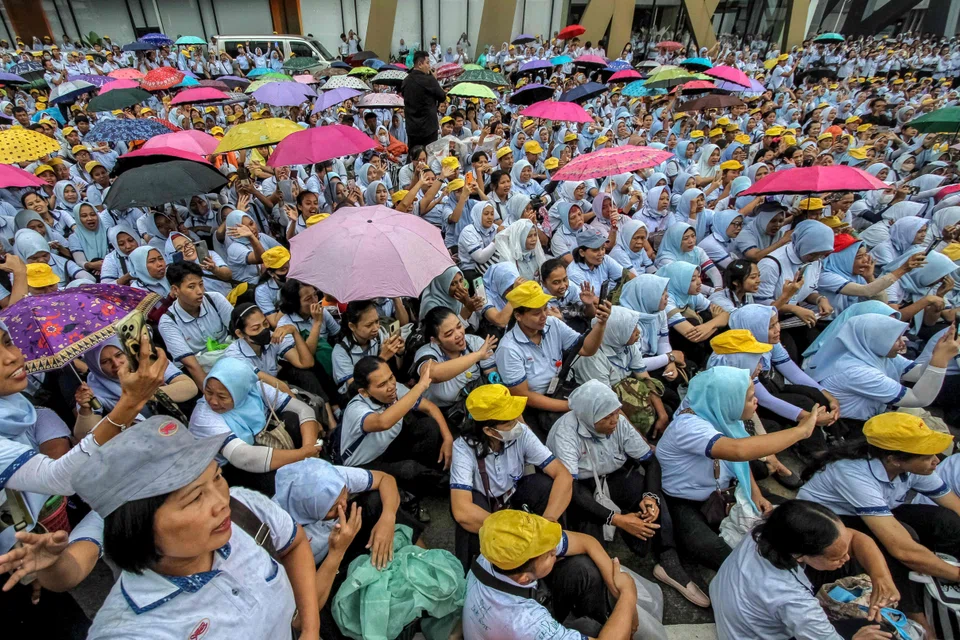
[JAKARTA] A storm is brewing in Indonesia’s job market. Mass layoffs have surged by a worrying 20.2 per cent last year, with 78,000 jobs wiped out, and it is only getting worse.
In January alone, the country’s Ministry of Manpower data revealed that 3,325 workers were left without pay cheques, exposing cracks in South-east Asia’s largest economy.
Amid this crisis, President Prabowo Subianto is racing against time to reignite growth.
His administration is banking on the festive Idul Fitri spending spree to inject momentum, but economists warn that deeper structural issues – and the looming spectre of US President Donald Trump’s potential trade tariffs – could derail the government’s ambitious 5 per cent growth target for the first quarter.
Teuku Riefky, an economist at the University of Indonesia’s Institute for Economic and Social Research, warns that the ongoing wave of mass layoffs signals a deeper crisis of “premature deindustrialisation”.
This trend, he cautions, could erode household purchasing power even further, hitting the middle class hardest as they struggle with rising living costs and scant government support.
Indonesia’s manufacturing sector is shrinking before it is even fully industrialised, a worrying trend that could knock the country off its path to sustainable growth. It also poses a significant challenge to President Prabowo’s ambitious target of 8 per cent growth, a goal that now seems increasingly out of reach.
“The decline in manufacturing productivity is a long-term issue,” Riefky told The Business Times. “It will be challenging for Indonesia to achieve higher economic growth, as we have yet to see the emergence of new growth engines in the economy.”
Lost lustre
Once the engine driving Indonesia’s economy, the manufacturing sector has steadily lost its momentum over the past two decades. In 2002, it contributed a robust 32 per cent to the country’s gross domestic product, a figure that has since shrunk to just 18 per cent in 2024, according to the Statistics Agency.
The decline underscores the growing challenges faced by an industry struggling to keep pace with shifting global dynamics and intensifying competition.
Last week, Prabowo summoned leaders from Indonesia’s biggest business groups – including Barito Pacific, Artha Graha, Sinar Mas, Lippo and Indofood – to the presidential palace, signalling his push to rally the country’s corporate elite in a bid to revive growth.
According to a statement from the presidential office, the meeting focused on strategic policies to strengthen key industries, with particular emphasis on the textiles sector, which has recently been hit hard by layoffs.
The closure of Sritex
The most striking layoffs to make headlines recently was that of Sri Rejeki Isman (Sritex), once a powerhouse in the region’s textile industry.
After 58 years, the company shut down this month under crushing debt, leaving over 11,000 jobless. Observers blame cheap Chinese imports and weak government support.
Andry Satrio Nugroho, head of the Institute for Development of Economics and Finance’s (Indef) trade and industry centre, blames the layoffs on the government’s failure to curb a flood of cheap imports, both legal and illegal, that have undercut local businesses.
“This situation could worsen if Trump’s proposed tariffs on China take effect, prompting China to dump its exports to Indonesia as an alternative market outside the US,” he explained.
The wave of layoffs has hit two Yamaha music equipment factories in West Java, putting their piano production lines at risk of shutting down this year – a move that could wipe out 1,100 jobs.
Meanwhile, in electronics, Sanken Indonesia will shut its factory by June 2025, putting 900 jobs at risk as it shifts from chipmaking to power supply exports for Japan.
Two Nike supplier shoe factories in Tangerang – Adis Dimension Footwear and Victory Ching Luh Indonesia – announced layoffs last week, cutting some 3,500 jobs.
According to Yoseph Billie Dosiwoda, executive director of the Indonesian Footwear Association, the layoffs stem from weakening demand that has not kept up with rising costs. Both factories, operating in bonded zones, rely entirely on exports.
“This was an unavoidable decision for the companies,” he added. “The high sectoral wages and regional minimum wages, coupled with a drop in orders, left no choice. It’s simply not feasible to pay workers without ongoing production.”
Industrial woes
Riefky from the University of Indonesia said that the layoffs underscore the struggles businesses confront with stagnating competitiveness and mounting industrial hurdles. Bureaucratic red tape in obtaining business permits and importing raw materials are further driving up costs.
“The hardest-hit sectors are mass industrial companies, particularly in textiles, garments, and footwear which face intense competition from other countries,” Riefky explained. “Many of these businesses are now struggling to keep up.”
He warned that without the creation of new job opportunities, it will be difficult for displaced workers to regain their productivity and secure a stable income.
To counter the economic slowdown, Andry from Indef suggested that the government introduce bold fiscal and monetary incentives, including tax holidays for the manufacturing sector and income tax exemptions for workers earning less than 10 million rupiah (S$814) across all industries.
The crisis is not limited to manufacturing. Other industries are also bleeding jobs, though for different reasons. eFishery – an aqua-tech firm and once a star of Indonesia’s startup scene – has plunged into financial distress, laying off more than 1,000 staff members amid fraud allegations.
Meanwhile, in the digital economy, e-commerce giants like Tokopedia have quietly trimmed their workforce, citing market consolidation and efficiency drives.
Even the banking sector has not been spared, with some financial institutions cutting staff as they pivot towards automation and digital services.
TRENDING NOW

Once staunchly pro-China, Malaysian Chinese businesses are now distancing themselves from Beijing

Looking beyond looming CEO succession, should UOB potentially pursue a transformative merger?

Could stablecoins be the future of money?

Grab CEO’s wife Chloe Tong on life with Anthony Tan and finding her purpose

