



Indonesia’s parliament approves changes to healthcare laws amid protests
 Add BT as a preferred source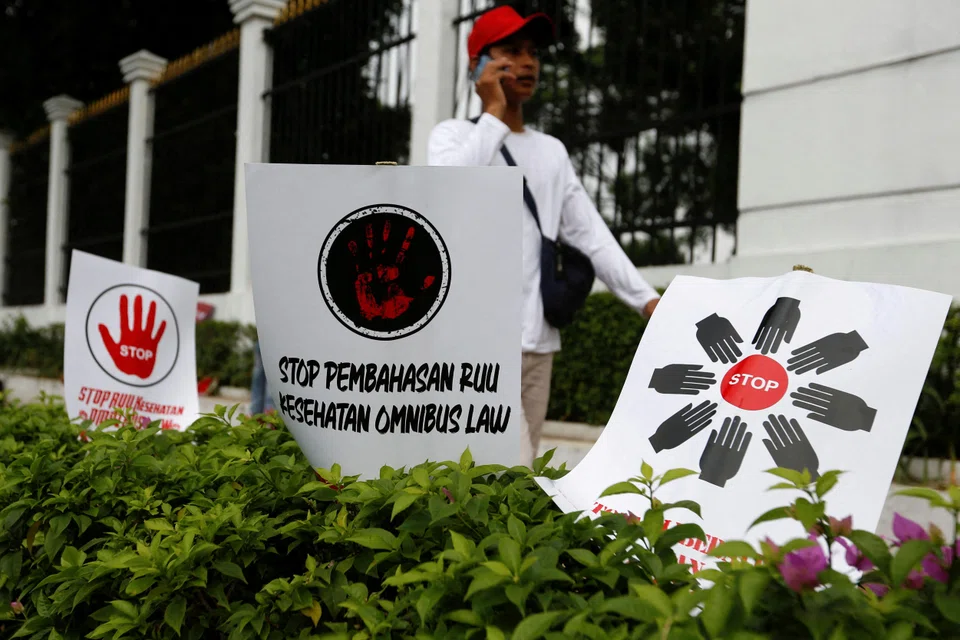
DeeperDive is a beta AI feature. Refer to full articles for the facts.
INDONESIA’S parliament on Tuesday (Jul 11) approved sweeping revisions to healthcare laws aimed at attracting foreign talent and improving services, sparking protests by medical workers concerned that they could be disadvantaged.
Hundreds of medical workers protested outside parliament in the capital Jakarta, demanding further public consultation on the reforms, which they said could weaken their protections.
The new laws will make it easier for foreign doctors to practise in Indonesia, enable patients to file criminal complaints against medical workers for malpractice, and remove a requirement for the state to allocate 5 per cent of its budget to the health sector, a parliamentarian told Reuters on Monday.
Health Minister Budi Gunadi Sadikin said in parliament that the law is aimed at transforming healthcare in the world’s fourth-most populous country.
“After the Covid-19 pandemic, it is the time to rebuild our health system,” he said.
Indonesia, a country of more than 270 million people, has about seven doctors for every 10,000 people, according to data from the World Health Organization. That figure comes in below Thailand with nine doctors, Philippines with eight doctors and Australia with 41 doctors per 10,000 people.
Navigate Asia in
a new global order
Get the insights delivered to your inbox.
The government has said granting permits for foreign doctors is intended to make up for staff shortages. In the new law, foreign specialist workers must have already worked for five years overseas and pass an evaluation, according to Charles Honoris, deputy chief of the parliamentary commission overseeing health.
Parliament also said the mandatory budget allocation was at risk of misuse whereas the new law would allow for more targeted spending.
But medical associations have raised concerns that slashing the mandatory budget allocation would strain public health centres across the country.
The law is set to take effect immediately, but the government will need to issue other regulations for its implementation.
Mohammed Adib Khumaidi, head of Indonesia’s Medical Association said the new law “will destabilise (the) health sector”.
The medical community also criticised the provision allowing patient data to be shared with overseas agencies. Parliament said the data can only be shared with the patients’ consent.
Decoding Asia newsletter: your guide to navigating Asia in a new global order. Sign up here to get Decoding Asia newsletter. Delivered to your inbox. Free.
Share with us your feedback on BT's products and services
TRENDING NOW

Shelving S$5 billion office redevelopment plan proved ‘wise’ as geopolitical risks mount: OCBC chairman

Eurokars Group introduces rental car franchises Enterprise Rent-A-Car, National Car Rental, and Alamo to Singapore

20 photos that show how dramatically Singapore has changed in two decades

Singapore’s key exports up 15.3% in March from electronics surge, exceeding forecasts

