



Indonesia’s planned push to retire 13 coal-fired plants could face social, funding challenges
The country is the world’s largest coal producer and consumer, with 81% of its electricity generated from fossil fuels

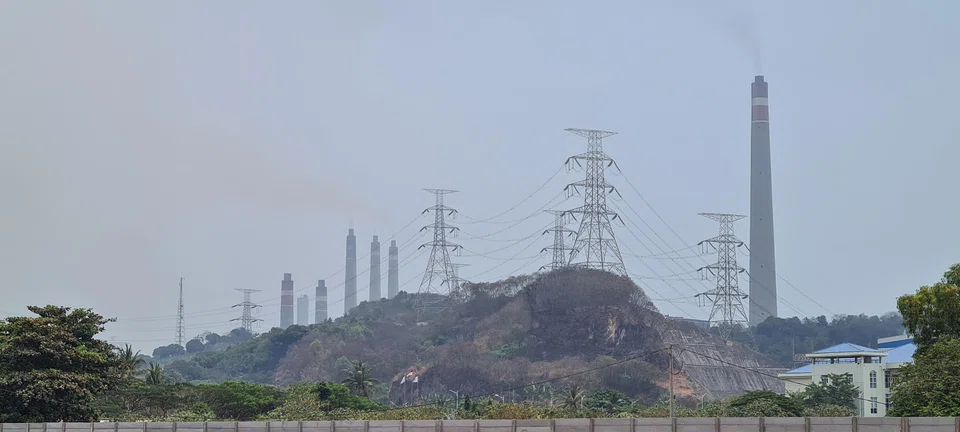
[JAKARTA] Indonesia wants to retire 13 coal-fired power plants by 2030, in what could be a decisive move for the country’s decarbonisation efforts, but experts warn it could face substantial challenges, particularly in managing social impact and securing necessary funding.
As the world’s largest coal producer and consumer, with 81 per cent of its electricity generated from fossil fuels, Indonesia’s proposed regulation, announced on Aug 22, is set to become a road map for accelerating the early retirement of coal-fired power plants.
The 13 plants – with a total estimated capacity of 4.8 gigawatts (GW) and producing around 48 million tonnes of CO2 equivalent – are owned by state-owned utility PLN, making them low-hanging fruit for shutdowns compared to those owned by private-sector independent power producers. “We hope to complete it by the end of September. In drafting this legal framework, we must proceed with utmost caution and ensure we have proper legal guidance,” Eniya Dewi, the director-general of new renewable energy and conservation at the Ministry of Energy and Mineral Resources, told The Business Times.
The ministry, through a joint study with the Bandung Institute of Technology and the United Nations Office for Project Services, identified these plants for retirement based on factors such as their economic life, electricity production and emission levels, said Dewi.
While the ministry has not decided the specific units of the plants, it has named three priority locations.
These include parts of the 4 GW Suralaya power complex in Banten province, specifically targeting older units that have been operational since 1984 and are nearing the end of their economic life with high emissions output.
Located about 125 km from Jakarta, the Suralaya plant has been identified as a significant contributor to air pollution affecting the Greater Jakarta area.
Another facility highlighted in the study is PLN’s unit at the 4 GW Paiton power complex in East Java, as well as the 200 megawatt (MW) Ombilin plant in West Sumatra, which primarily operates as a peaking plant – facilities that are only utilised during periods of high demand.
The government noted that shutting down the Ombilin plant would have minimal impact on the local community, as the 27-year-old plant has reached the end of its lifespan.
Dinita Setyawati, a senior electricity policy analyst for South-east Asia at Ember Climate, an independent global energy think tank, said the upcoming road map should be seen as a positive step for Indonesia’s energy transition.
“If the early retirement of coal-fired power plants has been initiated and drafted, it will be crucial for the next government (under president-elect Prabowo Subianto) to follow through on this plan,” Setyawati said.
PLN spokesperson Gregorius Adi said that as part of its strategy to phase out coal-fired power plants, the utility remains committed to delivering both reliable and environmentally sustainable electricity.
The national utility is aiming for an ambitious transition, with 75 per cent of its electricity generation coming from renewable energy and the remaining 25 per cent from gas, by 2040.
The executive vice-president of PLN acknowledged the challenges involved, noting: “This is certainly not easy, as we also need to develop smart transmission infrastructure, which is a complex and lengthy undertaking.”
On-grid electricity demand is expected to grow by about 4.7 per cent annually, reaching 445 terawatt hours by 2030, according to PLN’s 10-year business plan.
Ember Climate’s Setyawati said: “Indonesia’s current coal-fired power plant capacity is sufficient to meet electricity needs until 2030.”
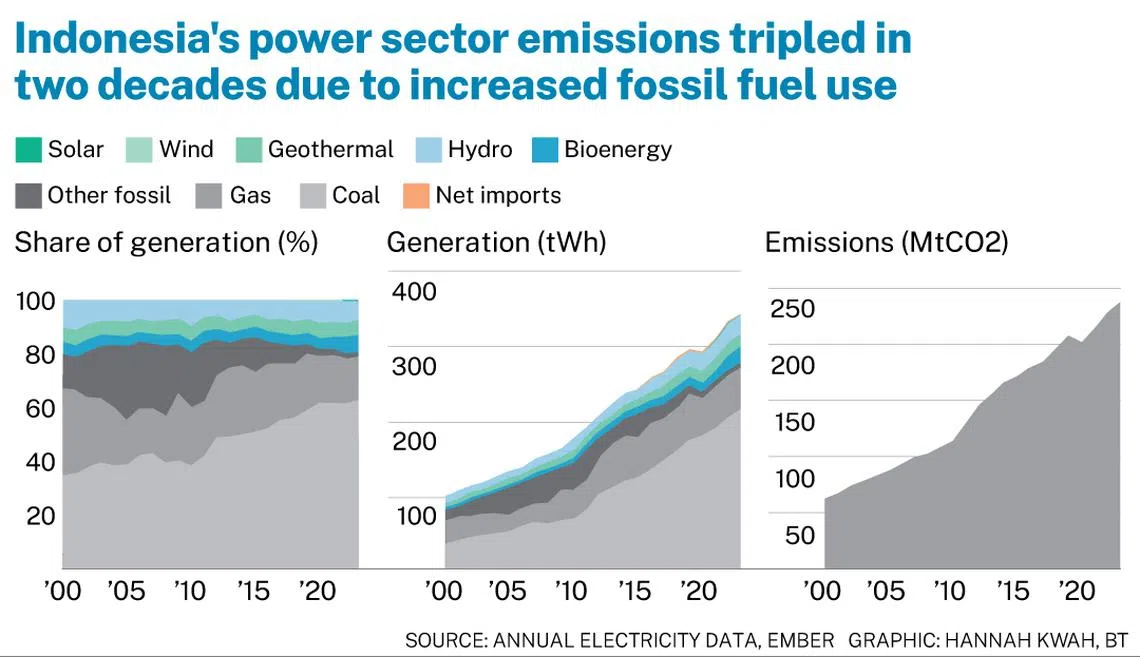
Over the past decade, coal usage in power plants has surged, driving a sharp increase in power sector emissions – up by 86 million tonnes of CO2 from 2013 to 2023.
This surge was fuelled by the government’s 35,000 MW electricity programme, launched in 2015, which accelerated the construction of new coal power plants to support President Joko Widodo’s target of 7 per cent annual economic growth.
However, on the back of international pressure and shifting market trends towards cleaner energy, Indonesia has committed to halting the construction of new coal-fired power plants from 2023.
Coal-fired plants operated by independent producers will remain operational until their contracts with PLN expire, with the latest agreements extending until 2050.
While Indonesia has committed to phasing out coal and increasing its use of renewable energy, progress has been slow. The country trails its regional neighbours in the development of renewable energy.
Indonesia aimed to achieve a 23 per cent share of renewable energy by 2025, but the Energy Ministry has confirmed that this target is unlikely to be met.
Between 2018 and 2023, the country added just 3.3 GW of renewable energy, raising the total to 13 GW by 2023. This accounts for less than 13 per cent of the nation’s total electricity generation capacity.
Funding hurdle, concerns over social impact
While the upcoming regulation is seen as positive, observers warn that the transition could disrupt communities and displace workers dependent on these plants.
This raises concerns about broader economic impact in regions heavily reliant on coal, such as East Kalimantan, South Kalimantan and South Sumatra, where coal mining supports more than 150,000 jobs.
A recent report by Ember Climate suggests that the shift to and planned expansion of clean-energy projects, particularly solar panel installations, in these regions could create 50,000 new jobs and attract US$4.3 billion in investment.
Financing the decommissioning process and transitioning to cleaner energy sources also present a formidable challenge for the country.
In November 2023, Indonesia became the second country to join the Just Energy Transition Partnership, which aims to provide US$20 billion from developed countries to help reduce reliance on fossil fuels. However, substantial investment plans have been delayed.
Rachmat Kaimuddin, Deputy Coordinating Minister of Maritime Affairs and Investments in Infrastructure and Transportation, said that the negative yield perception, coupled with regulatory and economic factors, has led to limited interest from international investors in financing the early retirement of these coal-fired plants.
“Investor interest in Indonesia’s energy transition sector is actually quite substantial, but they currently seem to prioritise renewable energy projects over early retirement,” Kaimuddin told BT.
So far, Indonesia has secured a commitment from the Asian Development Bank through the Energy Transition Mechanism to support the early retirement of the 660 MW Cirebon-1 coal-fired power plant. Originally scheduled to operate until July 2042, the plant is now set to close in December 2035.






