



Indonesia’s Q3 growth cools as protests, policy shifts test investor confidence
Consumer spending shows strain amid rising costs

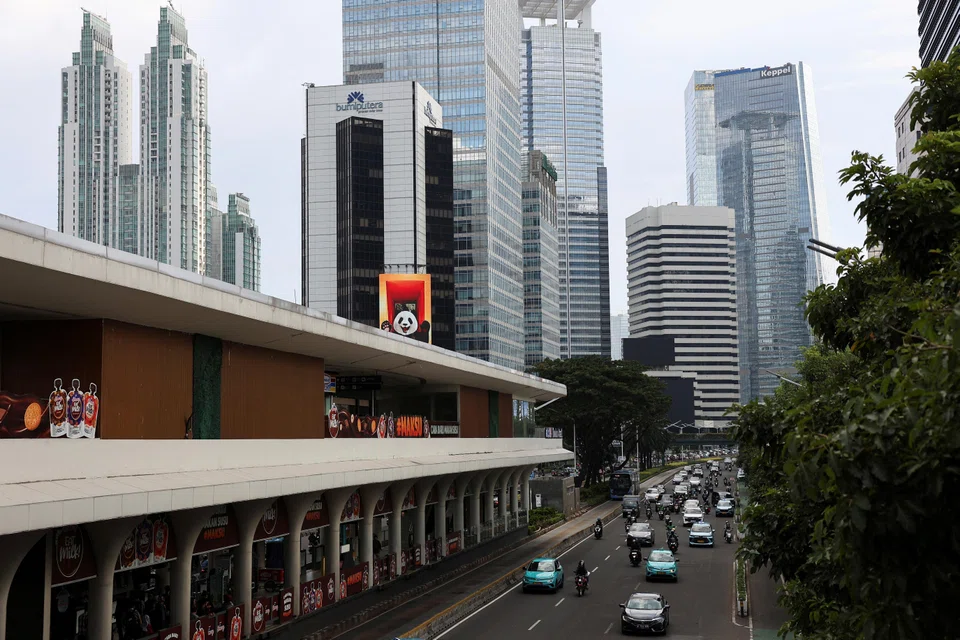
[JAKARTA] Indonesia’s economy slowed slightly in the third quarter of 2025, reflecting softer consumer and investor sentiment following nationwide protests in late August. But analysts said that the country’s growth remains resilient compared with that of its regional peers.
Official data released on Wednesday (Nov 5) showed that gross domestic product grew 5.04 per cent year on year in Q3, slightly down from 5.12 per cent in the previous quarter.
The figure was in line with the expectations of economists polled by Bloomberg, highlighting a mild but notable cooling in South-east Asia’s largest economy.
The country is navigating an eventful transition under President Prabowo Subianto, with the new administration introducing a series of policy changes amid rising pressure from shifting global trade dynamics.
Economists warned that domestic headwinds could continue to weigh on Indonesia’s outlook in the coming quarters.
Lavanya Venkateswaran, senior Asean economist at OCBC Bank, said there remain upside risks to the bank’s 2025 GDP growth forecast of 4.8 per cent, but the moderation in domestic demand points to continued softness.
“This will likely support Bank Indonesia’s (BI) dovish bias, and we still expect a cumulative 50-basis-point (bp) rate cut from BI,” she added.
Despite a total 125 bp rate cut by the central bank since its easing cycle began in September last year, demand in Indonesia’s 280-million-strong market remains subdued.
Consumer spending, which accounts for more than half of GDP, has shown signs of strain, as rising living costs and political uncertainty weigh on confidence.
Household consumption grew 4.95 per cent year on year in Q3, slightly slower than the 4.97 per cent increase recorded in the previous quarter.
On a quarter-on-quarter, non-seasonally adjusted basis, GDP rose 1.43 per cent, slightly below the previous quarter’s pace.
Manufacturing, agriculture and trade remained the main drivers of growth. The education, business services and tourism-related sectors posted the fastest expansion.
Support from government
Analysts noted that the momentum was supported by government stimulus measures, a modest increase in public spending and a positive net external trade balance, fuelled by front-loaded manufactured goods and commodity exports.
The Indonesian government has rolled out a stimulus package worth about 24.44 trillion rupiah (S$1.9 billion) since June this year.
Reflecting on the quarter, Wijayanto Samirin, senior economics lecturer at Paramadina University in Jakarta, said that despite facing multiple shocks, Indonesia remains resilient and could potentially finish the year with growth above 5 per cent. However, he stressed that the focus should be on the quality of growth rather than the headline figure.
“Job creation and stronger household purchasing power should remain central to boosting domestic demand and enhancing resilience against external shocks,” he noted.
Indonesia’s Q3 GDP growth remains among the highest in South-east Asia, surpassing the regional average and trailing only Vietnam and Malaysia in overall growth rates.
The government aims to push annual growth above 5.5 per cent, supported by cash aid programmes scheduled for roll-out later in 2025, as pledged by Finance Minister Purbaya Yudhi Sadewa.
Radhika Rao, senior economist at DBS Bank, said the anticipated acceleration in spending is expected to help sustain growth in the final quarter. However, she cautioned that policy space is tightening as the rupiah weakens against the US dollar, which could limit BI’s ability to cut interest rates further in the near term.
“We don’t expect BI to shift its policy stance this year,” said Rao. “While there remains room for rate reductions, a weaker currency may prompt the central bank to pause in November to prevent further narrowing in rate differentials with the US.”
Brian Lee, economist at Maybank, expects slightly stronger GDP growth in Q4 and is reviewing the bank’s 2025 forecast of 4.9 per cent for potential upside.
He noted that Indonesian exports are likely to remain resilient, supported by robust manufactured goods amid strong electronics demand, limited front-loaded inventories by US companies since Q2, and Indonesia’s tariff advantage over China and India.
“However, as domestic demand lifts imports, the net contribution from trade is expected to ease in the fourth quarter,” he added.
Need to go beyond short-term measures
While Indonesia’s growth remains among the strongest in the region, the government faces the challenge of balancing fiscal prudence, currency stability and investment-driven advancement.
The rupiah, one of Asia’s weakest currencies this year, was at 16,722 against the US dollar, edging down 0.1 per cent following the GDP data release. Meanwhile, the benchmark stock index rose 0.32 per cent.
Economists from the Macroeconomic, Finance and Political Economy Research Group, under the University of Indonesia’s Faculty of Economics, said that sustaining long-term growth requires moving beyond short-term measures such as subsidies and fiscal stimulus to tackle deeper structural bottlenecks.
“For the remainder of 2025, Indonesia should shift from short-term fixes towards addressing fundamental issues such as regulatory certainty, legal enforcement and ease of doing business,” the economists noted.
“If successful, these reforms could put Indonesia on a more sustainable and inclusive growth path. Failure to act may prolong economic stress into 2026 and beyond.”
Economists emphasised that a mix of targeted spending and credible structural reforms will determine whether the South-east Asian nation can maintain its 5 per cent growth trajectory in the years ahead.
TRENDING NOW

Once staunchly pro-China, Malaysian Chinese businesses are now distancing themselves from Beijing

Looking beyond looming CEO succession, should UOB potentially pursue a transformative merger?

Could stablecoins be the future of money?

Grab CEO’s wife Chloe Tong on life with Anthony Tan and finding her purpose

