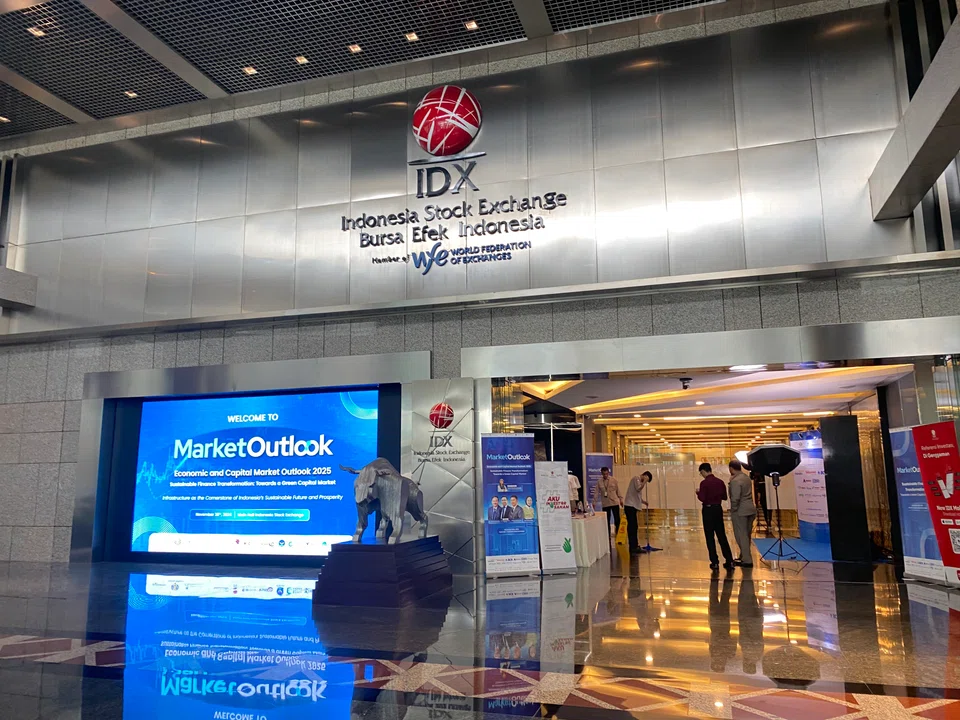
Indonesia’s stock exchange eyes rebound with major IPOs and renewed investor confidence in 2025
With energy and real estate IPOs leading a pipeline of 19 listings, including two major offerings worth over 3 trillion rupiah, the IDX is poised for a 2025 revival

[JAKARTA] The Indonesia Stock Exchange (IDX) is poised for a strong rebound in 2025, with seven companies already making their market debuts and 19 more in the pipeline. These include two major initial public offerings (IPOs) valued at over three trillion rupiah (S$250 million), signalling renewed momentum, according to the exchange’s top executive.
Notable newcomers from the energy and real estate sectors have led the charge on Indonesia’s stock market at the start of 2025, while 17 of the companies in the exchange’s pipeline collectively hold assets exceeding 250 billion rupiah, said IDX president director Iman Rachman.
This potentially signals a sharp turnaround from an unremarkable showing last year.
Last year, the IDX’s IPO landscape experienced a significant slowdown, with the number of new stock offerings halving to 41, while funds raised fell by nearly two-thirds to 14.35 trillion rupiah, compared to 2023 – reflecting shifting market dynamics amid economic uncertainties and global volatility.
This sets the stage for a promising year for the IDX, with market activity expected to pick up as the country moves beyond the political fervour that has led many investors to adopt a “wait-and-see” stance since the first half of last year.
“We are confident that the political stability following the election will boost investor confidence and encourage more companies to pursue IPOs and list on the IDX,” said Rachman in an interview with The Business Times.
Rachman said with the new administration under President Prabowo Subianto gaining momentum, key policy directions are becoming clearer, especially with a recent wave of economic stimulus measures designed to boost market confidence and support growth.
He added that the exchange is being proactive, planning near-term initiatives to strengthen its regulatory framework and to ensure it remains responsive to changing market demands.
These efforts include simplifying the listing process to cut out redundancies and rolling out the Indonesian Depository Receipt, letting companies with foreign ownership tap into Indonesia’s capital markets without the hassle of restructuring.
“By adopting a sector-agnostic approach and providing strategic tools and frameworks, IDX can ensure its appeal to high-quality companies across diverse industries, including those at the forefront of technological innovation and sustainability initiatives,” he said.
Another big move potentially in the offing is adjustments to existing free-float regulations for IPOs, which the exchange is reportedly considering, although it is unclear when these could happen.
While 2024 may not have been a standout year for Indonesia’s stock market, it has retained its status as one of the most active exchanges in the region, trailing only Malaysia and Hong Kong in listing activity.
Last year, the consumer cyclicals sector led the way, with 13 companies raising a total of 5.7 trillion rupiah. To cap the year, in December, the Indonesian unit of the Malaysian home improvement retailer Mr DIY debuted on the IDX, raising 4.2 trillion rupiah in the largest IPO of the year.
Amid market fluctuations, Rachman pointed out that energy companies stood out as one of the top-performing counters over the year, led by global energy price dynamics and shifting demand patterns.
Luring tech and green
Even so, gaps remain. For tech and green energy companies, sectors that are all abuzz these days and are firmly on investors’ radar, launching on Indonesia’s capital market remains a formidable challenge
Rachman noted that the current global high-interest rate environment has dampened corporate borrowing, making public funding less attractive for many companies.
He, however, expects such concerns to ease once the US Federal Reserve signals a clearer tightening trajectory this year. The US Fed, the world’s largest central bank, cut interest rates by 25 basis points in December 2024, following earlier reductions in September and November, while signalling caution for 2025 amid persistent inflation and a strong labour market.
Rachman is also concerned that fundraising activities in the capital markets are facing challenges due to a shift in investor preferences towards high-yield, attractive instruments such as government bonds, which is making liquidity harder to access for financial market participants.
The challenging global economy has significantly impacted digital sector companies – once standout performers during the pandemic era.
Last year, the technology sector on the IDX recorded a 5.4 per cent drop in share performance, underscoring challenges faced by the digital industries.
Unicorns such as GoTo and Bukalapak, once celebrated for their standout IPO debuts, have seen their stock prices plummet by over 50 per cent from their initial offering values. This steep decline has sparked investor concerns about the long-term growth potential of these tech giants.
Youthful edge
Indonesia’s youthful and rapidly growing population presents a significant opportunity for the IDX to attract new investors, said Rachman.
“With the fourth-largest population in the world, Indonesia’s demographic bonus can be transformed into an asset and productive value, which can benefit the economy in the future,” he said.
This potential is further amplified by the rise of digital adoption and improved financial literacy, which have driven a steady increase in retail investors over the past five years.
By 2022, retail investors accounted for nearly 20 per cent of market ownership, with the majority comprising millennials and Generation Z, underscoring the transformative role of younger demographics in shaping the country’s capital market landscape.
As at 2024, the number of capital market investors in Indonesia has surged to 14.59 million, marking an extraordinary nearly tenfold growth from just 1.6 million six years ago.
While retail investors still hold a smaller share of market ownership compared to foreign and local institutional investors, their influence has grown substantially, dominating trading value over the past four years.
Rachman said that the IDX is strategically focusing on this segment by rolling out a series of development programmes with a structured curriculum.
These initiatives are designed to deepen market engagement, enhance investor protection, and foster regional collaboration, particularly through partnerships with other Asean stock exchanges, including Bursa Malaysia, the Stock Exchange of Thailand, and the Singapore Exchange.
To further support these goals, the IDX will introduce a new rule starting in 2025, prohibiting the cancellation of stock orders during pre-opening and pre-closing sessions. This measure is intended to maintain market stability and safeguard novice retail investors by minimising unnecessary risks.