Indonesia’s Widodo starts working in new capital as basic infrastructure takes shape
He affirms that the development of Nusantara is progressing smoothly

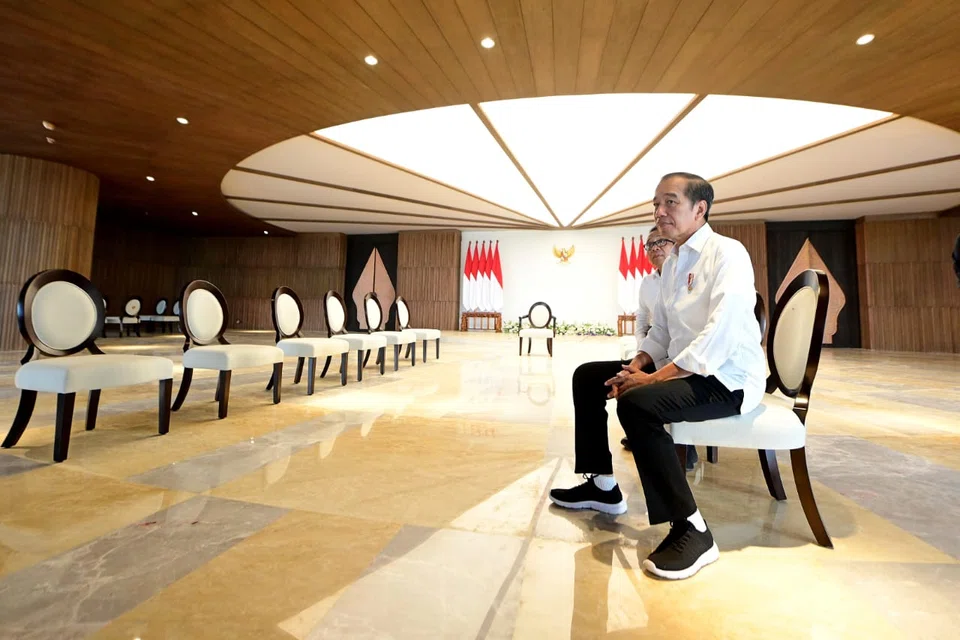
[JAKARTA] In a significant step towards realising Indonesia’s ambitious capital relocation project, President Joko Widodo officially commenced operations in Nusantara, the country’s new capital, on Monday (Jul 29), despite earlier delays.
Widodo, who has been in Nusantara, East Kalimantan, since last weekend, has officially begun working and receiving guests at the nearly completed Presidential Palace.
“Since Monday morning, the president has been receiving guests and starting to work in the office,” Troy Pantouw, spokesperson for the Nusantara Capital Authority, told The Business Times.
Widodo’s plan to begin work in Indonesia’s new capital city was delayed from the original timeline of early July. The postponement was attributed to delays in the completion of essential supporting infrastructure, including water supply systems and key supporting buildings, which had not been fully realised.
In an official statement, Widodo affirmed that the development of Nusantara is progressing smoothly, with the bird wing-shaped Presidential Palace constructed.
He mentioned that water, electricity and the Internet are functioning properly, allowing him to work without any interruptions.
“We came here to assess the latest advancements in the development of the new capital,” Widodo said. “This is a big job. It can take 10, 15, 20 years. This is not a job that takes one or two years.”
Although construction at the Presidential Office in Nusantara is still under way, Widodo has announced that he will begin working at the new facility.
He plans to start receiving guests and holding meetings in the Nusantara area, but may also travel to Jakarta for other important events.
A race to finish
Situated in the lush jungle of Kalimantan, Nusantara is projected to be fully completed by 2045. The development is planned in five phases, with the project currently in its initial phase.
Construction workers are working round the clock to ensure the 256,000 hectare capital city is ready to receive state guests for Indonesia’s Independence Day ceremony on Aug 17.
While the Presidential Palace is nearly complete, the authorities are racing to finish other crucial projects, including the new city’s electricity grid and transportation infrastructure, such as tollways and a VIP airport.
Recently, the authorities carried out a series of tests on supporting infrastructure in the Nusantara region, with the Public Works and Housing Ministry assessing the flow from the Sepaku dam, a 836 billion rupiah (S$68.9 million) water facility located near the city.
The dam features a water treatment plant with a capacity of 300 litres per second, a 16 km transmission pipe, a reservoir and a 22 km distribution network that supplies essential areas including the Presidential Palace, worker housing, hospitals and hotels.
The government has been accelerating to build the infrastructure required for the relocation of the first batch of 12,000 civil servants this September. However, the plan has been twice delayed due to the slow pace of construction work.
The authorities have revealed that the construction of civil servant housing in Nusantara is delayed due to weather issues. As a result, the plan to relocate civil servants in the early stages has been scaled back to 1,700 due to limited housing availability.
Slow investment
Stepping down in October, Widodo has ambitions to make Nusantara a replacement capital for the sinking Jakarta.
The government has issued a number of incentives such as tax breaks and ease of doing business for foreign investors who want to invest in Nusantara.
In a recent move, Widodo signed a regulation granting foreign investors land and building use rights for 95 years in Nusantara. Despite this, efforts to attract foreign investment have shown little progress.
Widodo has repeatedly sought to attract foreign investors on his signature project during his international visits, including his most recent trip to meet investors in Abu Dhabi last week. However, no real commitments were signed between Abu Dhabi and Nusantara.
Indonesia estimates that developing Nusantara will require at least 466 trillion rupiah, with the bulk of the funding expected from private investors.
Nusantara has thus far attracted a total investment of 49 trillion rupiah, with the majority still coming from domestic sources, according to data from the Ministry of Investment.
Deputy Minister of Investment Yuliot Tanjung noted that the government has received 400 letters of intent from foreign investors, up from 200 last year; however, none has yet translated these letters into actual investments.
Achmad Nur Hidayat, a public policy expert and lecturer from UPN Veteran Jakarta, described the ceremony next month as a crucial test to demonstrate that the project is not merely a promise, but a reality being realised.
“This is a crucial moment that will be watched by the business community and investors to assess the future prospects of the new capital,” he said.
“The government wants to show that despite many challenges, the project is still progressing and has the full support of the central government.”
He added: “But, if the event fails, it could be a warning that there are fundamental problems that have not been resolved, which could reduce investor confidence.”
TRENDING NOW
Grab CEO’s wife Chloe Tong on life with Anthony Tan and finding her purpose
Tech titans including Nvidia’s Huang, OpenAI’s Altman join Trump, Xi at White House state dinner
Ex-Sembcorp Marine CEO Wong Weng Sun acquitted of charges in Brazil corruption case
Singapore launches national semicon brand initiative, inks R&D deals