Inside Indonesia’s trial of Gojek co-founder: How a Google laptop deal became a multi-trillion-rupiah case
Nadiem Makarim, also a former minister under the previous president, has consistently denied any wrongdoing
 Add BT as a preferred source
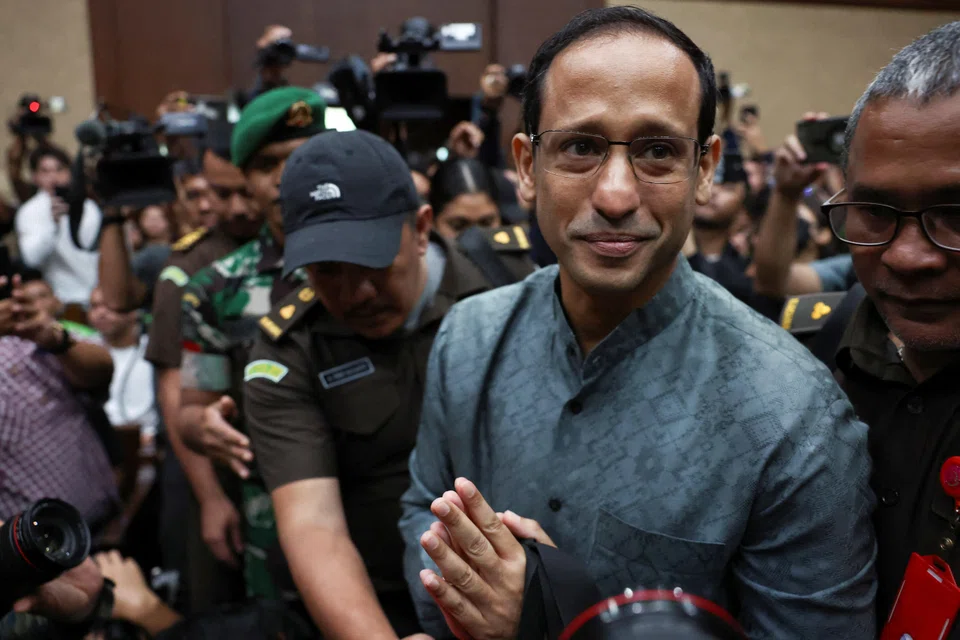
[JAKARTA] Indonesia’s high-profile trial of former education minister and Gojek co-founder Nadiem Makarim is shaping up to be more than a corruption case, with investors and technology leaders watching it as a test of where flawed policymaking could cross into criminal liability.
The allegations relate to a programme to procure 1.2 million laptops for schools during his 2019 to 2022 tenure as education minister. Nadiem founded Gojek, now part of GoTo Group, before entering government.
Prosecutors said the programme, which caused significant state losses, favoured devices running Google’s operating system.
What is at the heart of the case?
During the Covid-19 pandemic, the education ministry, then led by Nadiem, launched a major digitalisation programme to accelerate the use of technology in classrooms by distributing laptops to schools across the archipelago.
However, doubts over the programme emerged in May last year, when Indonesia’s Attorney-General’s Office (AGO) began investigating the procurement process.
In a charge read out in court, prosecutors said that the ministry procured about 1.2 million Chromebook laptops between 2020 and 2022; the total budget was estimated at around 10 trillion rupiah (S$740 million), despite internal recommendations favouring devices that run on Microsoft Windows.
Navigate Asia in
a new global order
Get the insights delivered to your inbox.
They alleged that Nadiem carried out the procurement in a manner that deviated from the original plan, and violated established public procurement principles.
Investigators also alleged that some vendors sold the laptops to the government at inflated prices, contributing to estimated state losses of more than 2.18 trillion rupiah.
The charges
The case escalated on Sep 4, when AGO announced that Nadiem had been formally named a suspect and detained in connection with the investigation.


Prosecutors also named four other suspects, including Ibrahim Arief, a former vice-president at Bukalapak, who at the time was a consultant to the Ministry of Education on its digitalisation programme.
Prosecutors further alleged that the procurement process was manipulated in ways that benefited certain suppliers and promoted the adoption of ChromeOS devices in the national education system.
Nadiem, 41, has consistently denied any wrongdoing. In a statement posted on his LinkedIn account, which is now managed by his legal team following his detention, he said he was “innocent of all charges” and rejected accusations that he had caused financial losses to the state.
At a media briefing in Jakarta on Wednesday (Apr 22), his legal counsel Ari Yusuf Amir raised concerns about his client’s health, saying doctors have advised him to undergo medical treatment.
The trial is expected to reach a verdict in May – roughly eight months since his detention.
Spotlight on the Google deal
One of the most controversial aspects of the case centres on alleged links between the Chromebook procurement and investments by US tech giant Google.
At the first hearing in January, prosecutors alleged that Nadiem had set requirements that effectively matched only Google’s operating system, which they claimed was aimed at making the company “the sole controller of the education ecosystem in Indonesia”.
Prosecutors alleged that he sought to enrich himself by 809 billion rupiah through the transfer of investment funds in Aplikasi Karya Anak Bangsa to Gojek Indonesia. Prosecutors alleged that most of the funds originated from Google’s investment in Aplikasi Karya Anak Bangsa.
They further pointed to what they described as a potential link between the procurement project and Google’s investment in Gojek.
Google invested in Gojek between 2017 and 2021, with total funding of about US$786 million over that period.
The Chromebook procurement proceeded despite a 2018 internal ministry review, which found that the devices required stable Internet connectivity to function effectively.
Prosecutors told the court that the programme moved forward after Nadiem allegedly held several meetings in 2020 with representatives from Google Asia-Pacific and Google Indonesia, a claim Nadiem has denied in court.
At a hearing on Monday, three former Google Asia-Pacific executives called as witnesses rejected the allegations in their testimony. Those who appeared included Caesar Sengupta, former vice-president of Google Asia-Pacific, and Scott Beaumont, its former president – both of whom testified via video conference from Singapore.
Sengupta told the court that Google was a minority investor in companies linked to Indonesia’s technology ecosystem, and did not control corporate or government policy decisions.
He also rejected claims that Google’s investment activity was connected to the Chromebook procurement. “There was absolutely no relationship between Google’s investment and government policy on the use of ChromeOS,” he said, adding that the claim of 809 billion rupiah in payments was “not true and does not reflect what we did”.
Beaumont echoed this, telling the court there had never been any request from the Indonesian government for investment or payment in connection with the Chromebook policy.
From startup icon to graft defendant
The case has drawn attention to Indonesia’s broader struggle with procurement-related corruption, which has long been a significant source of state losses. The Corruption Eradication Commission (KPK) has identified goods and services procurement as one of the most common areas linked to corruption cases.
While the trial itself centres on the details of the country’s procurement procedures, it has attracted wider, global attention because of Nadiem’s unique background.

Before entering government, the Singapore-born entrepreneur was widely seen as a leading figure in Indonesia’s startup boom.
He co-founded Gojek, one of South-east Asia’s most valuable technology companies, before joining former president Joko Widodo’s cabinet as education minister. At the time, his appointment was widely viewed as a sign that Indonesia was opening its bureaucracy to leaders from the technology sector.
Analysts said the case is now being read through different lens. For a country seeking to position itself as a regional technology hub, the trial could carry implications on how entrepreneurs and professionals view public service and policy risk.
Beyond the courtroom
Achmad Hidayat, an economist and public policy specialist at UPN Veteran Jakarta university, said the case had unsettled parts of Indonesia’s technology diaspora and some investors because, in his view, it suggested that policy decisions could later become the subject of criminal proceedings.
“What investors and technology professionals see is not merely a legal case,” he said. “They see a signal that controversial policy decisions in Indonesia can easily turn into criminal risk.”
In many innovation-driven sectors, he noted, policy experimentation is often necessary. “If every flawed decision is interpreted through a criminal lens, what emerges is not good governance, but a bureaucracy paralysed by fear.”
Some foreign investors have expressed similar concerns about the clarity of Indonesia’s legal framework.
Analysts said Nadiem’s case highlights the broader risks that investors and executives may face when dealing with government-linked projects in Indonesia, particularly when policies are later reviewed under new political leadership.
Leigh McKiernon, founder and president-director of advisory firm StratEx, said the laws are generally sound on paper, but their interpretation can shift with politics.
“While the legal framework makes sense on paper, there is a history of people believing they were operating within the law, but later finding themselves in hot water,” he said.
Another high-profile case is that of Thomas Lembong, a former trade minister under Widodo. Lembong was accused in 2024 of corruption linked to raw sugar imports during his 2015 to 2017 tenure, although court proceedings did not show he had personally benefited from the policy.
McKiernon said that for investors, that kind of uncertainty can affect capital flows. Despite these concerns, he stressed that Indonesia remains one of South-east Asia’s largest and most attractive markets.
Even so, he advised foreign investors to adopt a more cautious approach when entering partnerships with government entities and to work with experienced local legal advisers who understand Indonesia’s regulatory environment and political dynamics.
“Companies should also conduct thorough due diligence,” he added.
Decoding Asia newsletter: your guide to navigating Asia in a new global order. Sign up here to get Decoding Asia newsletter. Delivered to your inbox. Free.
Copyright SPH Media. All rights reserved.