



As Jakarta chokes in the smog, authorities make bigger push for public transport
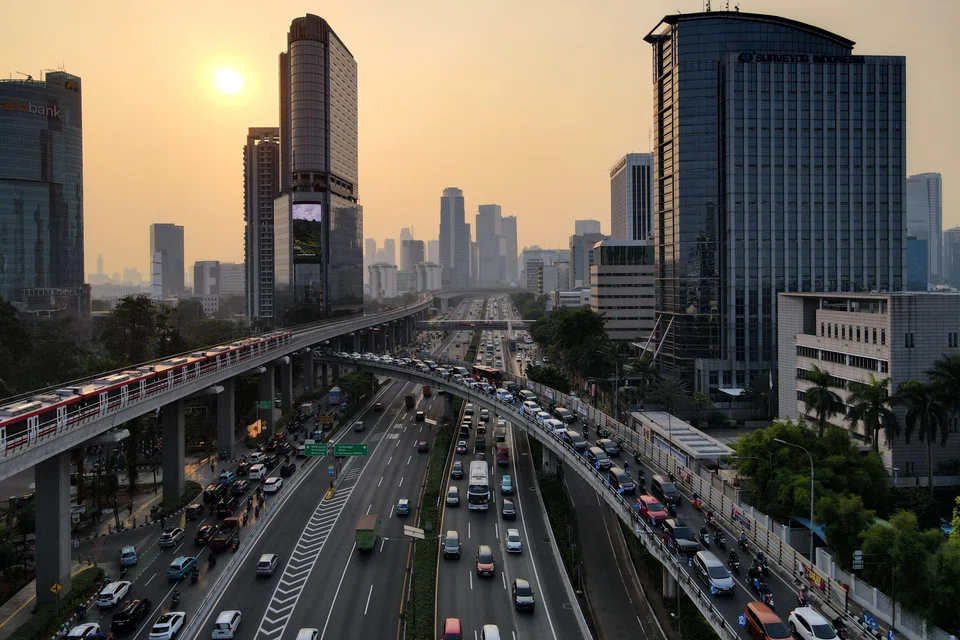
[JAKARTA] It is no secret that Jakarta is one of the most polluted cities in the world – a problem made worse this year by a combination of a long dry season, heavier road traffic and greater production levels at the country’s coal-fired power plants.
On Monday (Oct 9), the Swiss-based air technology company IQAir named Jakarta – a city of more than 10 million people – as having the third-worst air quality in the world, behind only Lahore in Pakistan and New Delhi in India.
The unhealthy air is largely due to the sheer volume of vehicles on the roads. According to figures from the Ministry of Transportation, some 17.5 million motorcycles, 4.2 million cars and 856,000 trucks travel in the greater Jakarta metropolitan area each day.
To reduce congestion, President Joko Widodo’s government is investing billions of dollars to improve the public transport system.
Apart from the Mass Rapid Transit (MRT), which is being expanded, a new 41.2 km Light Rapid Transit (LRT) system – which covers the Greater Jakarta area – recently began operations. The project was built at a cost of US$2.1 billion, and has 18 stops that service Jakarta, Bogor, Depok, Tangerang and Bekasi.
At the LRT’s inauguration ceremony in August, Widodo said the aim is to nudge more people to leave their private vehicles at home and take public transport instead.
The amount spent on the LRT is justifiable, given that traffic congestion in the capital is estimated to cost as much as US$4.6 billion in annual economic losses.
With the heavy investments, the government is clearly banking on the MRT, LRT and the high-speed railway network as the key public transport modes to help alleviate the chronic congestion.
Last week, Widodo launched the new high-speed rail service between Jakarta and Bandung, a China-backed project that was built at an inflated cost of US$7.3 billion due to numerous delays. Passengers now take 40 to 45 minutes to travel between the two cities, down from about two-and-a-half hours by car.
Beyond improving public transportation, however, there is a case for both public and private property developers to chart a new direction in urban sustainability. The tried and tested formula of developing sprawling townships and the massive highways connecting them needs to be re-examined.
Mitbana – a joint venture between Japan’s Mitsubishi Corporation and Singapore’s Surbana Jurong – is working with Indonesian property developers such as Sinar Mas Land and Intiland Development on new models such as transit-oriented developments (TOD).
The latter refers to a type of urban development that maximises residential, commercial and entertainment spaces within walking distance of public transport nodes.
Karolina Astaman, a director and development manager at Mitbana, said TODs can play a vital role in reducing traffic congestion.
“Creating mixed-use developments around transit nodes in the suburban centres can reduce pressure on the central business district,” she said. “Residents can live, work and shop near the public transportation hubs, reducing the need for long commutes and private car usage, hence alleviating the traffic congestion in the city.”
On its part, the Jakarta provincial government is also encouraging the use of electric vehicles (EVs) in the capital city to reduce air pollution.
Acting Jakarta Governor Heru Budi Hartono noted recently that the city’s bus service company Transjakarta is accelerating the process of electrifying its fleet by adding 190 electric buses in 2023, which would bring the total number to 220.
A joint study by AC Ventures and e-mobility association AEML indicated that the EV market in Indonesia is set to surpass US$20 billion by 2030.
The number of EVs in Indonesia has been growing steadily over the past few years. The total number of electric motorcycles jumped from just 1,947 units in 2020 to 26,000 units at the end of last year, with 7,600 electric cars on the roads, up from just 230 units, over the same period.
Indonesia hopes to have as many as 400,000 electric cars and 1.8 million battery-powered motorcycles on the roads by 2025. Whether it can reach those targets is a big question mark at this point, but every little bit of change will go some way towards reducing congestion and improving the torrid air quality over time.
TRENDING NOW
Who is Leo KoGuan, the Singapore-based billionaire backing Nvidia’s Jensen Huang?

Demand, tech capabilities position Apac and AI as Skyscanner’s next growth frontiers: CEO Bryan Batista

Higher rates, weaker spending: Is the Philippines entering stagflation?

South-east Asia has lost Nvidia’s best salesman

