



Jakarta pulls plug on EV import perks, raising stakes for Chinese auto giants
Imported battery EVs account for about 64% of Indonesia’s total EV sales; ending incentives could hurt demand

[JAKARTA] Indonesia will scrap tax incentives for battery electric vehicles (EVs) that are imported, starting from January 2026. The move could hurt Chinese EV makers’ momentum in South-east Asia’s largest economy, where they still rely heavily on imports to build brand presence.
The move could also weigh on Indonesia’s auto sector, which is already grappling with softer sales amid weakening consumer demand.
The country has two different schemes for EVs – one for domestically assembled models and another for fully built-up imports. Locally produced EVs benefit from a significantly lower tax burden.
Thus, the import incentives – which waived duties and taxes on fully built-up EVs – had helped global Chinese brands such as BYD, Geely, XPeng and Aion break into Indonesia and capture a sizeable share of South-east Asia’s biggest automotive market.
Imported battery EVs make up around 64 per cent of Indonesia’s total EV sales, underscoring the market’s heavy reliance on imports and raising concerns that removing these incentives could drive prices up and slow the pace of EV adoption.
From January to July, Indonesia’s imports of completely built-up electric cars jumped 70.45 per cent year on year, with the majority of shipments coming from China.
The policy shift will give locally produced models a clear price and policy advantage, noted Koketso Tsoai, auto analyst at Fitch Solutions’ BMI, which would likely steer demand towards domestically assembled vehicles.
“In the near term, demand for higher-priced imported models may soften,” he said.
Other automakers, including China’s Wuling and South Korea’s Hyundai, have already started producing EVs in Indonesia with a minimum of 40 per cent local content.
As a result, these vehicles are subject to a 2 per cent value-added tax, with no additional luxury sales tax, giving locally assembled models a significant pricing advantage over imported alternatives.
Of the Chinese carmakers still dependent on imports, only BYD has pledged local investment, with a US$1 billion commitment to building a manufacturing plant in Subang, West Java.
Even so, the end of import incentives next January poses a challenge for BYD, as reports indicate that construction of its Indonesian plant was only 45 per cent complete as at August.
In response to a query from The Business Times, BYD said it is committed to complying with Indonesian regulations and will begin producing vehicles locally. The facility, designed to produce more than 150,000 units a year, is slated for completion by the end of 2025.
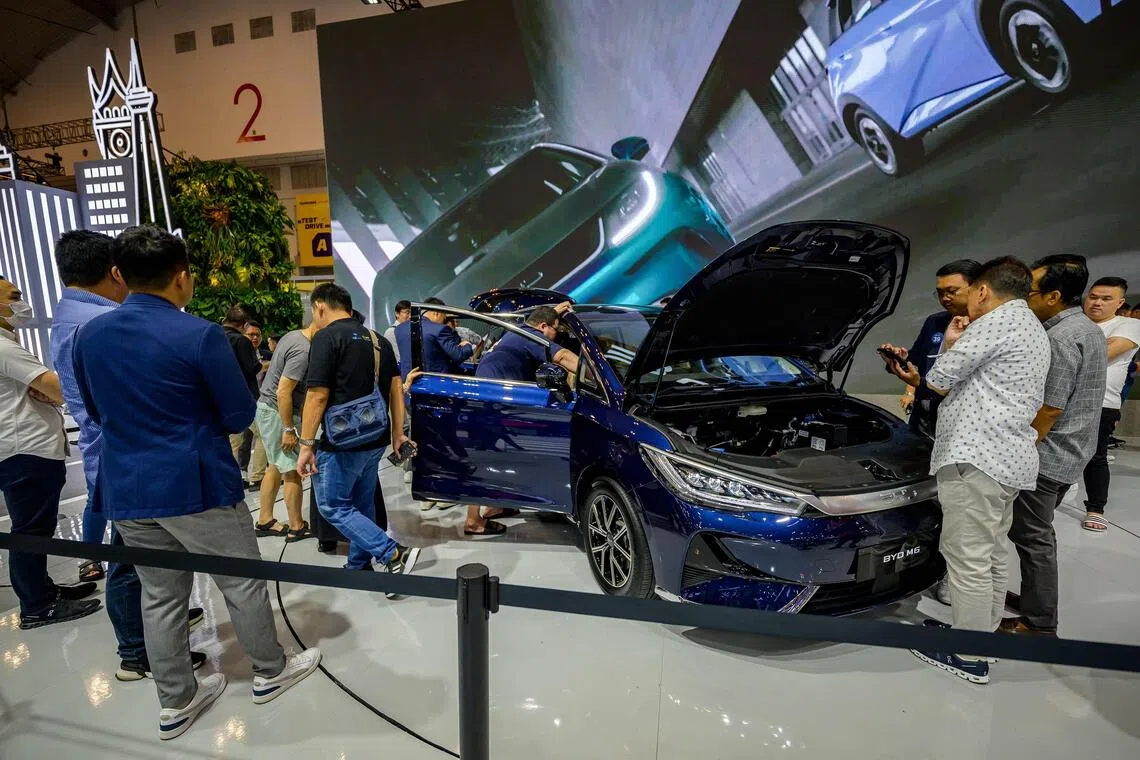
The EV giant’s Indonesian plant is projected to prioritise the production of its sport utility vehicle (SUV) line-up, which includes the Atto, Seal and M6 models.
Yet, analysts warn of timing risks: If new plants face delays or limited initial output, temporary supply shortfalls could undermine market momentum and push adoption targets off track.
BMI noted that consumers may face fewer choices or delayed launches if import economics worsen before local production scales up. Higher effective prices on imports could also deter first-time buyers in mass-market segments.
Indonesia’s automotive market is under pressure, weighed down by slowing household consumption and weaker purchasing power. Data from the Association of Indonesia Automotive Industries (Gaikindo) noted that overall car sales this August fell 19 per cent year on year.
Gaikindo chairman Jongkie Sugiarto said the withdrawal of the tax incentives will weigh heavily on Indonesian consumers, whose average annual income is about US$5,000.
“Price is the deciding factor,” he said. “Given the current per capita income, most people can afford only cars priced under 300 million rupiah (S$23,190).”
BYD hits the fast lane
Indonesian consumers are increasingly drawn to Chinese battery EVs, which have ranked among the country’s best-selling brands in 2025. As at August this year, sales of Chinese EVs had reached more than 45,000 units, with BYD leading the race, boosted by its wide range of models and strong market presence built up over recent years.
Its imported seven-seater M6, priced between 380 million and 400 million rupiah, has become one of the most sought-after models, with buyers waiting an average of 75 days for delivery.
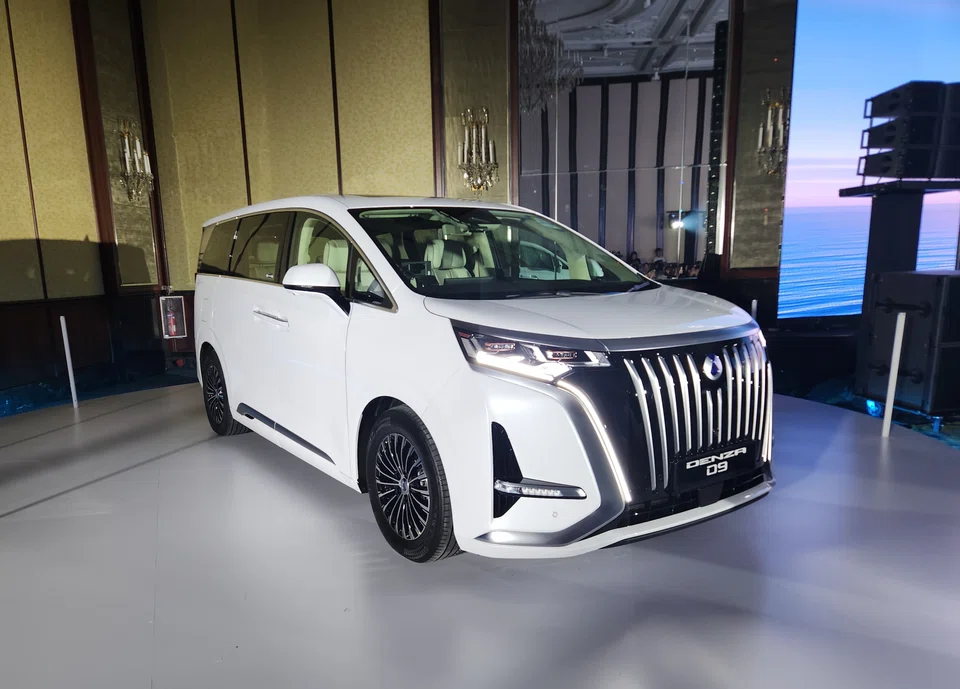
Indonesian interest in BYD extends beyond its SUVs. Denza, BYD’s premium marque, has gained rapid traction, selling more than 6,500 units since its January debut and capturing a 1 per cent market share within just a few months. Buyers currently face wait times of at least 90 days for delivery of the imported fleets.
However, the outlook comes with risks. Analysts warn that unless these models are produced locally, their prices will likely rise once the incentives are removed, potentially testing consumer demand and slowing market momentum.
Boosting domestic manufacturing
Earlier this month, the Indonesian government announced its plan to pull the plug on tax incentives for imported cars that have been in place since 2023. The move aims to push foreign automakers to invest locally and set up production plants ahead of the policy’s expiry next year.
Indonesia, rich in nickel – a key material for EV battery production – intends to build a robust EV ecosystem, positioning itself as a crucial market in the global EV supply chain.
Rachmat Kaimuddin, deputy for transportation at the Coordinating Ministry for Infrastructure and Regional Development, said there is no longer an urgent need for Indonesia to continue incentives for imported EVs, as adoption of such cars made domestically continues to grow steadily.
“The direction is clear: Build EVs locally. We want investment, production and jobs to grow, not just imports,” he said in a recent media briefing.
Although four-wheeler EVs currently make up just 2.2 per cent of total vehicle sales, he noted that once market penetration reaches the 5 to 10 per cent tipping point, adoption typically accelerates rapidly, driven by the multiplier effect of early adopters.
While regional peers such as Thailand and Vietnam continue to lean on incentives to attract buyers and investors, analysts argue that Indonesia’s long-term fundamentals remain compelling.
“This decision (to end tax incentives for imports) strengthens Indonesia’s pull for EV manufacturing investment,” Tsoai from BMI noted.
He added: “The market is huge, the economy is growing, and the charging ecosystem is expanding. For automakers, putting plants and supplier networks here today can pay dividends as local line-ups broaden and costs come down.”






