



Japan and Asean are ‘natural partners’ to work together in increasingly complex global environment: panellists
From investment to trade, deeper ties could serve as a hedge against rising geopolitical risks

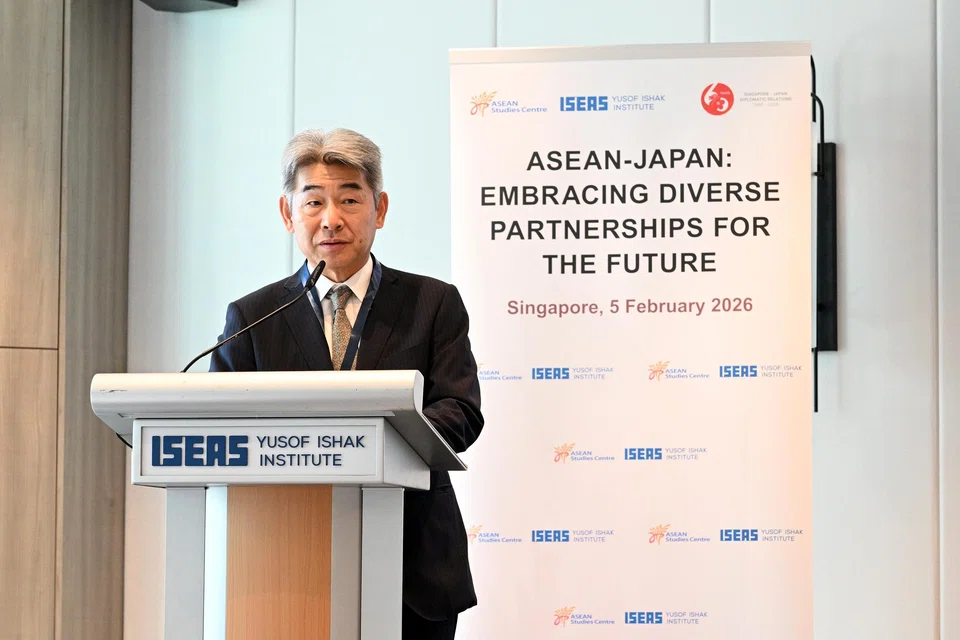
[SINGAPORE] It has just been about 13 months since US President Donald Trump returned to the White House for a second term. Yet within a span of just slightly over a year, the actions of the second Trump administration, which includes the “Liberation Day” tariffs, have shaken up the US-anchored global order.
Beyond heightened geopolitical uncertainties and supply chain realignments, there is also a concern about the “erosion of trust” brought about by these developments as highlighted by the Japanese Ambassador to Singapore Hiroshi Ishikawa.
“This is particularly troubling at the time when collective responses are urgently needed to address global challenges such as climate change and demographic transitions,” Ishikawa said in his keynote address at a closed-door seminar on Asean-Japan relations.
The seminar, organised by the Singapore-based think tank the Iseas-Yusof Ishak institute, was attended by academics, policymakers and diplomats.
Ishikawa noted that Japan has always seen building trust as a practical approach to its diplomacy, adding that Tokyo has always valued Asean’s aspirations and needs during its decades-long engagement with the regional bloc.
Japan is a long-time investor in South-east Asia and is consistently one of the top sources of foreign direct investments (FDI) into the region. The country is also the most trusted major power in the region, according to the 2025 edition of Iseas-Yusof Ishak’s annual State of Southeast Asia survey.
During a panel on navigating Asean-Japan relations under the second Trump administration, analysts also highlighted why the regional bloc and Tokyo are “natural partners” to work together.
“Japan and Asean both face severe security environments in the region and are prone to be caught in great power competition,” said a panellist.
“Second, there are common values of trust between Japan and Asean, which should not be taken for granted under today’s geoeconomic climate,” added the panellist.
While Japan’s economy is bigger than each individual Asean economy, the East Asian country, like many of the economies in the regional bloc, also often finds itself navigating an increasingly fraught US-China relationship. Like many governments in Asean, Tokyo appreciates the security umbrella provided by the US but would also want to continue having good relations with China, its largest trading partner.
“They (Japan and Asean) know that the strategic environment is dangerous and uncertain, hence the need for both Asean and Japan to work together. Both Asean and Japan want to engage China, but again they’re not naive,” said Dr William Choong, senior fellow for the regional strategic and political studies programme at the Iseas-Yusof Ishak Institute.
Complementary relationship
Economically, deepening relations between Asean and Japan would bode well for both parties as well.
Economies in Asean have already benefited from Japan’s continued FDI, which has often resulted in technology transfers and skills upgrading across the region, said Allen Ng, group head for regional surveillance at the Asean+3 Macroeconomic Research Office.
Yet continued investments and deeper ties would be a “natural complement” as Asean’s young and increasingly skilled workforce can help alleviate some of Japan’s domestic capacity constraints.
But it is not only a one-way investment from Japan to Asean. A growing middle-class in South-east Asia also represents steadily rising demand for finished goods from Japan.
“I think closer ties with Asean provide access to one of the fastest-growing consumer markets in the world. Asean has nearly 700 million people and a very rapidly expanding middle class, and it is already one of the largest destinations for Japan’s value-added exports,” Ng added.
Decoding Asia newsletter: your guide to navigating Asia in a new global order. Sign up here to get Decoding Asia newsletter. Delivered to your inbox. Free.
Copyright SPH Media. All rights reserved.






