



Japan’s Seven Bank enters Malaysia, sharpens 7-Eleven’s edge amid stiff competition
The banking arm of the 7-Eleven Group hints at plans to put more of its ATMs into the group’s convenience stores and high-traffic areas

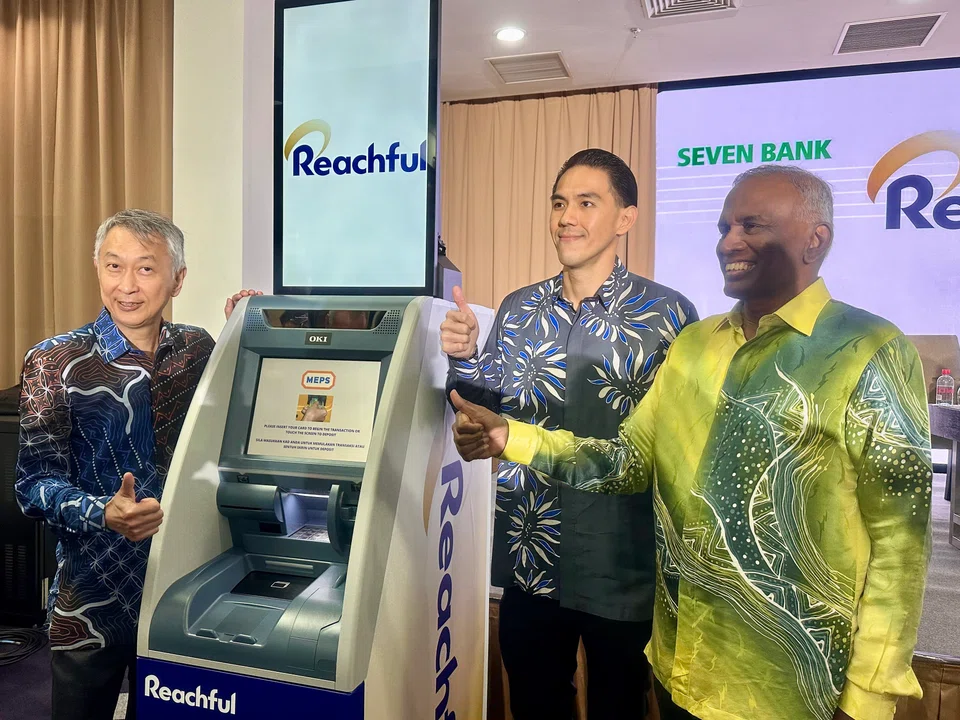
[KUALA LUMPUR] Seven Bank, the banking arm of the 7-Eleven Group and Japan’s largest digital bank, has officially entered the Malaysian market in a move aimed at expanding its presence in South-east Asia by tapping into 7-Eleven Malaysia’s network of 2,600 convenience stores.
The move, Seven Bank’s fourth overseas venture after the United States, Indonesia and the Philippines, is aimed at complementing the retail chain’s operation amid fierce competition in the convenience store arena.
Under its initial rollout, Seven Bank will install 100 automated teller machines (ATMs) in key Malaysian cities, including those in the Klang Valley, Penang, Johor and East Malaysia. For a start, the ATMs will offer basic banking services such as cash deposits and withdrawals.
Masaaki Matsuhashi, president of Seven Bank, said more ATM features will be added down the road, including those for concert ticket purchases and international money transfers.
He also hinted at a phased expansion; plans are afoot to install ATMs in all 7-Eleven convenience outlets in Malaysia if their locations meet operational requirements.
“Additionally, we are also exploring placement opportunities in petrol stations and other high-traffic areas,” he told reporters at the launch of a Seven Bank ATM in Kuala Lumpur on Monday (Jan 20).
A joint-venture company, Abadi Tambah Mulia Internasional Malaysia, was set up last May for Seven Bank’s expansion into Malaysia.
The joint venture has a capital investment of RM13.2 million (S$4 million), with Seven Bank holding a 50.1 per cent majority stake, and 7-Eleven Services and two Malaysian investment firms, HQZ Credit and SMRT Holdings, the rest of the shares.
Jin Sudo, chief executive officer of Abadi Tambah Mulia Internasional Malaysia, said that Malaysia’s growing population and increased cash usage are the primary reasons behind Seven Bank’s expansion into the country.
“We already have a presence in the Philippines and Indonesia, two of the most populous countries in South-east Asia. With a population of 34 million, Malaysia still has many consumers in non-urban areas who have difficulties in accessing ATM services, making it an ideal market for Seven Bank,” he said.
Tan U Ming, executive director and co-CEO of 7-Eleven Malaysia, echoed Sudo’s sentiments, noting that more than seven in 10 Malaysian consumers rely on cash for daily transactions.
He added that the average number of ATM withdrawals is significantly higher in Malaysia than in Japan and elsewhere.
Tan is also the son of Malaysian tycoon Vincent Tan, who is a major shareholder in 7-Eleven Malaysia.
Focusing on non-bank ATM business
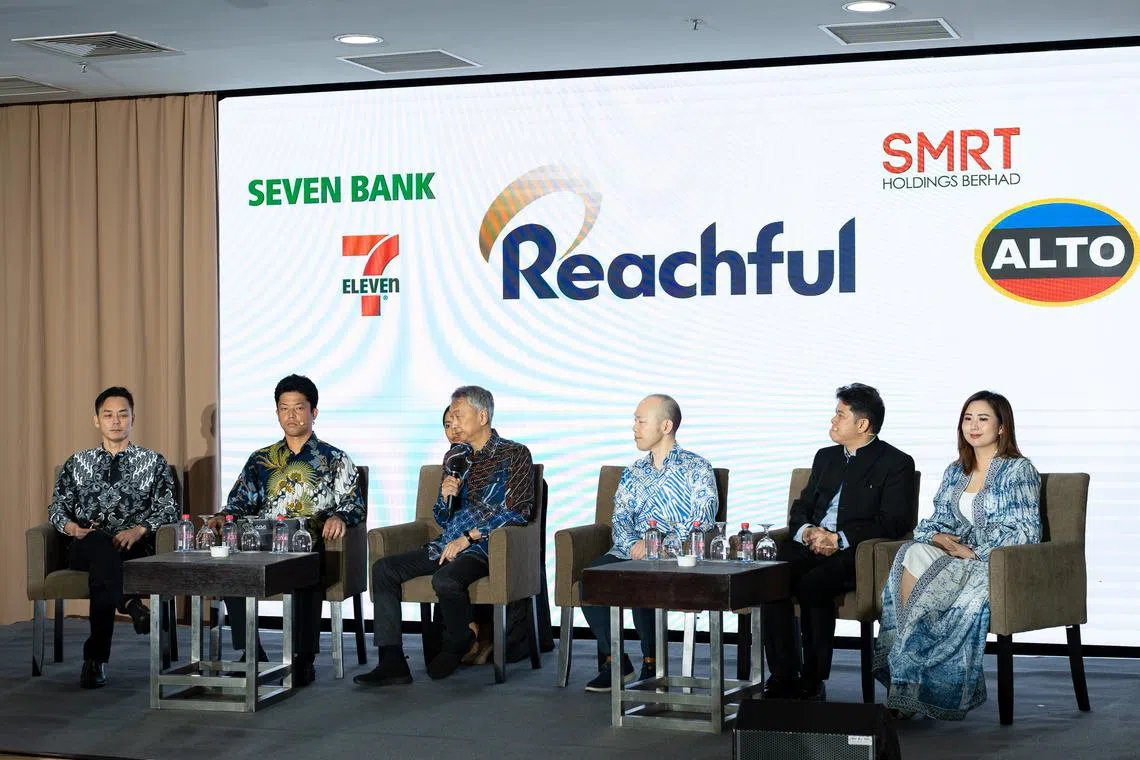
Seven Bank currently is not considering offering its digital-banking services, such as account opening and micro loans, in Malaysia. Matsuhashi said the focus for now would be on expanding the bank’s ATM footprint in Malaysia.
There are now five digital banks in Malaysia – the recently launched Ryt Bank by YTL Digital Capital and Singapore’s Sea, Grab’s GXBank, Boost Bank by Axiata Group and RHB Bank, Aeon Bank, and a digital bank led by KAF Investment Bank.
Globally, Seven Bank operates 27,848 ATMs, with the United States and Indonesia being its key markets. With Malaysia as the latest addition to its portfolio, the bank has no concrete plans for further international expansion at the moment, said Matsuhashi.
7-Eleven Malaysia eyes growth amid challenges

The partnership between Seven Bank and 7-Eleven Malaysia comes just as the convenience store chain navigates a competitive field while expanding its 7CAFe concept.
Of 7-Eleven Malaysia’s 2,611 convenience stores across the country – it is Malaysia’s largest such chain – 471 include 7CAFes, where consumers can pick up food and beverages on the go.
Wong Wai Keong, executive director and co-CEO of 7-Eleven Malaysia, described the 7CAFe concept as a significant draw for customers, but was unable to disclose footfall numbers.
“The competition among convenience store players in Malaysia is intense. We are witnessing a growing demand for more lifestyle food and beverage options; therefore, we have decided to expand this concept to additional stores, particularly to enhance the older stores.”
He noted that 7-Eleven started incorporating the 7CAFe concept three years ago, after setting up its central kitchen and introducing a new line of F&B products.
7-Eleven Malaysia plans to grow the number of 7CAFe outlets to 800 by the end of 2025, he added, noting that each new 7CAFe requires an investment of RM400,000 to RM500,000.
Net profit for the convenience store chain has been declining for three consecutive quarters. Despite the company having booked 4.3 per cent more revenue in the first nine months of 2024 – around RM2.1 billion – it suffered a 20 per cent drop in net profit to RM44 million.
Wong attributed the decline to higher operating expenses from higher labour costs and the cost of opening new stores and revamping old ones.
Although he declined to comment on the company’s earnings outlook, he noted that investments in 7CAFe have gradually begun to yield returns. On average, he estimates that it takes about two to three years for a 7CAFe to start generating profit
By integrating Seven Bank ATMs, 7-Eleven Malaysia aims to boost foot traffic and enhance overall sales.
Wong noted that the move aligns with the company’s strategy to strengthen its position as Malaysia’s largest convenience store operator while tackling rising operational challenges.
TRENDING NOW

Two Singapore-listed palm oil firms named in Greenpeace report on Indonesian plantation fires
Singapore Airlines flight returns to San Francisco after ‘unruly’ passenger incident

Singapore looking into which companies responsible for haze-causing fires: PM Wong
Deluge IPO 3.86 times subscribed ahead of SGX debut

