Jardine-linked Thaco joins race for Vietnam’s US$67 billion bullet train project
The move sets up a showdown with Vingroup-linked VinSpeed, as both vie for priority access to prime station-side land for real estate plays

[HO CHI MINH CITY] The battle to build Vietnam’s largest bullet train project is heating up as Truong Hai Group (Thaco) – a sprawling Vietnamese industrial conglomerate backed by Singapore-listed Jardine Cycle & Carriage – throws its hat into the ring for the US$67 billion North-South High-Speed Railway.
Thaco’s proposal would pit it against another heavyweight contender, VinSpeed – part of the Vingroup empire – which is also vying to build the mammoth, decade-long transnational railway project connecting Hanoi and Ho Chi Minh City.
Thaco, founded by auto tycoon Tran Ba Duong, is 26.6 per cent owned by Jardine Cycle & Carriage, a subsidiary of Hong Kong-based Jardine Matheson. In Vietnam, Jardine has steadily expanded its footprint not only through its stake in Thaco, but also via investments in the dairy producer Vinamilk and the infrastructure and utilities firm REE Corp.
According to Thaco’s proposal dated May 26 that was submitted to Prime Minister Pham Minh Chinh and reviewed by The Business Times, the conglomerate has proposed to invest around US$61.4 billion into the project, excluding expenses related to site clearance and resettlement that will be handled by the state.
Like VinSpeed, the industrial heavyweight has proposed gaining priority access to the prime land surrounding station sites for transit-oriented development (TOD) – a move that could unlock significant upside from rising land values and commercial spillovers.
Thaco is also seeking tax exemptions on imported equipment, materials, and machinery not available through local manufacturing.
The Jardine-backed firm has pledged to cover 20 per cent of the US$61.4 billion project – or US$12.3 billion – through its own capital and other mobilised sources, with plans to borrow the remainder for construction and operations. This mirrors the proposal by VinSpeed.
Thaco additionally stated that it would invite other domestic firms to contribute capital and jointly implement the project, while retaining a controlling stake and ensuring that no shares or capital are transferred to foreign entities.
In the letter signed by Duong, who is chairman of the group, Thaco proposed that the state own certain facilities as well and take responsibility for part of the management and operation.
“We are also committed to developing TOD models in an exemplary manner and at reasonable prices to meet the housing and living needs of the majority of Vietnamese people,” he wrote.
Best known domestically for automotive manufacturing, Thaco had an equity of 57.9 trillion dong (S$2.9 billion) as at the end of the first quarter of this year, with Duong and his family members holding 72 per cent of the stake.
Shift from state to private capital
The North-South High-Speed Railway project, approved by the country’s parliament in November 2024 under public investment, involves constructing a 1,500 kilometre rail line spanning 20 cities and provinces. The government plans to start construction in 2026 and put it into operation from 2035.
The proposals signal a potential shift from the current state-led investment model to one driven by private capital. This potential policy change, along with special mechanisms proposed for the project, is expected to be tabled for parliamentary review during the current legislative session, which runs until end-June.
These proposals also align with the recent Resolution 68, in which the ruling Communist Party of Vietnam has explicitly encouraged private firms to participate in national-scale initiatives and projects, including the development of high-speed railways, metro lines, power and digital infrastructure, and green transportation.
This is part of the South-east Asian nation’s ambition to foster the growth of its home-grown, mid-to-large private enterprises as well as develop internationally competitive corporations.
Thaco plans to raise 80 per cent of the project’s funding through domestic and foreign credit institutions, and is seeking a government guarantee, a risk-sharing mechanism to boost lender confidence, and full-interest subsidies over a 30-year loan period. In comparison, VinSpeed had earlier proposed zero-interest loans from the state over 35 years to finance a similar share of the investment.
Thaco estimates it will take seven years to develop three sections of the railway in two phases. In comparison, VinSpeed pledged to bring the entire line into operation within five years.
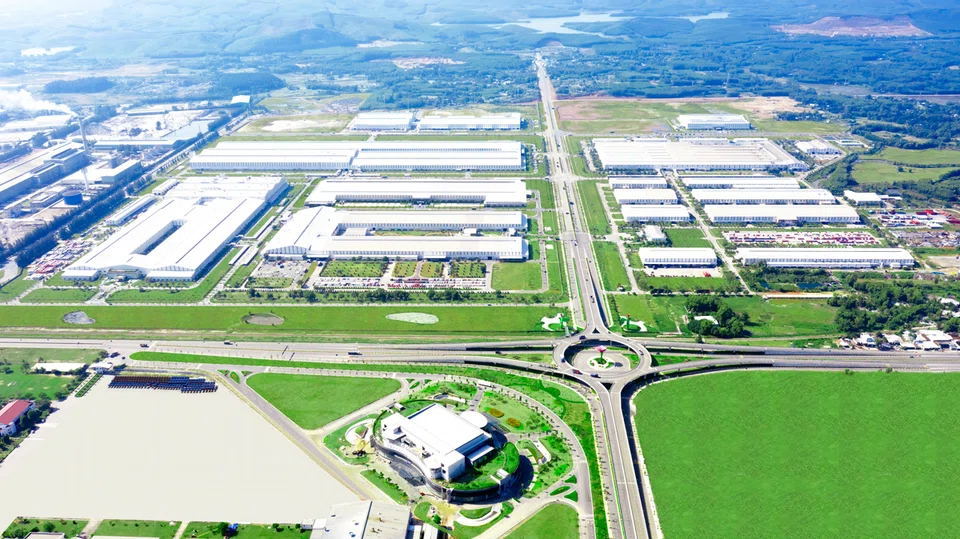
Headquartered in Ho Chi Minh City, Thaco operates one of Vietnam’s largest industrial parks within the Chu Lai Open Economic Zone in the central province of Quang Nam. The 1,200-hectare park hosts seven of Thaco’s auto plants producing and assembling a range of vehicles, from passenger cars to buses and trucks, for brands such as Kia, Mazda, Peugeot, Mitsubishi Fuso, and Thaco Bus.
The conglomerate also plans to begin construction of its industrial park specialising in mechanical and supporting industries in Vietnam’s southern manufacturing hub of Binh Duong in September, and another in the northern province of Bac Ninh next year.
Potential challenges ahead
VinSpeed’s proposal submitted on May 6 secured initial support from the government, with relevant agencies assigned to review and provide feedback before it is finalised and submitted to the parliament.
In its feedback on VinSpeed’s proposal, the State Bank of Vietnam (SBV) noted that Vingroup had a debt-to-equity ratio of 4.23 as at Mar 31, suggesting that the group relies heavily on debt financing, according to a document dated May 19 seen by BT.
The 20 per cent of the investment arranged by VinSpeed for the bullet train project already amounts to double Vingroup’s equity of 157.5 trillion dong.
By end-March, the conglomerate and 101 related firms in its ecosystem had a total domestic outstanding loan of 117.1 trillion dong. Meanwhile, the outstanding foreign debt of Vingroup and its subsidiaries, including electric car maker VinFast, hospitality firm Vinpearl, and residential real estate developer Vinhomes, stood at some US$2.4 billion.
“The North-South High-Speed Railway project is a particularly important project with complex technology and a large total investment, exceeding the appraisal capacity of credit institutions,” SBV noted.
Therefore, the central bank proposes a special mechanism related to a government guarantee for the domestic loan proposed by the firm to ensure the safety of banking operations.
“In the event that VinSpeed borrows a large amount of foreign capital within a short period, it could affect the limits on self-managed and self-repaid foreign loans, as well as the overall national foreign debt safety ratio,” it warned.