Johor landslide win fuels early Malaysia general election talk
Negeri Sembilan polls is another critical litmus test for Malaysia’s national election timeline

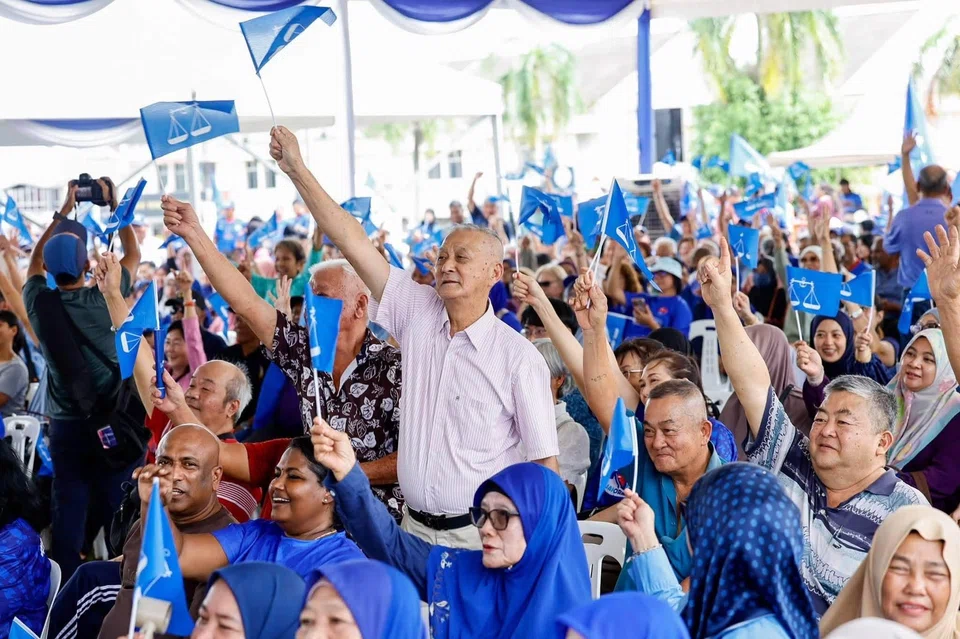
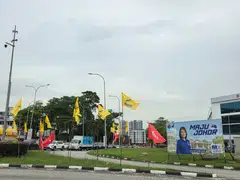
[KUALA LUMPUR] Barisan Nasional’s landslide victory in last Saturday’s (Jul 11) Johor state election has intensified speculation over an early general election, with market observers now turning their attention to the Aug 1 Negeri Sembilan polls as the next key test for Malaysia’s political trajectory.
In a market note on Monday, CIMB Research highlighted that an early 16th General Election (GE16) may become highly attractive for Barisan Nasional (BN) and Pakatan Harapan (PH) if the upcoming Negeri Sembilan polls confirm a voter shift away from Perikatan Nasional (PN).
To accelerate this timeline, the polls must reaffirm BN-PH core support, prove Malay votes are transferable from PN, and demonstrate manageable seat-sharing arrangements.
CIMB head of research Michelle Chia and senior economist Chew Khai Yen cautioned that Johor represents the upper bound of BN’s resurgence due to its status as a traditional Umno stronghold.
They expect stiffer competition in Negeri Sembilan, where more marginal seats are in play.
However, if the outcome is inconclusive, the government will likely stay the course, focusing on policy execution and voter consolidation before calling national polls.
Lau Zhe Wei, associate professor of political science at the International Islamic University Malaysia, echoed this caution against interpreting the Johor result as a definitive signal of an imminent general election.
He noted that Johor alone cannot dictate the GE16 timeline, pointing to Negeri Sembilan as the true barometer for early election pressure within BN.
“If BN performs strongly again in Negeri Sembilan, the pressure for a general election will increase. But if the result is less convincing, there will be stronger reasons for the government to continue governing and focus on policy delivery,” he told The Business Times.
SEE ALSO




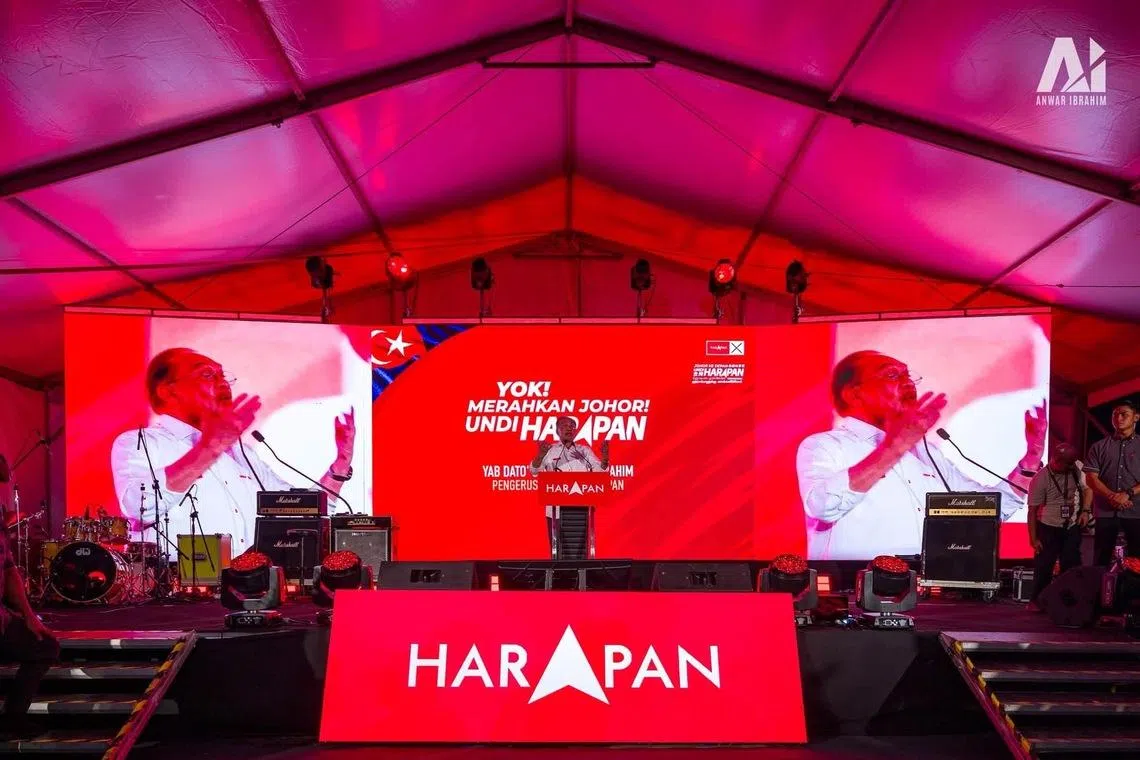
Prof Lau added that while Umno may push for an early poll, the ultimate decision lies with Prime Minister Anwar Ibrahim, whose term remains secure as long as the unity government maintains its parliamentary majority.
Macro policy direction remains
While the prospect of an early election is back on investors’ radars, economists emphasise that Malaysia’s macro policy direction remains largely intact.
OCBC senior Asean economist Lavanya Venkateswaran said the Johor result itself would have little impact on the state’s economic outlook as many of its flagship initiatives – including the Johor-Singapore Special Economic Zone (JS-SEZ) – were jointly developed by the federal and state governments.
She said national snap elections “cannot be ruled out over the next 12 months”, with the political calendar likely to become increasingly active after the Johor polls.
“The intensification of the political cycle can weigh on investor sentiment, particularly because we have seen it has been impacted by these gyrations in the past,” she said in a report on Monday.
Venkateswaran noted that reforms such as the Public Finance and Fiscal Responsibility Act 2023 have already been embedded in legislation, while the JS-SEZ blueprint has received Cabinet approval and is expected to be released in the fourth quarter, providing greater assurance of policy continuity.
She said Johor’s investment momentum remained intact, with manufacturing investment approvals rising to RM24.6 billion (US$6 billion) in 2025 from RM13.6 billion in 2024, while cumulative approved investments under the JS-SEZ reached nearly RM77 billion through the first quarter of 2026.
Muted reaction on share market
Despite intense discussion surrounding the Johor election, Bursa Malaysia was largely unmoved on Monday.
At closing on Monday, the benchmark FTSE Bursa Malaysia KLCI stood at 1,698.44, around 0.4 per cent higher than last Friday’s close.
The uptrend was led mainly by plantation stocks after expectations that crude palm oil prices could rise about 1 per cent to RM4,500 a tonne due to severe El Nino weather.
Among plantation companies with significant Johor exposure, Johor Plantations Group rose around 2.7 per cent to RM1.92, SD Guthrie gained 3.4 per cent to RM6.45, IOI Corporation climbed 2 per cent to RM4.60, while Kuala Lumpur Kepong advanced 1.3 per cent to RM21.88.
Other Johor-linked counters traded in a mixed trend. Electronics manufacturer VS Industry rose around 7.7 per cent to RM0.21, while most other Johor-related companies were little changed or slipped by no more than 3 per cent, suggesting investors remained focused on company-specific fundamentals rather than the election outcome.
Businesses seek continuity
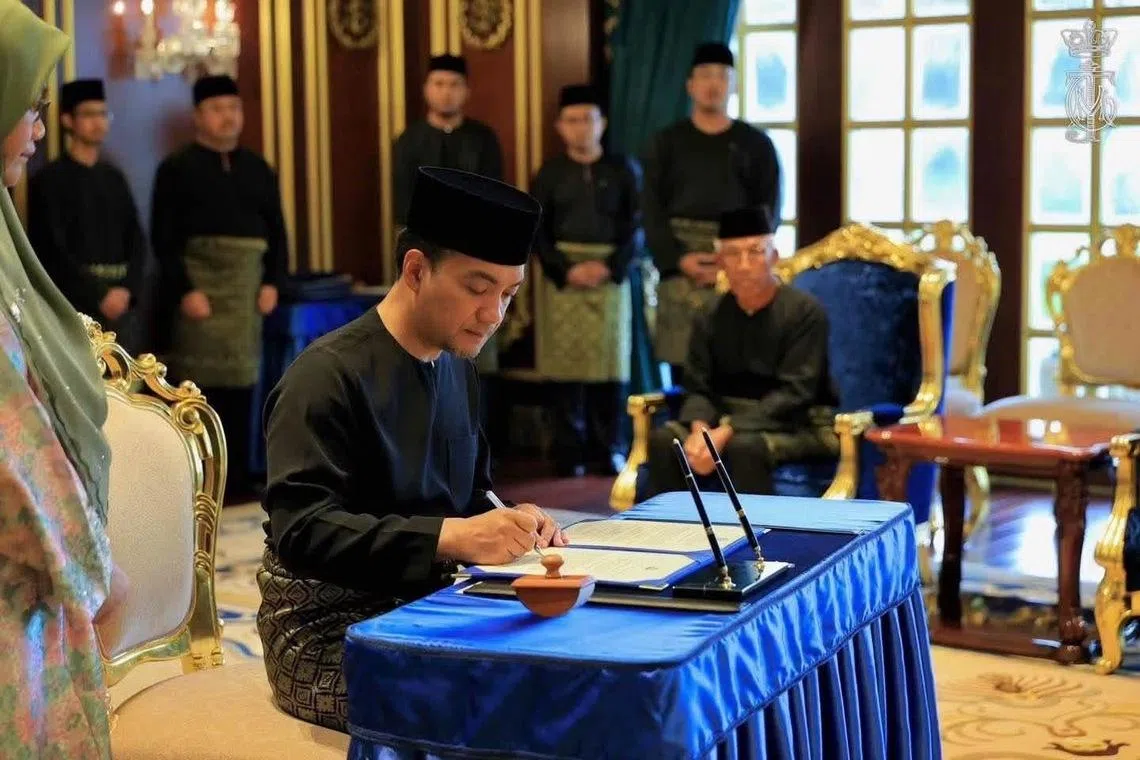
For businesses on the ground, the election result is expected to reinforce continuity rather than alter investment plans.
Jeffrey Lai, president of the Johor Bahru Chinese Chamber of Commerce and Industry, said economic development, particularly the implementation of the JS-SEZ and other major infrastructure projects, had become the state’s overriding priority.
“The economy has been put first,” he said, adding that the election outcome provides a strong foundation for the incoming administration to continue implementing long-term development plans.
Lai said projects such as the JS-SEZ and the Johor Bahru-Singapore Rapid Transit System Link have already attracted billions of ringgit in investments and are expected to create higher-quality jobs, raise incomes and strengthen Johor’s ambition of becoming a high-income, high-technology state by 2030.
Daniel Loh, founder and chief executive officer of Stellar Education Group, said the election itself was unlikely to have a meaningful impact on business activity.
“The change Johor needs most is a change of mindset,” he said, adding that the priority should be getting the fundamentals right, from infrastructure and public safety to creating an environment that attracts investment and talent.
Loh said the success of Johor’s economic transformation should ultimately be measured by whether it creates better opportunities for its own people. “That is the simple and honest test,” he added.
Decoding Asia newsletter: your guide to navigating Asia in a new global order. Sign up here to get Decoding Asia newsletter. Delivered to your inbox. Free.
Copyright SPH Media. All rights reserved.