



As Johor’s data centre scene sizzles, new projects face stricter criteria
Applications are now assessed for their potential to offer higher-paying jobs, as the Malaysian state adopts a more selective approval process

[KUALA LUMPUR] As Johor’s data centre industry booms, the state has tightened the reins on new approvals, prioritising high-value investments that deliver better-paying jobs for Malaysians, according to a senior executive from the state’s investment promotion agency.
While these billion-ringgit facilities are drawing significant global interest, they are also straining local resources, such as electricity and water.
This has prompted the state government to re-evaluate its approach to approving new data centre projects as global investor interest continues to grow, Invest Johor chief executive Natazha Harris told The Business Times in a recent interview.
The state government has formed an ad hoc committee to oversee data centre developments, with a focus on refining policies and criteria for future investors. Key considerations include economic benefits, job creation, competitive salary packages, and the impact on essential resources such as water and electricity.
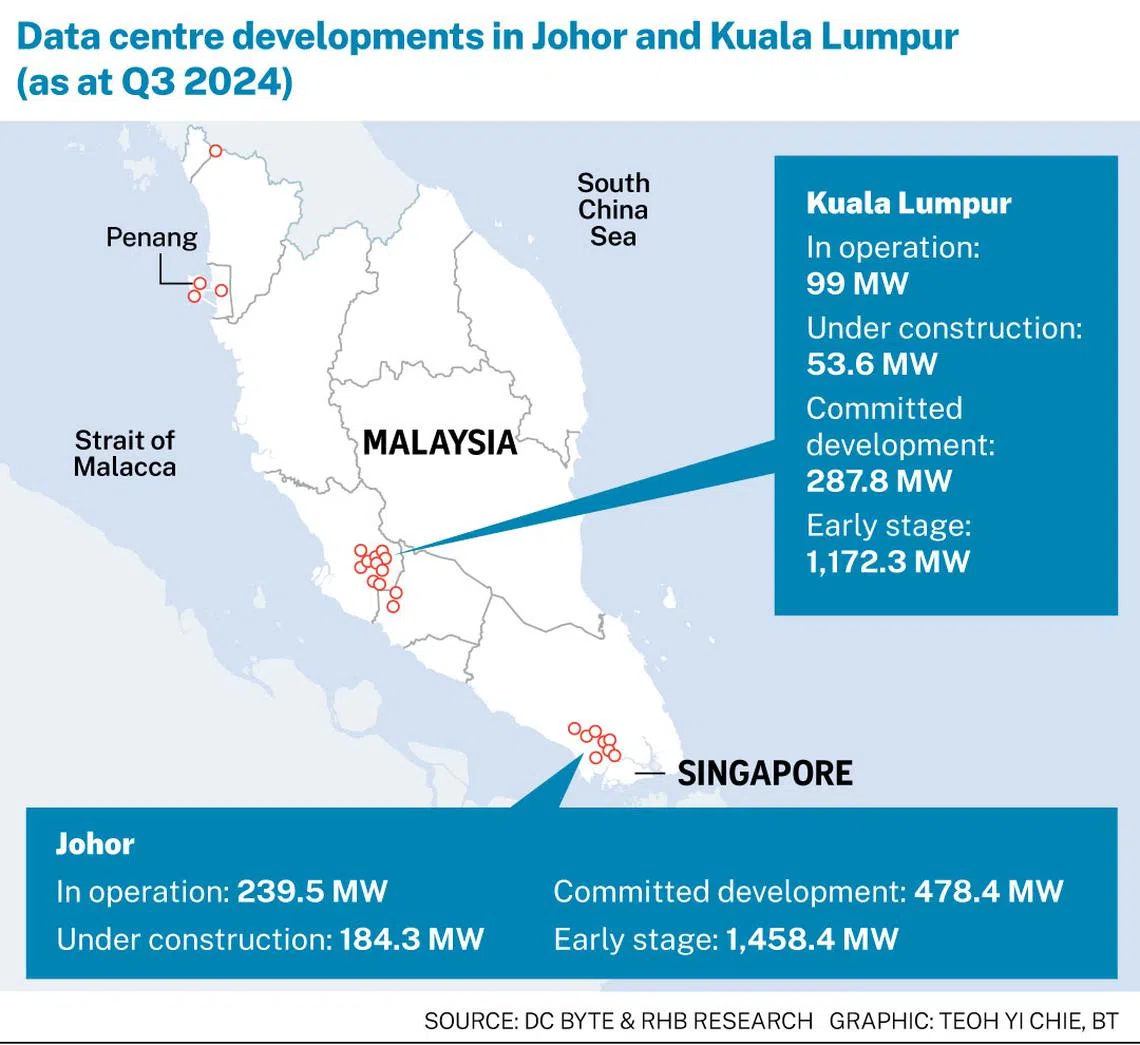
As at May this year, Malaysia had a total of 32 operational data centres, with 19 others in development. Among these, Johor has 17 – 13 operational and four under construction – according to data from Malaysia’s Ministry of Housing and Local Government.
Seeking better payday
New applications for data centre investments in the state are now assessed against a range of criteria, including their potential to offer higher-paying jobs to local residents.
Natazha shared a recent insight from a site visit to a hyperscale facility in the state, where senior management revealed that a skilled worker at a data centre in Johor earns around RM4,500 (S$1,380) a month. In comparison, a similarly skilled worker in Singapore earns the same figure, but in Singapore dollars.
“This means that just across the 3-km bridge, Malaysians are earning three times what they could in Johor for the same skill set,” he continued.
He noted that brain drain is a major issue for Johor and Malaysia, with many young professionals leaving the country for higher-paying jobs abroad.
While it may be difficult to match Singapore’s salary levels, he suggested that wages in Johor should be at least 50 per cent higher than current levels in order to retain talent.
“A reasonable salary would encourage more Malaysians to work and stay in Johor. The state’s lower cost of developing data centres should be offset by offering better-paying jobs for locals,” he stressed.
“We aim to reduce brain drain in Johor, and attract more talent back to the state,” Natazha said, adding that improved connectivity between Singapore and Johor, especially after the commencement of the Rapid Transit System Link in early 2027, will boost both business opportunities and talent mobility between the two countries.
Johor – the fastest-growing data centre market
Malaysia, and Johor in particular, became a popular destination for data centre investment in 2021, after Singapore’s moratorium on new data centre development.
Drawing billions in investments from global tech giants, Johor has rapidly emerged as South-east Asia’s fastest-growing data centre market, with more than 1.6 gigawatts (GW) of total supply, much of it added in the past three years.
Dedi Iskandar, head of data centre solutions at CBRE Singapore, highlighted Johor’s ample land and resources as key advantages for the industry.
However, he pointed out that Johor faces a severe shortage of skilled talent for data centre management and maintenance, forcing some companies to hire from Singapore at a higher cost.
According to Dedi, running a data centre requires a specialised workforce due to the complexity of the facility, which involves both mechanical and electrical components.
A typical data centre needs around 12 staff working on a rotational basis, with salaries on the higher side due to the technical expertise required.
“This presents an opportunity to upskill the local talent pool. There is also potential for growth in renewable energy solutions, which are currently underdeveloped in Johor,” he told BT.
He added that other industries supporting the data centre ecosystem, such as manufacturing for racks, uninterruptible power supply devices and generators, are likely to benefit from the sector’s expansion.
However, challenges remain, including limited competition among utility and connectivity service providers in Malaysia. “The country has only one power provider and a handful of telecommunications providers, offering few backup options for data centres.”
Singapore and Johor: A shared future

Singapore has long been the preferred destination for data centre investment in South-east Asia, thanks to its availability of technical expertise and concentration of global corporations.
Currently, the island nation hosts more than 70 data centres. However, its three-year moratorium, imposed in 2019 due to concerns over land and power constraints (this has since been lifted) has hindered significant expansions in this space.
Dedi said: “Singapore has strong reasons (for limiting data centre expansion), as the existing facilities consume about 9 per cent of the nation’s electricity, with projections indicating this could rise to 13 per cent if demand remains unchecked.”
This situation has benefited Malaysia, particularly Johor, where industrial land prices have gradually increased from RM50 to RM130 per square foot over the past two years.
Singapore still a sweet spot
Despite these challenges, Singapore continues to be a prime location for mission-critical applications, due to its robust legal framework and advanced digital infrastructure.
“Singapore’s established regulations, such as the Personal Data Protection Act, give it a competitive edge over its neighbours, though Malaysia is rapidly catching up,” he said.
Rather than competing directly with Johor, Dedi said Singapore and Johor could collaborate by positioning Johor as a backup site for data hosted in Singapore. By leveraging each other’s strengths, both sides can continue to attract investment to the region.
“This strategy would require close coordination between governments and stakeholders to harmonise regulations and service standards across both locations, ensuring mutual growth in the data centre sector,” he added.
The future of Malaysia’s data centres

According to a recent report by RHB Research, Malaysia is poised to become the largest data centre hub in South-east Asia, with up to 4 GW of capacity to come online in the next four to five years.
Currently, around 2 GW is under construction, primarily in Johor, with nearly 3 GW in various development stages.
RHB analysts Jeffrey Tan and Wan Muhammad Ammar Affan noted that the rising demand for graphics processing units (GPUs), driven by artificial intelligence workloads that double every six months, is expected to create new revenue streams for data centre operators through GPU-as-a-Service.
They said data centres are catalytic enablers to raise Malaysia’s economic complexity and technological advancement. For instance, Google’s US$2 billion investment in the country is expected to create 26,500 jobs and add more than US$3 billion to Malaysia’s gross domestic product by 2030.
A study by Oxford Economics indicated that Google’s data centre investments in Europe generated US$1.1 billion in worker income and contributed US$2.2 billion to GDP.
The Johor-Singapore Special Economic Zone (JS-SEZ), meanwhile, is set to play a key role in this growth. Spanning 3,505 square metres across six districts in Johor, the zone is attracting major investments from hyperscalers and co-location providers.
According to DC Byte, the Iskandar Malaysia region is projected to deliver more than 2 GW of capacity by 2027, surpassing Singapore’s capacity constraints.
“The JS-SEZ will enhance demand for data centres, benefiting from Singapore’s overflow while promoting digitisation initiatives in both the public and private sectors,” said RHB’s Tan and Wan Muhammad in the report.
TRENDING NOW

Things to know about DBS’ incoming chairman Anthony Lim

DBS eyes prime brokerage business as Q3 profit falls 5% on weaker trading income

Royal Group and Sunset Hospitality abandon plans to open Casa Mett hotel off Orchard Road

George Yeo adds 100,000 Wilmar shares at S$2.97 apiece, taking stake to over 1 million shares

