



Johor’s investment arm JCorp leans on Ibrahim Technopolis to boost SEZ with Singapore
The conglomerate, with interests in agribusiness, healthcare, food services and real estate, is in talks with Singapore investors to form JVs, co-locate and coordinate marketing strategies


[KUALA LUMPUR] Johor Corporation (JCorp), the investment arm of Malaysia’s southern state, is courting Singaporean and global investors to power its flagship Ibrahim Technopolis (Ibtec) to home in on cross-Causeway demand in healthcare, technology and advanced manufacturing, its chief told The Business Times.
JCorp president and chief executive Syed Mohamed Syed Ibrahim said in an e-mailed response to BT: “We are proactively engaging with potential Singaporean and international investors, as well as aligning our subsidiaries to ensure we attract the right-fit companies that align with the JS-SEZ’s (Johor-Singapore Special Economic Zone) growth clusters.”
He added that the company was “actively targeting investors” in these sectors through joint ventures, co-location strategies and coordinated marketing with Singaporean counterparts.
JCorp, a conglomerate with interests in agribusiness, healthcare, food services and real estate, and several listed entities on Bursa Malaysia, posted revenue of RM7 billion (S$2.1 billion) in FY2024. Its total assets under management stood at RM24.5 billion as at Dec 31, 2024.
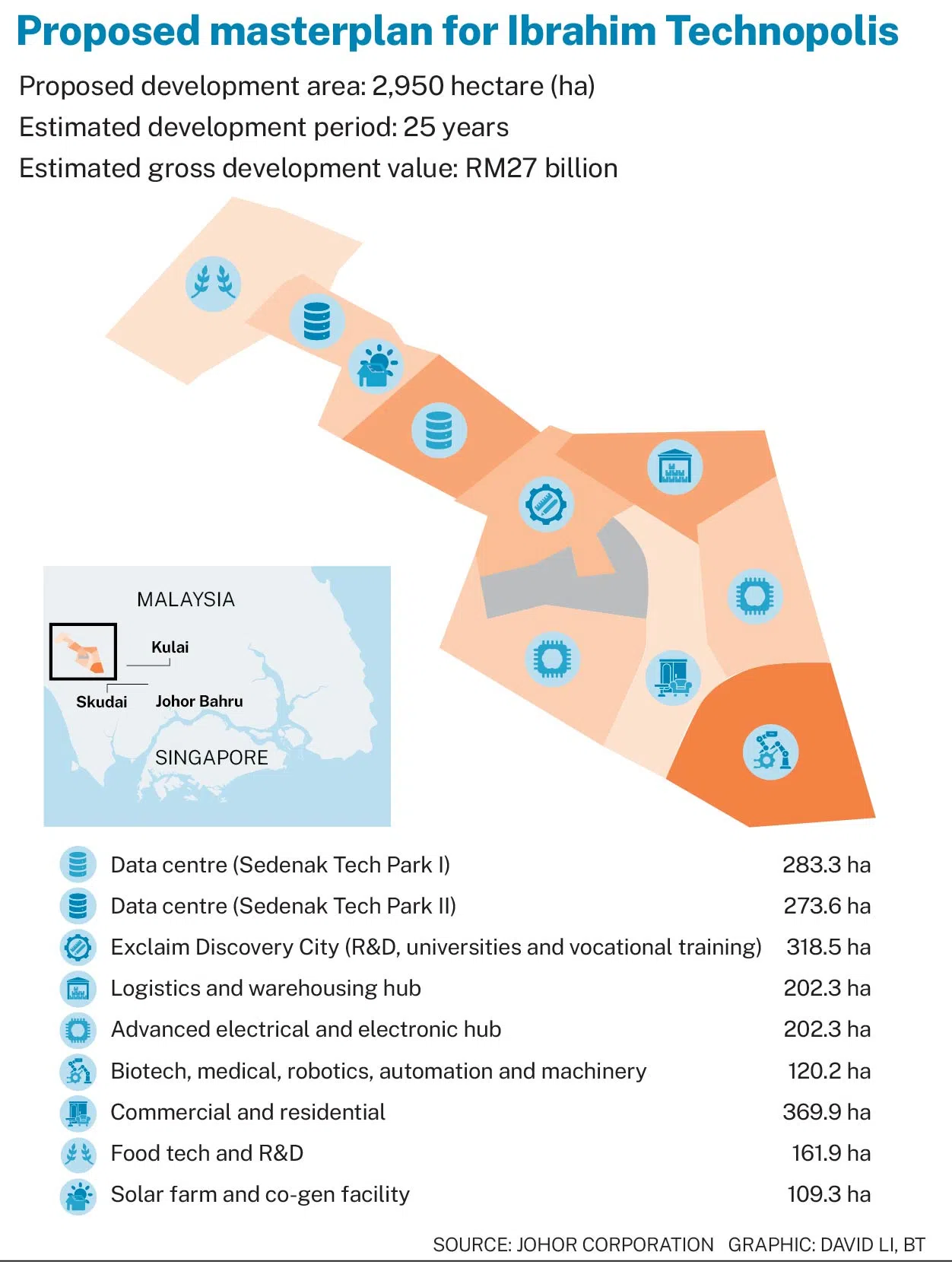
The Ibtec regional hub, which is part of the JS-SEZ and a flagship development in Malaysia’s southern state, will be developed over the next 25 years. Located in Sedenak and occupying 2,950 hectares, it has an estimated gross development value of RM27 billion, and will be the backbone of JS-SEZ’s digital economy.
It is hoped that the project will transform Sedenak – now a prime location for data centres – into a smart industrial township in South-east Asia, complementing JS-SEZ’s development.
“We are aligning our portfolio and partnerships with the sectors where Johor has both capability and demand pull from Singapore, such as healthcare, technology, logistics and advanced manufacturing,” Syed Mohamed added.
A circular economy within the JS-SEZ

Planned as a circular economy within the JS-SEZ, Ibtec will feature smart logistics wired to the Rapid Transit System Link, highways and ports.
“The integrated network, including the Tanjung Langsat Port, aims to establish Johor as a logistics and industrial nexus within South-east Asia,” noted Syed Mohamed.
A highlight of Ibtec is the 235.5-hectare Exclaim Discovery City, master-planned by Zaha Hadid Architects as a showcase of futuristic urban design.
JCorp has pulled in 11 data-centre operators to the Sedenak Tech Park. These include Bridge, Keppel and Yondr Group, with a combined IT load topping 1.2 gigawatts.
Anchoring the JS-SEZ

As master developer and anchor investor, JCorp is recasting the driving force of the JS-SEZ; Syed Mohamed said that it is “uniquely placed to catalyse high-tech manufacturing”.
One of the visible examples of JS-SEZ’s potential is in food production.
JCorp, through its subsidiary FarmByte, is creating an integrated agrifood ecosystem that covers farming, processing and logistics. It also formed a pact with Singapore’s agritech firm Archisen to build Malaysia’s largest indoor vertical farm; the 52,000 square foot (sq ft) facility is expected to produce more than 300,000 kg of leafy greens annually.
“The JS-SEZ gives us the platform to scale what we’re already good at, while deepening cross-border value creation with strategic partners,” explained Syed Mohamed.
There are gaps in the SEZ’s growth narrative. A talent crunch, for one, is a big challenge due to the state’s long-standing brain drain woes, from many skilled workers having chosen to work across the Causeway for higher wages.
“Through our Johor Skills Development Centre and partnerships with institutions in Singapore, we are implementing programmes to upskill and reskill 10,000 workers annually by 2027,” Syed Mohamed said.
Key drivers
Founded in 1968 with a mandate to eradicate poverty and modernise Johor’s economy, JCorp has evolved into a conglomerate spanning agribusiness, healthcare, food services and real estate. Its subsidiaries include Kulim (the parent company of Johor Plantations Group), KPJ Healthcare, QSR Brands and JLand Group (JLG). The group’s portfolio includes 34 industrial parks, six townships and 2.5 million sq ft of retail and office space.
In 2024, the initial public offering (IPO) of Johor Plantations Group raised RM735 million. It was the country’s largest IPO since March 2022, underscoring investor confidence in agribusiness.
Syed Mohamed added that Johor Plantations Group is also pressing ahead with its Integrated Sustainable Palm Oil Complex (ISPOC) in Sedili, Johor.
The catalytic project aims to expand downstream activities into specialty fats, animal feed and renewable energy. ISPOC is positioned as a multi-stakeholder platform for sustainable palm oil, appealing to global investors prioritising environmental, social and governance standards.
KPJ Healthcare, another flagship, commanded a market capitalisation of RM11.8 billion as at Tuesday (Aug 26). The group’s restaurant network QSR Brands has more than 1,350 outlets in the region, and JLG’s assets are valued at RM3 billion.
Growth in volatile times
JCorp’s profit before tax stood at RM718 million in FY2024, up 19 per cent from the prior year, which, Syed Mohamed noted, was higher than the target. Its revenue, however, missed expectations.
“While tariffs may impact certain industries, they also present new avenues for agile economies like Johor to capitalise on evolving global supply chains,” said the 66-year-old chief, who has helmed JCorp since January 2020.
He previously served as chief operating officer and senior vice-president at Knowledge Economic City in Saudi Arabia, president and CEO of Iskandar Investment, group director at DRB-Hicom, and CEO of TH Properties.
Healthcare as a growth engine
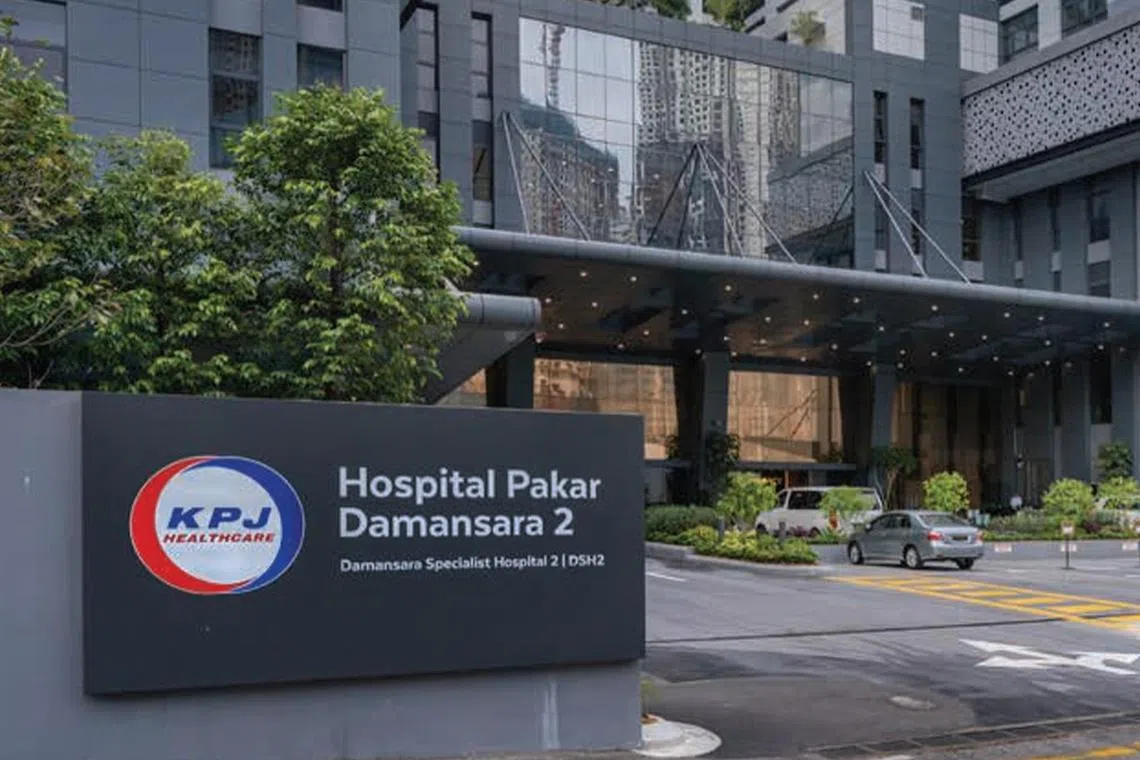
Syed Mohamed noted that JCorp’s healthcare unit, KPJ, has continued its growth momentum and remains as a key earnings contributor for JCorp. KPJ has 31 hospitals nationwide, and is looking to expand capacity from about 3,733 beds to 5,000 beds by 2028 through brownfield projects.
In 2024, KPJ announced two significant moves to support its future growth: One was in the setting up of an Academic Health System, and the other, a collaboration with the US-based Mayo Clinic.
Syed Mohamed cited the Mayo Clinic partnership, as well as one with Marriott International, as being “designed to raise clinical standards and improve patient care in the fast-growing medical tourism sector”.
He noted that Johor’s proximity to Singapore opens opportunities for cross-border healthcare hubs combining diagnostics, ambulatory services and digital care. Ibtec’s life-sciences cluster, for instance, is envisioned as a natural extension of KPJ’s innovation ecosystem.






