



Joko Widodo’s decade in power: Infrastructure, economic and welfare gains amid governance hurdles
His leadership galvanised reforms and boosted Indonesia’s connectivity and per capita income, but it was also marked by striking institutional challenges

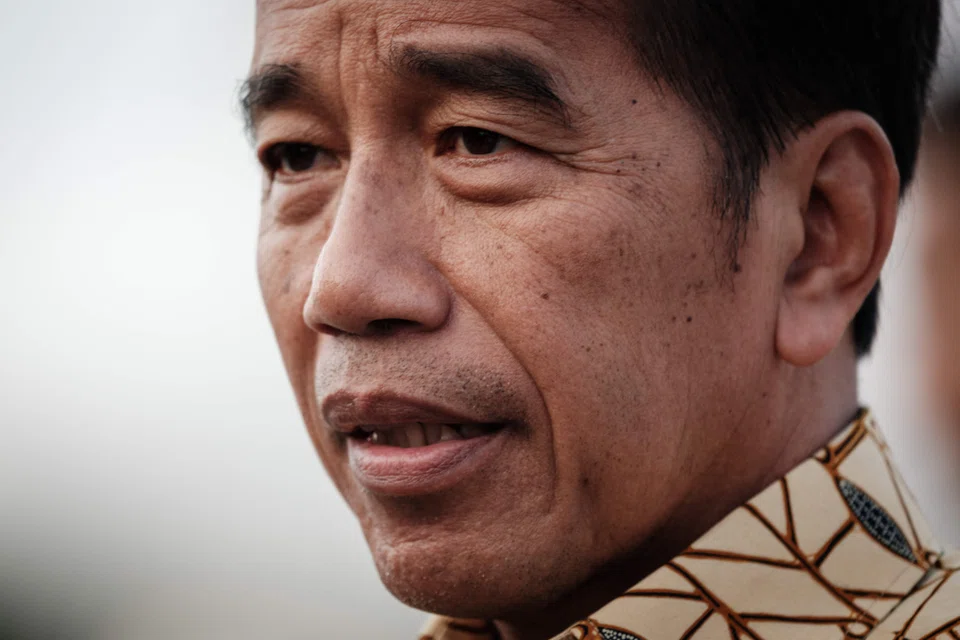
[JAKARTA] When Joko Widodo was first elected president of Indonesia a decade ago, and then re-elected in 2019, his economic vision was clear: to develop infrastructure evenly across the country and attract foreign investment.
“If there’s one key takeaway (from his time in power)... it’s the impressive infrastructure build-out in Indonesia. It has significantly fuelled economic growth and attracted the interest of many multinational companies,” said Siantoro Goeyardi, Deutsche Bank’s chief country officer for Indonesia.
Over the past 10 years, Widodo, a 63-year-old former furniture salesman, has transformed Indonesia into a prime investment destination, capitalising on the country’s abundant natural resources – ranging from palm oil to nickel – and the strong consumption power of its 280 million citizens.
The surge in foreign direct investment underscores Indonesia’s rising global significance, with annual foreign investment having jumped 146 per cent over the decade to US$47.4 billion in 2023.
But the recent Aug 22 street protests that erupted when Widodo’s strong political coalition proposed tweaking the age-requirement rules to pave the way for his 29-year-old son’s run for governorship in Central Java tarnished his popular image as outsider-turned-president.
This, coming after he successfully positioned another son as incoming president Prabowo Subianto’s vice-presidential running mate by making a similar change to the law last October, has opened him to charges of manoeuvring to keep political influence through his family.
His legacy faces growing scrutiny as he prepares to hand over power on Oct 20 to Prabowo, a former rival-turned-ally.
‘Jokowinomics’
Widodo’s first term was defined by a government-led initiative to address Indonesia’s infrastructure gaps, a strategy famously dubbed “Jokowinomics”.
Shortly after taking office in October 2014, he cut billions in fuel subsidies, and redirected those funds towards major infrastructure projects such as toll roads, housing developments and airports.
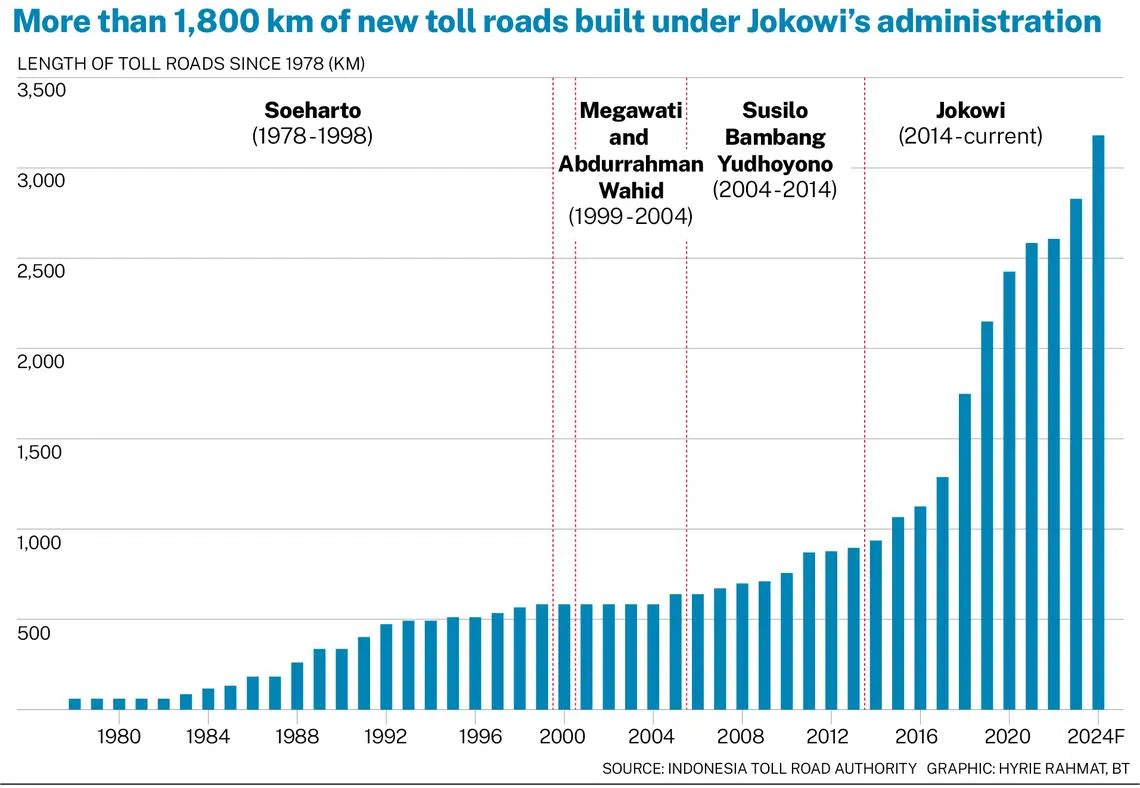
On his watch, Indonesia’s economy grew consistently at 5 per cent. This fell short of his 7 per cent target, which was viewed as being overly ambitious, with the country’s historical growth rate having been below 6.5 per cent.
The country quickly bounced back from the 2020 recession triggered by the pandemic, aided by US$47.6 billion in fiscal stimulus.
Economic growth under Widodo was slower than in the previous decade, partly due to lower commodity prices, but investor confidence was bolstered by macro stability and moderate inflation, and supported by responsive central bank policies.
Kaushik Shaparia, chief executive officer for emerging Asia in Deutsche Bank, told The Business Times: “Investors have a fair amount of confidence in how Indonesia has managed itself, particularly regarding fiscal discipline, sustained growth and controlled inflation.
“As a result, we can expect more investors to take a deeper interest in Indonesia, not only in terms of foreign direct investments, but also in broadening the country’s investor profile for financing.”
Per capita income has been steadily rising and is fast approaching the US$5,000 mark, a milestone that is expected to grow the middle class.
Former finance minister Chatib Basri, now a senior lecturer at the University of Indonesia, warned that the economy must sustain an annual growth rate of 6 to 7 per cent until 2050 to avoid falling into the middle-income trap.
Over the past decade, poverty in Indonesia fell from 11.2 per cent to 9.4 per cent, aided by cash transfers and subsidies from the government, though inequality persists with rising living costs and unemployment.
China ties and green investments
Indonesia has greatly benefited from China’s Belt and Road Initiative, with the East Asian giant becoming its top trading partner and key investor. One major milestone was the US$7.3 billion China-funded high-speed rail linking Jakarta and Bandung.
Widodo has also invited China to invest in Indonesia’s goal of becoming a global electric-vehicle hub, leveraging its vast nickel reserves.
Following his ban on the export of nickel ore to boost domestic processing, Indonesia attracted more than US$3.1 billion in investments and created 70,000 jobs. Processed nickel exports soared from US$4 billion in 2017 to US$34 billion in 2024, a 750 per cent rise.
Indonesia aims for net-zero emissions by 2060, with support from initiatives such as the Just Energy Transition Partnership. The country is actively attracting green investment, focusing on developing downstream industries and harnessing renewable resources.
Despite progress, challenges persist in balancing growth with sustainability, given the still-heavy reliance on coal and the need for renewable infrastructure investment.
In 2023, Indonesia secured around US$1.5 billion in climate-related investments, far short of the US$285 billion needed to meet its 2030 climate targets, noted the Institute for Energy Economics and Financial Analysis (IEEFA).
Red tape, regulatory ambiguity
Stubborn gaps in Widodo’s legacy remain.
The IEEFA’s energy finance analyst Mutya Yustika said Indonesia remains bogged down by lengthy procurement processes. These add costs and risks to green projects, making them less attractive to carry out in Indonesia than in the neighbouring countries.
“The complexity of procurement in Indonesia is a significant setback for investors. Most of the time, tenders are cancelled without explanation, forcing investors to record expenses as sunk costs,” she added.
The lack of regulatory clarity and consistency has been a significant stumbling block during Widodo’s administration. Observers say that policies are chopped and changed, and decisions are made without thorough planning, thus fanning controversy and leaving investors uncertain and confused.
Wijayanto Samirin, a senior economist from Paramadina University, said Widodo tends to be spontaneous and quick in decision-making, which is advantageous for tactical matters.
“(But) this is often problematic for strategic issues that require careful planning and thorough analysis,” he said.
Widodo has generally enjoyed significant political support in parliament, which has paved the way for many of his policies, including his ambitious plan to move the capital from Jakarta to Nusantara in Kalimantan.
Despite criticism from environmentalists, the US$33 billion plan was endorsed by the majority of political parties, with only one dissenting voice.
His administration has pursued a nationalist policy regarding Indonesia’s natural resources, characterised by efforts to increase state control and value-added processing.
One of Widodo’s key policy initiatives was the Made-in-Indonesia rule, aimed at boosting domestic production by imposing stricter regulations on imports such as laptops and raw materials.
Nationalist policies
Dedi Dinarto, lead Indonesia analyst at the strategic advisory firm Global Counsel, said that although these nationalist policies have gained domestic popularity, they have raised concerns among foreign investors.
This could hinder Indonesia’s efforts to combat de-industrialisation, a phenomenon marked by a premature decline in industrial capacity or activity, he noted.
Political dynasty
Despite Widodo’s high approval ratings, critics argue that Indonesia’s democratic institutions and practices have faced notable challenges and setbacks under his presidency.
Adhi Priamarizki, a research fellow at the S Rajaratnam School of International Studies, said: “A strong political coalition has effectively given Widodo a blank cheque. With checks and balances not functioning perfectly, he can act without restraint, and there is little to prevent him from taking actions that may not align with regulations.”
The proposal by Widodo’s political coalition to change the rules to clear the way for his youngest son Kaesang Pangarep’s political career, and a similar 2023 change to the law that has since installed his eldest son Gibran Rakabuming Raka in national-level politics, are cases in point.
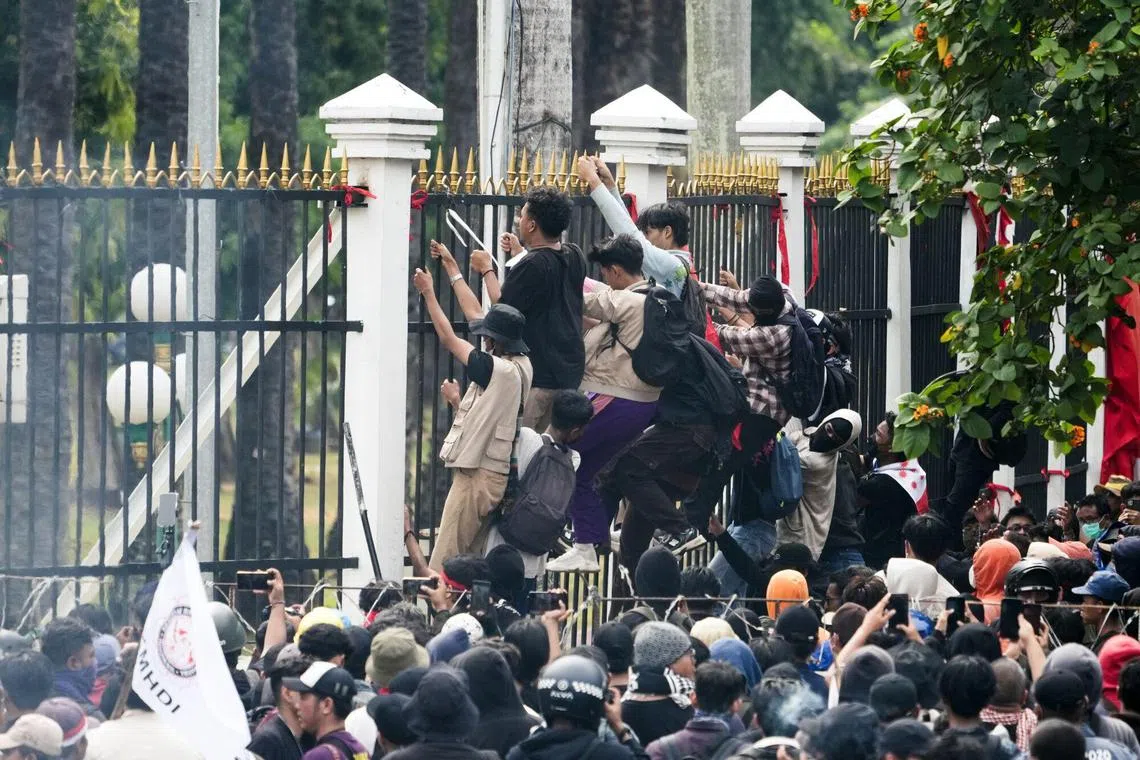
The proposed amendment for Kaesang’s entry into politics sparked significant public backlash on Aug 22 when thousands protested in the streets of Jakarta and other major cities to demand its repeal.
Arya Fernandes, head of the department of politics and social change at the Centre for Strategic and International Studies Indonesia, noted that the protest was a “reflection of the public’s growing frustration” with Widodo’s attempts to establish a political dynasty.
He added: “This is the final test for Widodo as he approaches the end of his term. The question is whether he will be remembered as a defender of the Constitution – or not.”






