


Legal pressures in Vietnam may push Temu to mull a pivot, compete directly with Shopee
The shopping platform may have to include more Vietnam-registered businesses instead of relying only on a direct-from-China supply chain
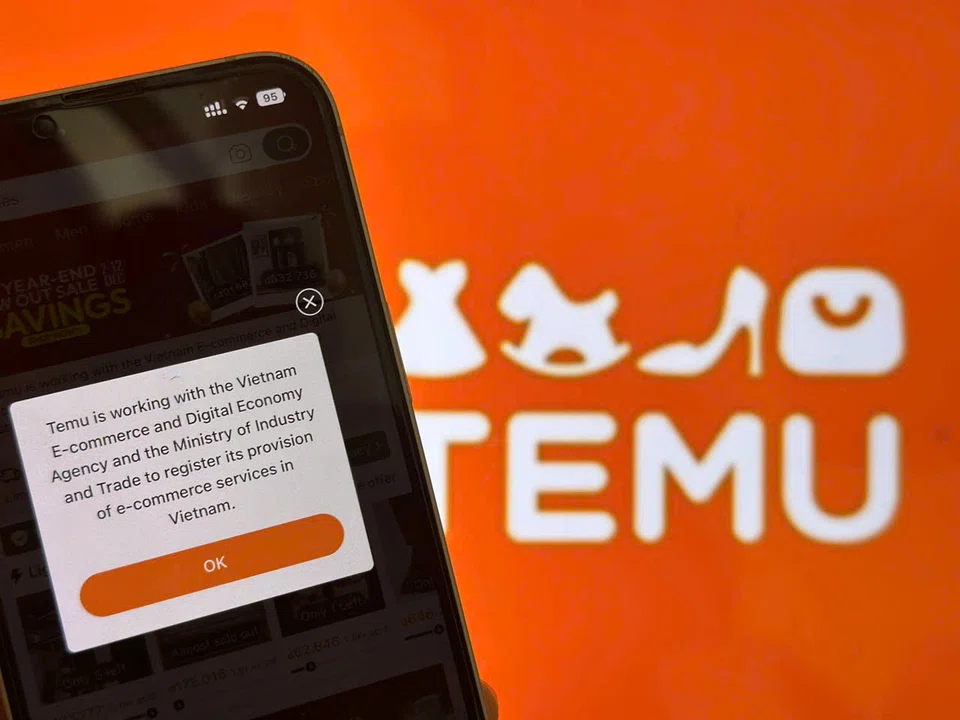
[HO CHI MINH CITY] Cross-border shopping platform Temu is feeling the heat in Vietnam from regulatory hurdles, backlash from local sellers and higher taxes, and may have to pivot from its direct-from-China supply-chain model.
One of its options is to adopt the marketplace model it is rolling out in its largest market, the US, which could put the Chinese e-commerce giant in more direct competition with South-east Asia’s leading e-commerce player, Shopee.
Hanoi suspended Temu’s operations in Vietnam over registration issues a mere month after its debut in October, in its drive to step up scrutiny of local operators of foreign e-commerce platforms.
The pressure comes from both Vietnamese businesses and authorities, who are concerned about the potential sale of counterfeit items and unfair competition initiated by the entrance of major Chinese e-commerce players into Vietnam – the third-largest e-commerce market in South-east Asia.
The heightened regulatory oversight has also hit Shein, a Chinese e-commerce platform for fast fashion, which also temporarily halted the Vietnamese edition of its website earlier this month, after at least two years of operations in the country.
The Vietnamese government is also considering removing tax exemption for low-value imported goods that are bought mainly through online platforms.
Li Jianggan, chief executive at Singapore-based research firm Momentum Works, said: “For Temu to operate effectively and long-term in this market, it probably can’t do everything cross-border.”
He suggested that the Chinese firm may need to operate as a local marketplace, at least in the medium term, just like it does for its other major markets such as the US, Europe, Japan and Korea.
This would entail onboarding merchants registered in Vietnam to sell their goods on its platform, complementing its existing pool of approximately 300,000 sellers, most of whom are based in China, according to estimates by e-commerce intelligence firm Marketplace Pulse.
The model could put Temu in a tighter race with Shopee – the e-commerce marketplace that held a commanding 61 per cent market share in Vietnam last year, much like its rivalry with Amazon in Western markets.
According to the website analytics tool Similarweb, Temu’s website received about five million visits from Vietnam in the past two months, representing 0.37 per cent of its total traffic. This was slightly lower than its performance in Thailand and the Philippines, which recorded over 5.6 million and 6.7 million visits, respectively, in the same period.
Li of Momentum Works said: “Obviously, Temu sees (Vietnam) as promising, and it has the resources and capabilities to enter (the market).”
He estimated that Temu received “a few hundred thousand orders per day” from customers in Vietnam within a month of launching its services, suggesting significant interest in its offerings.
While Temu is gaining traction, products sourced from China have already been popular on Vietnam’s dominant e-commerce platforms.
A March 2023 report by the Vietnam Post Corporation, the country’s postal agency, noted that on average, between four million and five million small-value parcels were being shipped daily from China to Vietnam via platforms like Shopee, Lazada, Tiki, and TikTok Shop.
Vietnamese Gen Z consumers are showing a growing preference for high-quality, made-in-China products at affordable prices, noted Nguyen Phuong Lam, head of market insights at YouNet ECI, in a call with journalists last month.
He identified innovative purchasing options such as group buying – yet to catch on in Vietnam’s e-commerce scene – and consumer-friendly pricing as Temu’s strengths.
However, he added: “The challenge for Temu remains in the quality of shopping experiences and after-sales service it offers to meet the expectation of Vietnamese customers.”
Warehouses in China
A key driver of Temu’s rapid growth since its founding in 2022 is its full-consignment model. Under this approach, Chinese manufacturers agree on wholesale prices, often through exclusive deals, to supply goods in bulk to Temu’s processing warehouses in China.
The platform handles everything else – from pricing and marketing to operations, fulfilment and after-sales service – to sell Chinese products globally.
Temu’s plan is to build sufficient volume in foreign markets using heavy monetary incentives to attract shoppers, and then to diversify its business model down the road to achieve more sustainable growth.
In the US, for instance – where it aims to sell US$20 billion to US$25 billion in goods this year, or a third of its global sales target – the platform set up onshore warehouses and launched a marketplace in April, attracting sellers with local inventory to get on board.
With this model, US sellers can use their own local warehouses or ship goods to Temu facilities in the country, and get them delivered to shoppers. The platform thus reduces its reliance on duty-free shipments of low-value orders, and can offer faster delivery and lower supply chain risks.
M&A play
The Business Times learnt that Temu was in talks in the past few months to acquire the warehousing and logistics units of a major Vietnamese e-commerce player, suggesting the firm’s preparation for a similar model it is adopting in the US. However, legal challenges were said to have stalled the discussions.
This is not the first time a Chinese powerhouse has eyed an acquisition to expand its footprint in the emerging South-east Asian e-commerce market.
Alibaba acquired a majority stake in Lazada in 2016; earlier this year, TikTok completed its merger with Indonesian shopping site Tokopedia, two months after being banned by Jakarta.
Li said: “If external parties see that your operations are fully suspended in one country, and you don’t turn it around, I think you will face more pressure in other countries.”
Temu said that it submitted all the required documents to the Vietnamese authorities, but no definite time frame has been given for the resumption of operations, Reuters reported.
Vietnam recorded an 18 per cent rise in total online merchandise value between 2023 and 2024, said a recent report by Google, Temasek and Bain & Company.
The country’s e-commerce market is expected to grow to about US$63 billion in 2030, from US$22 billion this year; it is expected to beat second-placed Thailand in the region by the end of this decade. Indonesia is expected to stay in pole position in 2030, with a total online merchandise value of US$150 billion.
Direct competition with Shopee
Half-consignment – a combination of a marketplace and a full-consignment model – has proven to be more efficient for Temu’s next growth stage, Li said.
However, he said that if Temu uses this model, it may not be able to scale as fast in Vietnam, given Shopee’s established dominance.
Temu’s value proposition to low-middle-income or young customers is also less obvious in these developing countries than in the more affluent and bigger markets in the West.
Both Temu and Shopee are very efficient, Li said, which makes the competition dynamics hard to predict in the coming period.
Momentum Works estimated in September that Temu was close to reaching breakeven point for its Ebitda (earnings before interest, taxes, depreciation, and amortisation). Shopee reported its profits in the third quarter of this year.
The two players can also tap into the capital market to fuel their growth, thanks to their respective deep-pocket backers, Nasdaq-listed Chinese commerce group PDD Holdings and New York Stock Exchange-listed Sea.
“One big advantage for Shopee is that it is South-east Asia-focused,” added Li, referring to the resources the platform put into resolving problems in its regional backyard.
Over the past years, Shopee has deployed extensive programmes in Indonesia and Vietnam to support micro, small and medium-sized enterprises to enhance their e-commerce capabilities.
Such education efforts, however, do not guarantee that manufacturers and merchants will go exclusive with a platform once they get the hang of online selling.
While Shopee remains the top player with a 48 per cent share in the region, its two China-backed rivals Lazada and TikTok Shop are nipping at its heels.
Damien Yeo, a consumer industry analyst at global insights consultancy BMI, noted that there is now little differentiation among the retail experiences provided by these major players in the fray.
“Until (further differentiation happens), the cross-border e-commerce market will remain fragmented with unloyal consumers who jump to whichever platform is offering vouchers at the moment, which is inherently an unsustainable business model,” he said.
TRENDING NOW
Fed hike throws Singapore banks a margin lifeline; UOB likely to benefit more
He built the Vingroup empire. Now South-east Asia’s richest man is handing some key roles to his sons
Chagee, Mixue and Luckin won the market. Sustaining their edge is the harder part
Canada is upping oil flows to Asia, but South-east Asia’s refineries aren’t ready to handle them yet



