



Malaysia central bank keeps interest rate at 3%
Bank Negara notes that the current overnight policy rate level remains supportive of the economy and is consistent with the current assessment of inflation and growth prospects


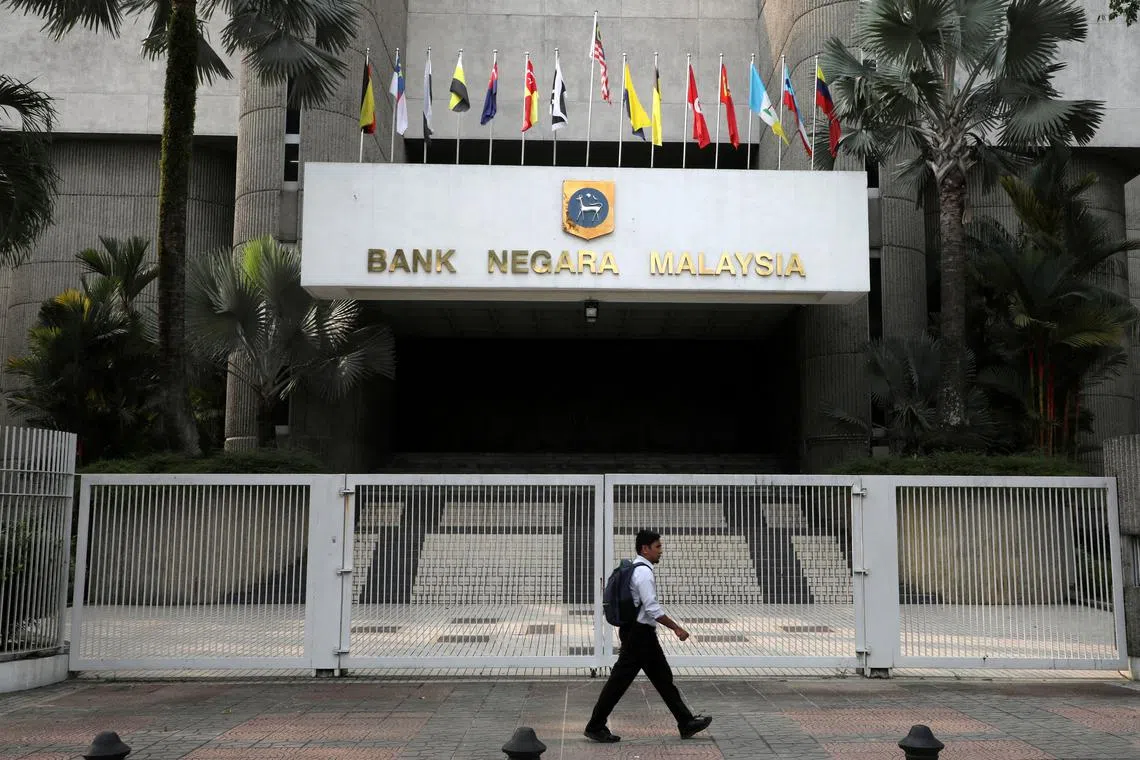
[KUALA LUMPUR] Bank Negara Malaysia held its benchmark overnight policy rate (OPR) steady at 3 per cent on Thursday (Sep 5), a widely expected move by economists amid a buoyant outlook on the country’s economic growth, inflation and ringgit performance.
All 30 economists in a recent Reuters poll anticipate that the central bank will keep the OPR at 3 per cent at least till 2025, while some of them expect the rate to stay unchanged until 2026, citing robust economic growth and manageable inflation as key factors influencing this decision.
Bank Negara last adjusted the OPR in May 2023, concluding a year-long tightening cycle that resulted in a total increase of 125 basis points.
In a statement on Thursday, the central bank said the current OPR level remained supportive of the economy and is consistent with the current assessment of inflation and growth prospects.
Both headline and core inflation averaged 1.8 per cent for the first half of 2024, said Bank Negara, noting that the spillovers from the diesel subsidy removal “have been contained” due to effective mitigation and enforcement measures.
“For the full year, average headline and core inflation are expected to remain within the earlier projected ranges and are unlikely to exceed 3 per cent,” said Bank Negara.
The central bank’s headline inflation forecast remained at between 2 per cent and 3.5 per cent. Core inflation is expected to range between 2 per cent and 3 per cent.
A report co-authored by Standard Chartered Bank economists Edward Lee and Jonathan Koh said that July’s inflation was benign, reflecting limited impact from earlier diesel subsidy removal, likely because of its targeted nature.
“We maintained our view that Bank Negara will stay on hold for the rest of the year, while noting that risks are biased more towards a rate hike than a rate cut,” said Lee and Koh.
Nevertheless, the central bank emphasises that the inflation outlook is highly dependent on the implementation of additional domestic policy measures. One key measure that is being closely watched is the potential removal of RON 95 petrol subsidies, which will significantly impact inflation.
Growth prospect remains strong
For 2024, the central bank expects the growth momentum to persist, supported by resilient domestic expenditure, increased export activity, strong tourist spending and robust expansion in investment activities.
“The global economy continues to expand amid resilient labour markets and continued recovery in global trade. Looking ahead, global growth is expected to be sustained by positive labour market conditions, moderating inflation and less restrictive monetary policy,” said Bank Negara.
Earlier, Bank Negara governor Abdul Rasheed Ghaffour reiterated that Malaysia’s full-year gross domestic product growth may reach the upper end of its previous projection, which ranges between 4 and 5 per cent.
The country’s GDP expanded 5.9 per cent in the second quarter, the fastest pace in 18 months, thanks to strong household spending, improved exports and investments.
This indicates that a rate cut from the central bank at this time is unnecessary and could lead to inflationary pressure.
RHB Research economist Chin Yee Sian said that given the manageable inflation pressures and stable economic prospects, there is a lack of impetus for the central bank to adjust the OPR. “For the remainder of 2024, we expect both external and internal drivers will drive the growth, with further acceleration in trade and manufacturing activities,” she added.
Ringgit strengthening ahead of Fed rate cuts
Bank Negara noted that the recent recovery in the ringgit is driven by the shift in expectations of lower interest rates in major economies, particularly the United States, as well as Malaysia’s strong economic performance.
The Malaysian currency strengthened about 6 per cent this year, driven by rising expectations that the US Federal Reserve may cut interest rates as soon as this month, which has weakened the US dollar.
As at Thursday 3.30pm, the ringgit traded at 4.3342 against the US dollar, representing a 5.6 per cent increase from 4.5892 in the beginning of the year. Against the Singapore dollar, the ringgit traded at 3.3280, reflecting a 4.3 per cent rise compared to 3.4778 on Jan 1.
“Looking ahead, Malaysia’s positive economic prospects and domestic structural reforms, complemented by ongoing initiatives to encourage flows, will continue to provide enduring support to the ringgit,” said Bank Negara.
UOB economists Julia Goh and Loke Siew Ting expect Bank Negara to extend the rate pause till 2025, and foresee a stable OPR at 3 per cent will provide support to the ringgit.
UOB forecasts the ringgit to trade at 4.28 against the US dollar in the fourth quarter of 2024, and continue to strengthen to 4.24 in the first quarter next year.
TRENDING NOW

Government to bring forward raising of retirement age, give employers more financial support to create flexi-load jobs

Indonesia stocks suffer worst plunge in nearly 30 years as MSCI proposes standalone status

If Europe goes to war, the fallout will be felt in East Asia

Natural gas to stay for the long haul beyond 2050: Singapore International Energy Week panellists

