Malaysia faces delicate balancing act as it prepares to lead Asean in 2025
The country is taking the reins at a time when its economy has fared reasonably well despite global uncertainties

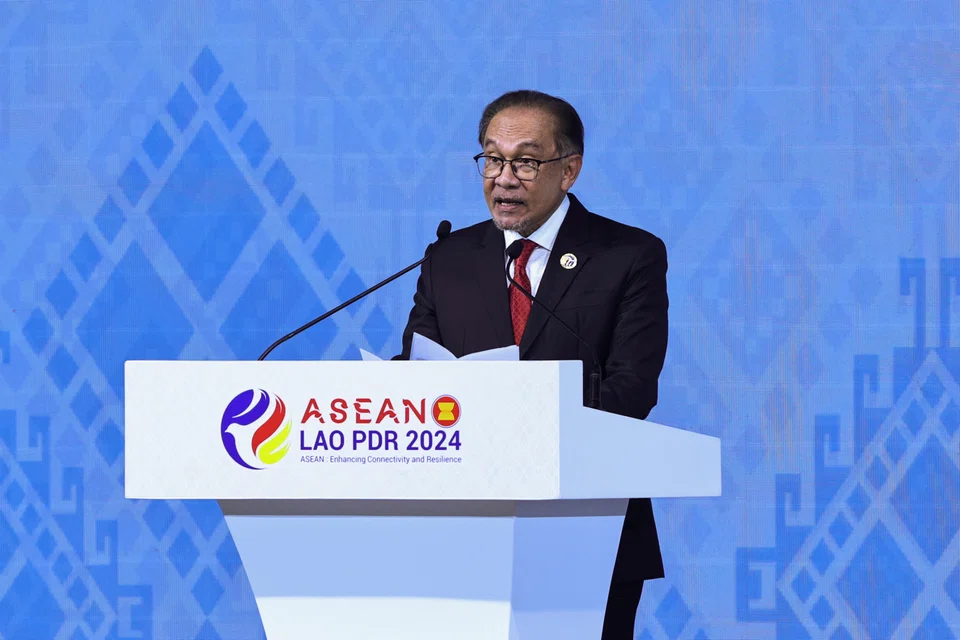
[KUALA LUMPUR] On the first day of 2025, Malaysia will formally assume the chairmanship of the 10-member Association of Southeast Asian Nations (Asean) bloc.
The country takes the helm at a time of great uncertainty in the region and beyond. Donald Trump will soon be sworn in for a second term as US president on Jan 20; the Myanmar crisis shows no signs of easing; there are still ongoing tensions in the South China Sea; and there is a greater need for Malaysia and Asean to balance competing interests and manage relations with the US and China.
Ahead of becoming chair, Malaysia Prime Minister Anwar Ibrahim raised some eyebrows with the appointment of former Thai prime minister Thaksin Shinawatra as an informal adviser.
The pair met on Thursday (Dec 26) and discussed various topics such as the urgency of fostering peace in southern Thailand and dealing with the civil war in Myanmar.
“Thaksin’s unparalleled network of relationships across the region, coupled with his unique expertise, promises to open invaluable opportunities for Malaysia and Asean to address these challenges with greater confidence and efficacy,” Anwar wrote on Facebook shortly after their meeting.
Rahman Hussin, senior partner of public policy consultancy firm Agyl & Partners, said that Anwar’s pragmatic diplomatic approach, especially regarding China’s Belt and Road initiative, could yield trade and infrastructure benefits.
“However, such cooperation requires delicately balancing Western apprehensions over China’s expanding role in the South China Sea and beyond,” he told The Business Times.
On the security front, observers noted that Asean’s unity will be tested, as Malaysia’s tilt towards China could alienate front-line states that are advocating for a stronger stance on territorial disputes.
Malaysia’s engagement with the Brics nations – which collectively account for nearly 28 per cent of the world’s gross domestic product – introduces another dimension to its economic strategy.
Leveraging financing avenues such as the New Development Bank may support sustainable infrastructure projects across Asean, though consensus-building among member nations remains a hurdle, said Rahman.
He noted that aligning Brics’ green technology initiatives with Malaysia’s sustainability goals could bolster Anwar’s vision of inclusive growth.
“As it moves towards its 2025 Asean chairmanship, Malaysia’s ability to foster regional cooperation, maintain neutrality and encourage sustainable development will profoundly shape not only its own future, but also the strategic direction of South-east Asia as a whole,” said Rahman.
Economic resilience
Malaysia takes charge of Asean at a time when the country’s economy has fared reasonably well despite global uncertainties. Growth in the third quarter of 2024 stood at 5.3 per cent. Various brokerages have said that full-year growth will be at least 5 per cent, which would be within the government’s official projection of 4.8 to 5.3 per cent.
Market observers said that emerging sectors, particularly semiconductors and data centres, are positioned to drive growth further as the country capitalises on reshoring efforts away from China.
Robert Gilhooly, a senior emerging markets economist at abrdn, said Malaysia is unlikely to be directly targeted by the new Trump administration due to its small trade deficit with the US.
“Malaysia could emerge as Asean’s largest data centre hub, fostering competition and geopolitical neutrality while reducing red tape and promoting a more open domestic industry,” he said.
Trinh Nguyen, senior economist for emerging Asia at Natixis Corporate and Investment Bank, said the ongoing US-China strategic rivalry creates both opportunities and risks for Malaysia.
She pointed out Malaysia’s role in the high-tech supply chain, particularly in artificial intelligence and semiconductors, as a key driver of its investment appeal.
Rajiv Batra, head of Asia-Pacific (excluding Japan and China) equity strategy at JPMorgan, anticipates increasing challenges from Trump’s war on tariffs, which could weaken exports and lead to regional currency depreciation.
However, he sees a positive outlook for Malaysia in 2025, driven by resilient domestic consumption supported by steady policy reforms and political stability, and given the fact that the next general election is not due until the later part of 2027.
Rising investments
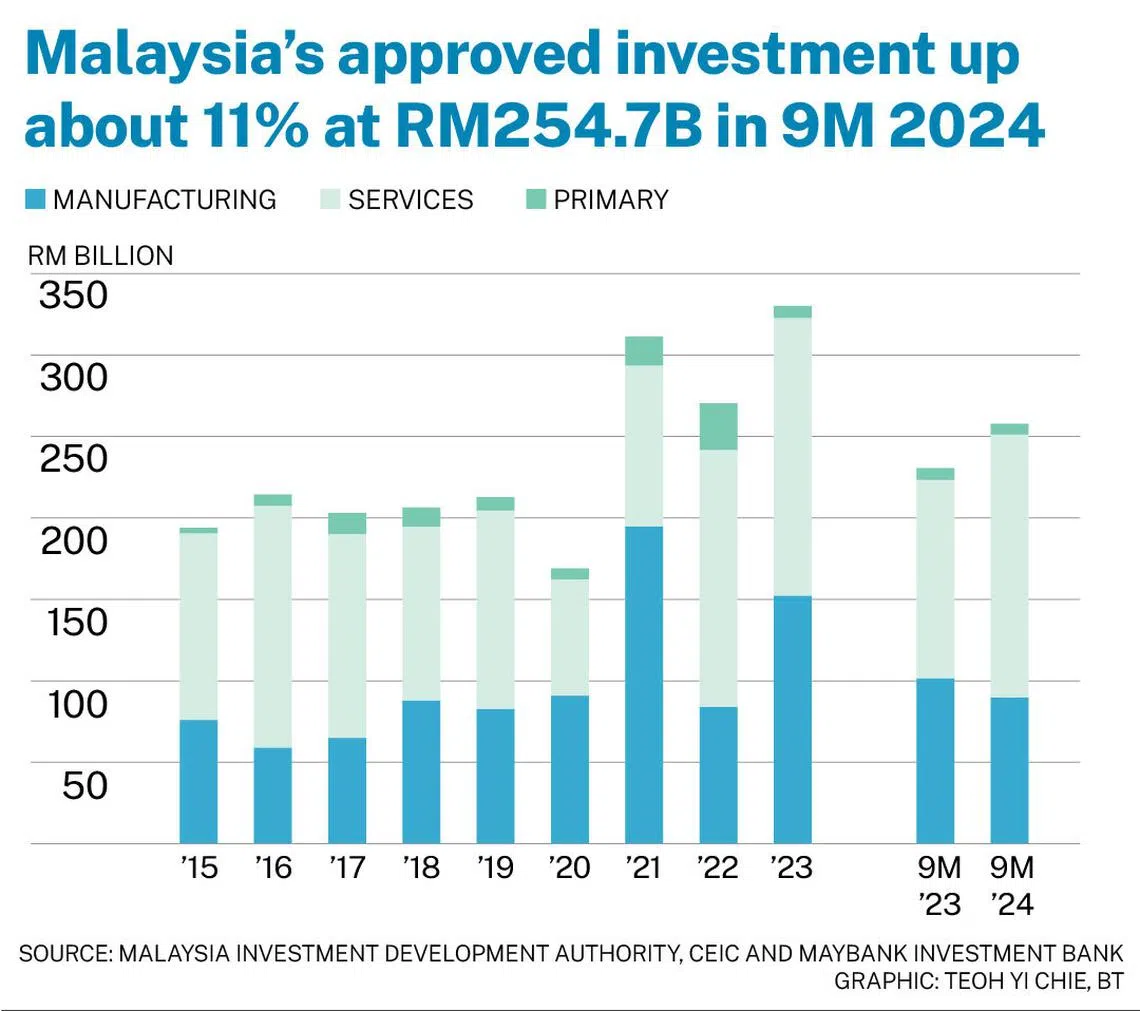
In the first nine months of 2024, approved investments in the country reached RM254.7 billion (S$77.4 billion), a nearly 11 per cent increase compared to the same period a year ago.
New projects across manufacturing and services are expected to generate over 159,000 jobs, according to latest data.
The new Johor-Singapore Special Economic Zone – set to launch in January 2025 – is anticipated to create up to 100,000 new jobs in Johor and contribute US$26 billion per year to the Malaysian economy for the next six years, Johor officials said.
Maybank Investment Bank said in a recent report that the country is currently in its third investment upcycle, as sustained investment momentum since 2021 translates into rising realised investment.
“This has (been) reflected in the uptrends in the implementation rate of approved manufacturing investment, imports of capital goods, banking system loans for industrial buildings, factories and lands, as well as corporate earnings,” the report said.
These measures include salary increments for civil servants and pension reviews involving an additional allocation of RM12.3 billion, enhancements in personal income tax relief and an increase in the monthly minimum wage to RM1,700 (from RM1,500).
Equity market outlook and currency trends

The resilience of Malaysia’s equities market amid global volatility bodes well for 2025, said observers.
MIDF Research has predicted a 9 per cent year-on-year earnings increase for the FTSE Bursa Malaysia KLCI, thanks to stronger domestic consumption and steady policy reforms.
JPMorgan’s Batra recommended focusing on defensive, domestically driven sectors such as healthcare and consumer goods, which are likely to perform better amid external pressures.
He highlighted that the country’s proactive measures in cutting subsidies and redirecting savings towards productive economic uses will bolster growth.
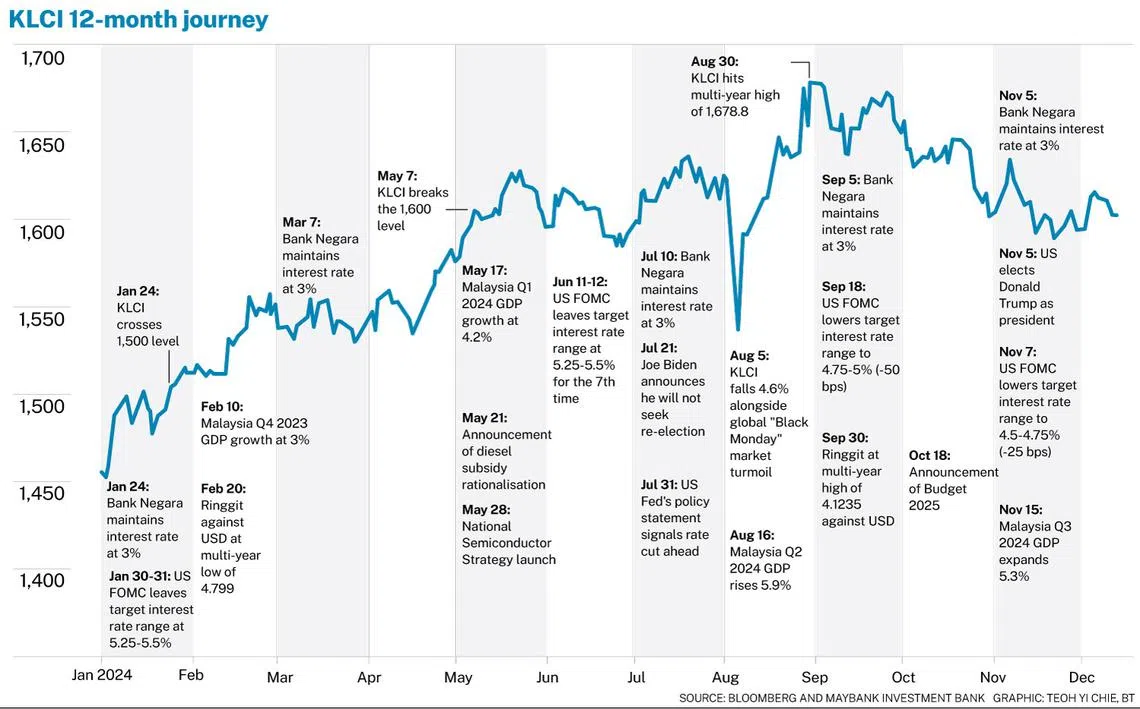
On the monetary front, market observers said Bank Negara is likely to maintain the overnight policy rate at 3 per cent throughout 2025.
As for the Malaysian ringgit, CGS International said the currency is poised to record its first meaningful gain since 2017, reversing years of depreciation against the US dollar.
The research firm expects ringgit’s exchange rate to strengthen to RM4.25 against the greenback in 2025.
As at Dec 30, the ringgit traded at 4.4702 versus the US dollar. The Malaysian currency appreciated nearly 2.6 per cent against the greenback, rising from 4.5892 at the beginning of the year.
MIDF Research expects the ringgit to strengthen in 2025, in view of policy changes and anticipation of risk-on fund flows to the local market. Against the US dollar, the research firm forecasts the Malaysian currency to average RM4.23 in 2025, stronger than the estimated average of RM4.56 this year.