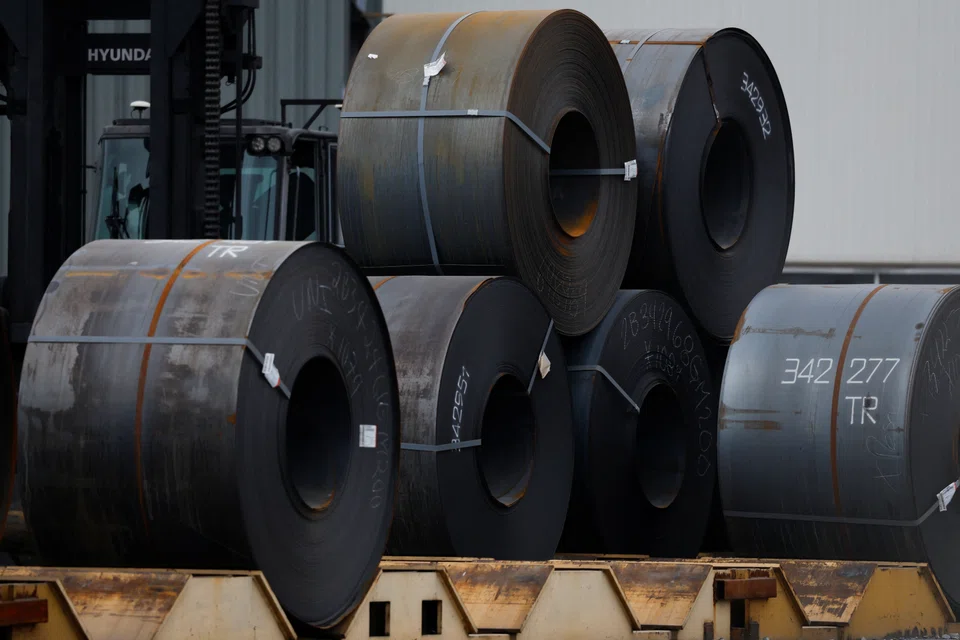
Malaysia faces potential steel import surge amid US tariff uncertainty
The country could become a key destination for the excess steel previously bound for the US, its iron and steel industry association says

[KUALA LUMPUR] The Malaysian steel industry is bracing itself for a potential influx of cheap steel imports, following the uncertainty surrounding the impact of a 25 per cent tariff on all steel and aluminium imports into the United States, said the Malaysian Iron and Steel Industry Federation (MISIF) on Wednesday (Feb 12).
The sweeping policy, recently announced by US President Donald Trump, takes effect on Mar 4. There are no exemptions for any country.
MISIF said that this move is likely to accelerate trade diversion, with Malaysia becoming a key destination for the excess steel that was previously bound for the US.
It added that countries such as Korea, Japan and Vietnam may now look to Malaysia as an alternative export market. “Vietnam and Japan, in particular, have free and direct access under existing free-trade agreements, making it even easier for their products to enter the local market,” it noted.
For years, China has leveraged countries such as Canada, Mexico, Brazil and Vietnam to bypass US tariffs.
In response, several North and South American countries have introduced their own tariffs over the past six months to curb the influx of Chinese steel products. However, significant damage has been done. This has led the US to revoke prior exemptions and exceptions granted to these countries.
With the introduction of new tariffs and their extension to downstream goods, these markets are no longer viable export destinations for China and countries – such as Korea, Japan and Vietnam – which previously benefited from exceptions or quotas.
Regional responses
Other Asean countries have taken pre-emptive steps to protect their domestic industries. Vietnam and Indonesia imposed anti-dumping tariffs on Chinese steel, while Thailand has introduced measures to monitor low-cost imports.
These measures make Malaysia an attractive alternative for exporters seeking new markets. MISIF urged the Malaysian government to act swiftly to prevent long-term damage to its domestic industry. It warned: “Without immediate and decisive action, Malaysian steel manufacturers will suffer irreversible harm.”
The industry association called for stronger anti-dumping regulations, faster investigations and immediate protective measures to shield local producers from unfair competition.
MISIF noted that the iron and steel sector plays a vital role in Malaysia’s economy, supporting key industries such as infrastructure, construction and manufacturing. It added: “We remain committed to working closely with policymakers to safeguard the domestic steel industry and ensure fair market practices.”
Earlier this year, Malaysia imposed provisional anti-dumping duties ranging from about 2.5 per cent to 36.8 per cent on some flat-rolled iron products or non-alloy steel imports from China, India, Japan and South Korea.
On Feb 5, the country’s Ministry of Investment, Trade and Industry expanded these duties to include stranded steel wires for prestressed concrete from China, levying a 21.72 per cent tariff.
In 2023, China exported 45,004 tonnes of flat steel products to Malaysia, accounting for nearly 56 per cent of the South-east Asian country’s imports – a 46 per cent increase from 2022, S&P Global Trade Analytics Suite showed.
TRENDING NOW
Grab CEO’s wife Chloe Tong on life with Anthony Tan and finding her purpose
Income Insurance appoints former Manulife Singapore top man as new CEO
Incidence of civil servants buying property near unannounced MRT stations ‘a concern’, but may not establish misconduct: PSD
Three ex-employees of Envy group join Ng Yu Zhi in bankruptcy