Malaysia PM Anwar’s 2026 Budget balances growth and fiscal restraint
It underscores a shift towards fiscal consolidation, anchored by wider public-sector coordination

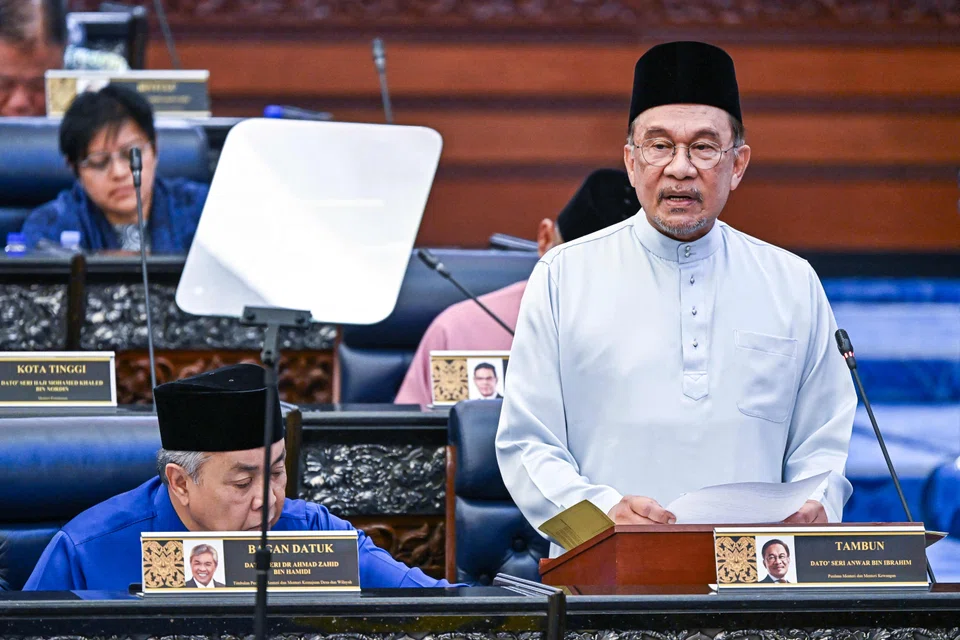
[KUALA LUMPUR] In his boldest fiscal move yet, Malaysia Prime Minister Anwar Ibrahim has tabled a record RM470 billion (S$144.5 billion) Budget to propel the country into the next phase of its development agenda.
Framed as the opening chapter of the 13th Malaysia Plan, Budget 2026 reflects Anwar’s determination to reshape national growth through innovation, regional integration and stronger fiscal discipline.
The government’s latest spending plan marks Malaysia’s largest to date, strategically drawing funds from across the public sector – including government-linked investment companies (GLICs), statutory bodies and ministerial-controlled firms – to fuel its transformation agenda.
Out of the RM470 billion allocation, RM338.2 billion will go to operating expenditure, RM81 billion to development projects, and another RM50.8 billion through investments mobilised from GLICs, public-private partnerships and federal entities.
Anwar, who also serves as finance minister, described the Budget as “not just an annual financial plan, but a historic compass for the era ahead”. He called it a “Fourth Madani Budget”, signalling a blueprint for comprehensive national rejuvenation anchored in fiscal integrity and shared prosperity.
Growth outlook amid global headwinds
According to the Ministry of Finance’s Economic Outlook 2026, Malaysia’s economy is projected to grow between 4 and 4.5 per cent next year, supported by steady domestic demand and government reforms.
Growth slowed to 4.4 per cent in the first half of 2025 from 5.1 per cent a year earlier, largely due to softening exports. The ministry warned that the full-year impact of US tariffs could weigh on Malaysia’s trade performance in 2026, particularly for the electronics and electrical sector, which accounts for about 40 per cent of exports.
Malaysia ranks sixth globally in semiconductor exports, contributing 7 per cent to the global market. While US tariffs currently exempt semiconductors from Malaysia, those privileges could be lifted under national security reviews – a move that may disrupt supply chains and dent competitiveness.
Despite external risks, Anwar reiterated that his administration remains committed to fiscal discipline.
“We reject the culture of uncontrolled debt accumulation. We fight against leakages and corruption, and we detest the luxury of the elite that is paid for by the suffering of the people,” he said.
Balancing discipline with inclusion

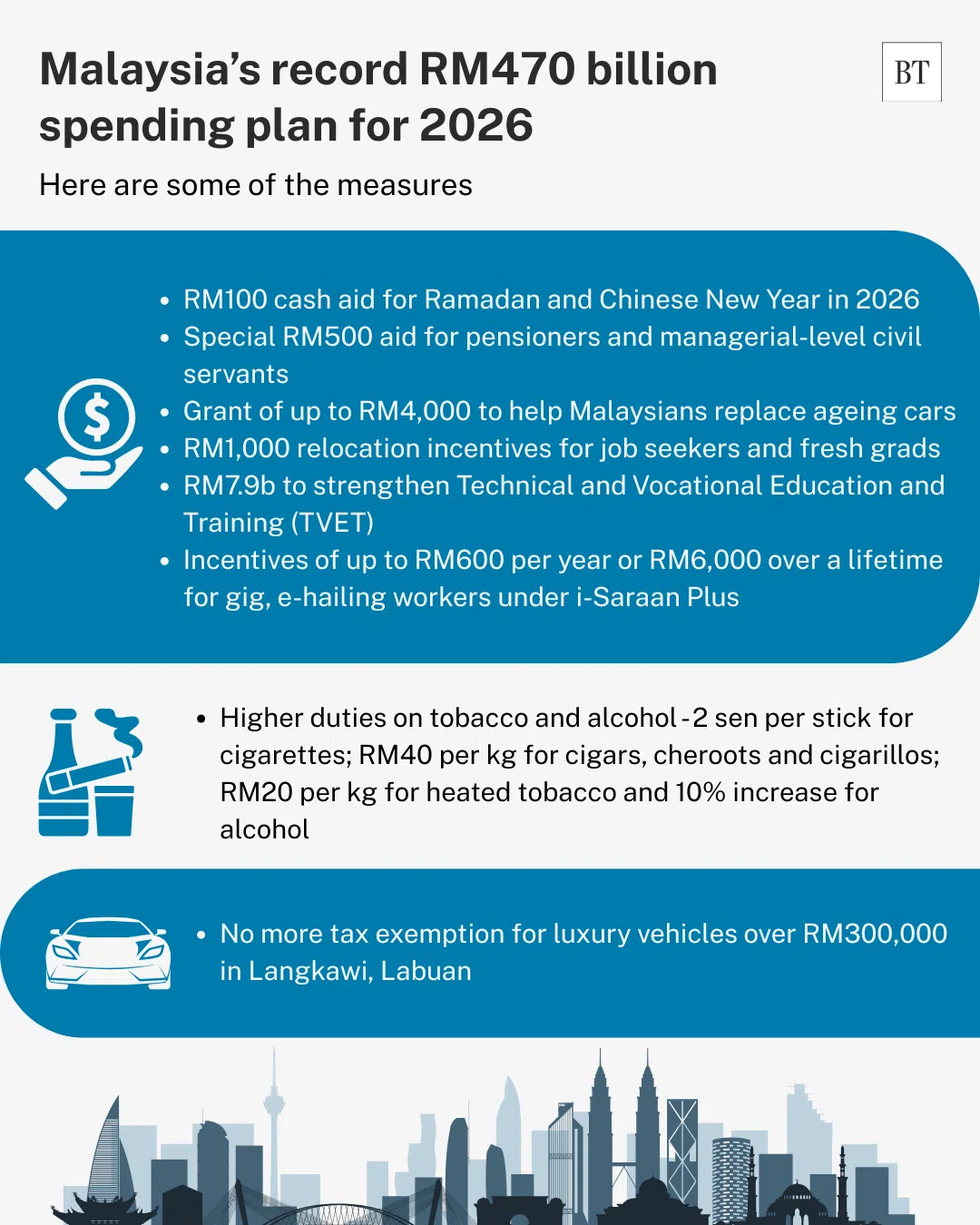
Even as the government reins in spending, Budget 2026 maintains support for households and businesses. Lower-income groups will continue to receive direct aid, while 22 million Malaysians will benefit from a one-off RM100 cash handout under the Sara Scheme, which will start in February 2026.
Anwar has sought to frame these measures as part of a broader national renewal, balancing social protection with structural reform. Analysts view the approach as both prudent and forward-looking.
Patrick Tay, deals partner, economics and policy at PwC Malaysia, described Budget 2026 as a well-disciplined and fiscally prudent one, which is much needed.
“The slightly contractionary stance complements monetary policy, by supporting moderate economic growth without exacerbating the cost-of-living pressures faced by the Malaysians,” he told The Business Times.
Arshad Mohamed Ismail, chief executive officer of Malaysian Rating Corp, said the decision to slightly reduce development expenditure to RM81 billion reinforces fiscal prudence and strengthens the government’s commitment to efficiency. “This measured stance highlights the ever-growing need for private participation in national development.”
He noted that frameworks like the Public-Private Partnership Master Plan 2030 create room for the private sector to act as partners in execution, innovation and delivery, and not just as financiers.
Under Anwar’s administration, Malaysia’s annual Budgets have steadily grown: RM388.1 billion in 2023, RM393.8 billion in 2024, and RM421 billion in 2025.
However, this overall increase is paired with a continuous effort towards fiscal prudence, as development spending is set to trend lower to RM81 billion, down from RM86 billion in the previous Budget.
Fiscal consolidation without austerity
Bank Muamalat’s chief economist, Mohd Afzanizam Abdul Rashid, said the government’s focus on narrowing fiscal deficits – from 3.8 per cent of gross domestic product in 2025 to 3.5 per cent in 2026 – would stabilise debt levels while keeping growth intact.
He pointed to three initiatives likely to have a meaningful impact: loan guarantees for micro-entrepreneurs, tax incentives for agri-food players, and cash transfers for vulnerable groups.
Although fiscal policy remains expansionary, Dr Mohd Afzanizam said the smaller scale of spending reflects the government’s intent to sustain discipline while supporting productivity-driven growth.
Investing in digital and green frontiers
A major focus of the Budget lies in innovation and technology. RM53 million will be channelled through the Malaysia Digital Acceleration Grant to advance frontier technologies such as blockchain, artificial intelligence (AI) and quantum computing.
The Malaysian Communications and Multimedia Commission will receive RM2 billion to establish a sovereign AI cloud, enhancing the country’s digital sovereignty and competitiveness.
Samuel Tan, CEO of Olive Tree Property Consultants, said such initiatives will “catalyse new opportunities in high-value industries” and spur business activity within the Johor-Singapore Special Economic Zone.
Prior to the Budget announcement, market observers viewed it as a pre-election manifesto for the upcoming Sabah state election in December.
Reflecting this focus, Anwar announced that Sabah and Sarawak are receiving the highest federal allocation in the Budget.
Sabah’s development allocation increased significantly to RM6.9 billion (up from RM4.4 billion in 2022), while Sarawak’s rose to RM6 billion (up from RM2.9 billion in 2022). Furthermore, the Special Grant for both states was doubled in this year’s Budget to RM600 million.
Strengthening governance and regional connectivity
Fiscal integrity and institutional reform are key pillars of Anwar’s administration. CEO of OCBC Malaysia Tan Chor Sen said the introduction of the Fiscal Responsibility Act and the proposed Government Procurement Act will enhance transparency and accountability – both critical to attracting foreign investment.
He noted that the Budget’s regional strategy, including the Asean Power Grid and Asean Business Entity status, positions Malaysia to deepen trade and talent flows across South-east Asia, strengthening its role as a bridge economy.
OCBC senior Asean economist Lavanya Venkateswaran said the government’s growth assumptions were realistic, with GDP forecast at 4 to 4.5 per cent, and inflation between 1.3 and 2 per cent.
She cautioned, however, that declining global commodity prices and reduced Petronas dividends may pressure non-tax revenue.
To offset this, the government plans to introduce higher excise duties on cigarettes and alcohol, and a carbon tax on industries including iron, steel and energy starting November 2025.
A Budget of renewal and resolve
Market observers said that Budget 2026 may not deliver immediate stimulus, but it signals a strategic pivot – from expansionary recovery spending to disciplined, future-oriented investment.
PwC’s Tay noted that the Budget prioritises long-term economic competitiveness, benefiting investors and employees in high-value and high-impact sectors.
“It also benefits the people in Malaysia, who can expect higher incomes, a fairer distribution of income, increased social protections, and meaningful progress on climate change mitigation and adaptation,” he added.
Christina Tee, president of the Malaysian International Chamber of Commerce and Industry, said that Budget 2026 reaffirms the government’s commitment to inclusive and sustainable nation-building as Malaysia continues to navigate global uncertainties.
“The combination of targeted fiscal incentives, human capital development and provisions in enforcement lays the groundwork for long-term economic strength and stability.”