



Malaysia PM Anwar’s first budget on Friday: Five things to watch out for
Tan Ai Leng
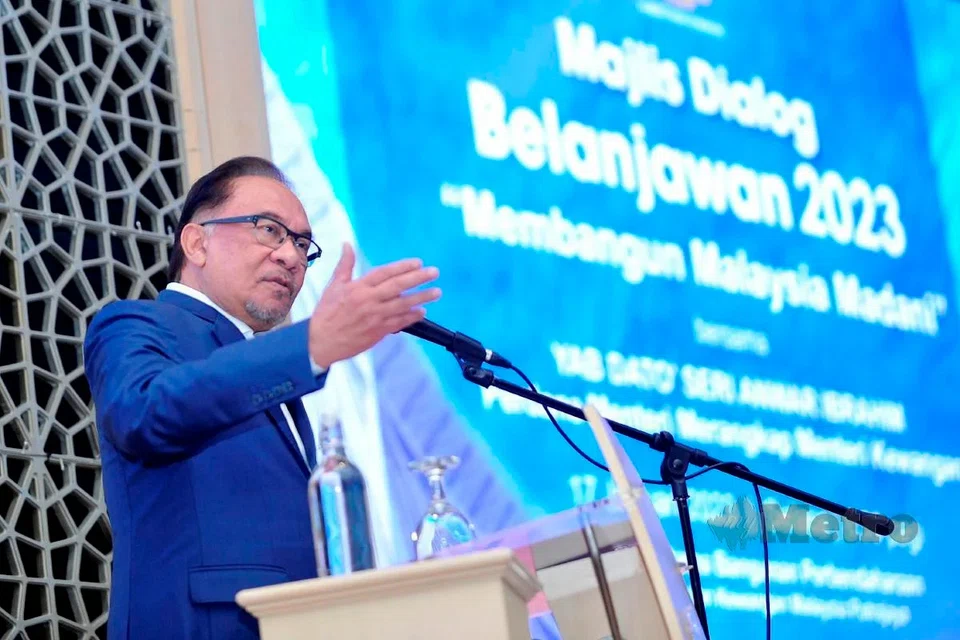
[KUALA LUMPUR] On Friday (Feb 24), Malaysia Prime Minister Anwar Ibrahim, who is also the finance minister, will unveil the unity government’s first budget in parliament.
The high cost of living, escalating core inflation, and an expectation of slower economic growth this year are the main challenges for Malaysia this year. The country is also still recovering from a damaging political crisis that began in 2020 and resulted in the change of two coalition governments and four prime ministers in just three years.
All eyes are also on whether Anwar will introduce any new policies or measures that will give some insight into Malaysia’s future economic direction.
This Friday’s budget takes place four months after former finance minister Tengku Zafrul Aziz had tabled a RM372.3 billion (S$113 billion) budget last October, a few days before parliament was dissolved for a snap general election a month later.
Not long after he took office, Anwar had said that the unity government would review the budget, although he indicated that most of the proposals would likely remain intact. His government has since approved a “mini budget” of RM107.7 billion in December to allow essential government services to continue without interruption.
Here are five things to watch out for in budget 2023:
More cash handouts, but subsidies could be reduced
The unity government has repeatedly stressed that it will take on cost-of-living issues. Therefore, handouts and financial aid are expected to dominate budget 2023.
The earlier budget tabled by Zafrul included an allocation of RM7.8 billion in cash aid for low-income households and individuals.
Nazmi Idrus, the head of economics at CGS-CIMB, thinks Anwar could introduce an “assistive basic income” to households earning below RM2,200 a month. Such a move would benefit as many as 700,000 households, he said.
For decades, Malaysians have enjoyed blanket subsidies for everything from fuel, cooking oil and electricity, to basic food items such as sugar, eggs and flour. The government spends nearly RM78 billion on subsidies a year, with about half (RM38 billion) allocated for fuel subsidies alone.
RHB Research chief economist and head of market research Sailesh K Jha said an adjustment of the fuel subsidy is expected to be on the cards in the revised budget 2023 to bring spending down.
However, Nazmi noted that the high inflation and the erosion of consumer spending power may force the government to continue providing larger support measures, including subsidies for food-related items.
Malaysia’s headline inflation increased to 3.3 per cent in 2022, compared with 2.5 per cent in 2021. Core inflation – which excludes volatile items and those with government-administered prices – averaged higher at 3 per cent last year, from 0.7 per cent in 2021, according to Bank Negara.
More focus on the green economy
With Malaysia’s commitment to achieve net-zero emissions by 2050, it is expected that there will be various initiatives brought up to achieve this target, including the introduction of a carbon tax that was first mentioned in last October’s budget.
There could also be incentives for Malaysians to switch to electric vehicles (EVs). At a recent event, Zafrul, who is now the trade and industry minister, said the government is looking into policies that will support the growth of the EV ecosystem, including production and charging facilities.
Currently, the government offers full import, excise and sales tax exemptions for locally assembled EVs until Dec 31, 2025, and full import and excise duty exemptions for imported EVs until the end of 2023.
Industry players are hopeful that there will be more measures that could help push prices of EV cars to under RM100,000 per car.
More infrastructure development?
CGS-CIMB expects development expenditure to remain high at RM95 billion this year – the same as the previous tabled budget – and mainly allocated to existing projects with low potential for readjustments.
These projects include the Pan Borneo Highway, the Johor Bahru-Singapore Rapid Transit System and the East Coast Rail Link Project.
Analysts are also waiting to see if the planned revamp of Subang Airport will be mentioned in Friday’s budget. Last month, Transport Minister Anthony Loke revealed the government’s plan to transform the ageing airport into a premium city airport and regional aviation hub.
If realised, this would go a long way towards beefing up Malaysia’s competitiveness in the aviation sector, with the airport having the potential to become an aircraft servicing and aeronautical centre.
Expanding government coffers
Since the implementation of the goods and services tax is now out of the picture, the unity government may need to resort to other avenues to generate more income, one of which is the imposition of prosperity tax (also known as a windfall tax) on banks.
CGS-CIMB expects the government to lift its tax base through some changes to taxation, such as a sales tax of 10 per cent on online purchases below RM500, a tax on foreign-sourced income, as well as a voluntary disclosure programme for indirect taxes.
Another measure that the government may consider is the adoption of a global minimum effective tax rate of 15 per cent for multinationals as part of an effort to prevent cross-border tax evasion, said CGS-CIMB in a report on Feb 15.
Narrow the fiscal deficit
Recently, Anwar noted that Malaysia is seeking to ramp up the nation’s participation in technology and the green economy, as well as to have a greater focus on helping small and medium-sized enterprises – all while maintaining fiscal discipline in the revised budget.
Looking at Malaysia’s current debt and liabilities – which are at about RM1.5 trillion, or around 5.8 per cent of GDP in 2022 – he said this year’s fiscal position will not be comfortable.
In a research note on Feb 15, Fitch Ratings said that the deficit reductions will be gradual as the government is likely to avoid resorting to unpopular measures to bring in revenue.
The research firm expects the central government’s deficit to reach an annual average of 4.5 per cent of GDP from 2023 to 2025.
CGS-CIMB expects a narrower fiscal deficit of 5 per cent of GDP for this year, as compared to the government’s target of 5.5 per cent, amid improving revenue and strong growth.
Malaysia’s official growth forecast is expected to be between 4 per cent and 5 per cent this year, down from 8.7 per cent in 2022.
TRENDING NOW

Who is Leo KoGuan, the Singapore-based billionaire backing Nvidia’s Jensen Huang?

Demand, tech capabilities position Apac and AI as Skyscanner’s next growth frontiers: CEO Bryan Batista

Higher rates, weaker spending: Is the Philippines entering stagflation?

South-east Asia has lost Nvidia’s best salesman

