Malaysia proposes RM5 billion infrastructure fund for Johor-Singapore SEZ: economy minister
This comes after both countries signed an agreement to jointly develop the zone which aims to attract investments in 11 key sectors such as digital economy, logistics and energy


[KUALA LUMPUR] Malaysia has proposed an initial RM5 billion (S$1.5 billion) infrastructure development fund for the Johor-Singapore Special Economic Zone (JS-SEZ), said Economy Minister Rafizi Ramli at Malaysia Economic Forum 2025 on Thursday (Jan 9).
Speaking at a fireside chat moderated by Maybank Group president and chief executive officer Khairussaleh Ramli, Rafizi explained that the fund was included in Malaysia’s Budget 2025, and is currently under discussion regarding its adequacy and implementation mechanism.
“The fund itself is not the main issue, but the challenge lies in the mechanism due to multiple layers between federal and state governments,” he said.
In an interview with The Business Times, Rafizi noted that the fund size is not limited to RM5 billion. “If the return on investment is sufficiently high, the federal government may consider increasing the fund size,” he added.
The infrastructure fund is designed to enable Malaysia’s Ministry of Economy to directly approve and allocate funds to local councils for developing the necessary infrastructure to facilitate investment.
The application process will be overseen by the Iskandar Regional Development Authority, a unit under the Ministry of Economy.
“By doing so, we expedite the approval and construction processes, thereby speeding up project development and ensuring investor confidence,” added the minister.
At this stage, both countries have agreed on the categories and types of investments, focusing on high-tech and high-value projects that enhance economic complexity and incorporate a high degree of technology and digitalisation.
Rafizi noted that both governments have not decided on specific parameters for the criteria for the approval of the infrastructure fund, such as revenue and return on investment, but this will be addressed in due time.
“We hope that within the next six to 12 months, the JS-SEZ will attract anchor investments, kick-starting infrastructure development and creating an impact that draws in more medium and smaller players,” he said.
The minister added that both governments have engaged with their respective business communities over the past year.
On Malaysia’s side, discussions have taken place with nearly 100 China-based companies, some of which have expressed strong interest in expanding their presence in the JS-SEZ.
“With the signing of the JS-SEZ agreement, we will reconnect with three to four selected potential anchor investors,” he added, but declined to reveal more details.
A unique concept globally
Rafizi noted that the concept of the JS-SEZ is unique globally, as most special economic zones operate under a single jurisdiction. In contrast, the JS-SEZ will function as a unified entity while adhering to the regulations and national policies of two countries.
He expects that processes will need to be harmonised, requiring both governments to align their internal procedures and regulations.
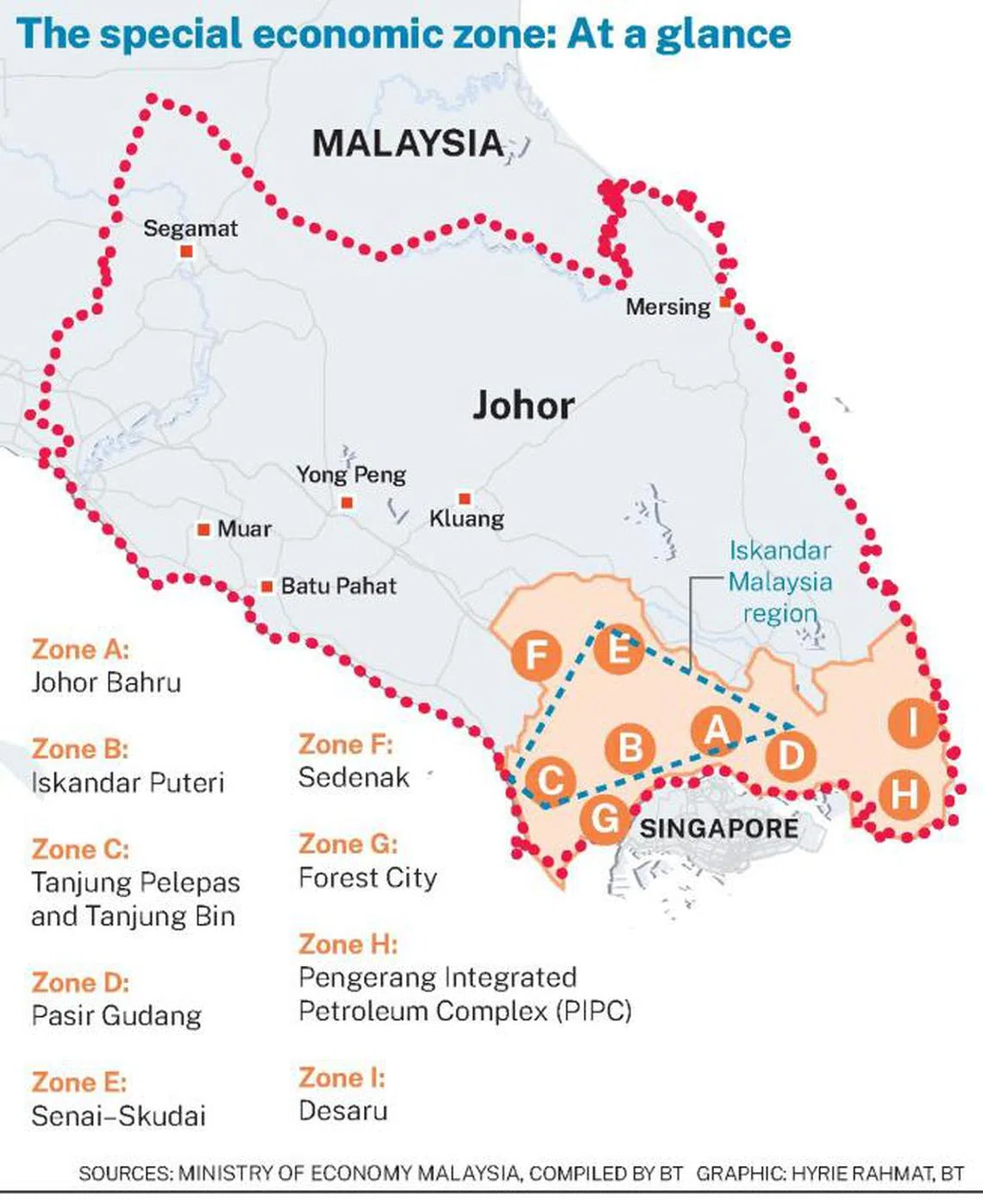
On Monday, Malaysia and Singapore signed an agreement to jointly develop the JS-SEZ, which aims to attract investments in 11 key sectors such as digital economy, logistics and energy.
The initiative is expected to have 50 projects in the next five years, with plans to expand to 100 projects over the next decade.
Under the agreement, Malaysia’s Ministry of Economy will establish a JS-SEZ infrastructure fund to construct the necessary facilities.
Rafizi said that the establishment of the JS-SEZ comes at an opportune time.
“Time is on our side, the stars are aligned, any right-minded leaders in Singapore or Malaysia acknowledge the fact that, given the geopolitical tensions, trade wars, we are better off working together to pitch this region to the world, given the complementary advantages.”
With Asean projected to become the fourth-largest economy in the next 15 years, driven by a youthful and Internet-savvy consumer market, the JS-SEZ is well-positioned to capture this potential, said Rafizi.
“Early estimates suggest that the JS-SEZ could contribute approximately US$28 billion annually to Malaysia’s GDP (gross domestic product) and may rival Klang Valley within the next decade,” he added.
Separately, Malaysian Prime Minister Anwar Ibrahim also outlined the country’s priorities for 2025, highlighting its strategic role in the global economy.
“In 2025, we aim to capitalise on our geographical centrality as a conduit for electricity, talent, and supply chain diversification,” he said, when delivering his opening remarks at the forum.
The country also plans to enhance its expertise in key sectors such as oil and gas, semiconductors, and Islamic finance to achieve global leadership in these fields. “Our neutrality and openness to partnerships make us a natural hub for collaboration,” he added.
Anwar emphasised Malaysia’s regional importance, noting that the establishment of the JS-SEZ is part of the country’s strategy to strengthen partnerships with neighbouring countries.
The construction of the JS-SEZ will serve as a vital focal point for Johor, Singapore and the surrounding areas, he added.