



Malaysia Q3 growth slows; Bank Negara to allow international banks to issue ringgit bonds
The country is on track to achieving full-year growth of between 4.8% and 5.3%: central bank governor


[KUALA LUMPUR] Malaysia’s economy expanded at a slower pace at 5.3 per cent year on year (yoy) in the third quarter, supported by strong investment and improving exports, said Bank Negara Malaysia on Friday (Nov 15).
The final figure aligned with the forecast of 5.3 per cent by 25 economists in a recent Reuters poll and the official advance estimate, but is lower than the 5.9 per cent from the previous quarter.
Mohd Uzir Mahidin, chief statistician at the Department of Statistics Malaysia, noted that robust investment was supported by significant spending on structures and machinery equipment, while household spending continued to grow.
He said exports strengthened due to recovering external demand and gains from the global tech upcycle.
“On the supply side, most sectors remained supportive of growth, in particular the manufacturing sector, although maintenance activities in the mining sector offset this,” he added.
On a seasonally adjusted basis, the gross domestic product rose 1.8 per cent quarter on quarter.
Key drivers

Bank Negara governor Abdul Rasheed Ghaffour is optimistic about the country’s economic growth, highlighting that it is supported by robust investment, improving exports and steady household spending.
From January to September, the economy expanded by 5.2 per cent.
He noted that the latest leading indicators suggest further improvement of the overall economy, and that the country is on track to achieving full-year growth of between 4.8 and 5.3 per cent.
Going into 2025, Bank Negara expects the economy to grow between 4.8 and 5.3 per cent, driven by household spending, and expansion in both employment and income.
Externally, the ongoing global tech upcycle, strong demand for manufactured goods and commodities, and increased tourism spending are expected to boost exports, said the governor.
Between June and September, Malaysia’s private consumption rose 4.8 per cent yoy; public consumption was up 4.9 per cent yoy.
Economists anticipate the growth momentum to continue. ANZ Research economists Arindam Chakraborty and Sanjay Mathur said the investment cycle is expected to continue, with sufficient fiscal flexibility.
“The cumulative budget deficit of RM51 billion (S$15.3 billion) in the first three quarters is only 60 per cent of the full-year target, suggesting no immediate need for the government to cut spending,” they said in a report.
OCBC senior Asean economist Lavanya Venkateswaran pointed out that the investment spending in both public and private sectors was a key driver of economic performance in the third quarter. For 2024, OCBC has revised the GDP growth forecast to 5.2 per cent from 5 per cent, expecting 4.5 per cent growth in 2025.
Easier to raise funds in ringgit, invest in Malaysia
Malaysia’s central bank has announced new rules to make it easier for certain international banks and financial institutions to issue debt securities in ringgit. This means they can now raise funds in ringgit to invest in Malaysia and lend money to local businesses.
Abdul Rasheed said the liberalisation of foreign exchange policy aims to encourage investments in key growth areas, such as the electrical and electronics industry, technology, sustainability and data centres.
“This will enable both financiers and businesses to structure financing in ringgit for domestic projects while reducing the risk of currency mismatch,” he added.
The regulatory flexibility is in line with greater demand and interest from international financial institutions to finance high-value investment projects in Malaysia.
According to a note by Bank Negara, no application is required and there are no restrictions, as long as the money raised from issuing ringgit-denominated bonds or sukuk is used in Malaysia, and the financing goes to a local business.
Multilateral development banks and qualified development financial institutions can choose how they want to operate in Malaysia. They can either issue ringgit bonds, provide ringgit financing or both, depending on their business strategy.
Bashar Al Natoor, managing director and global head of Islamic finance at Fitch Ratings, noted that such a move will enhance the market liquidity and attract a diverse range of investors, particularly those seeking high-quality, investment-grade securities.
He also warned of challenges such as market volatility and increased competition for local issuers.
Ringgit appreciates nearly 15% in Q3
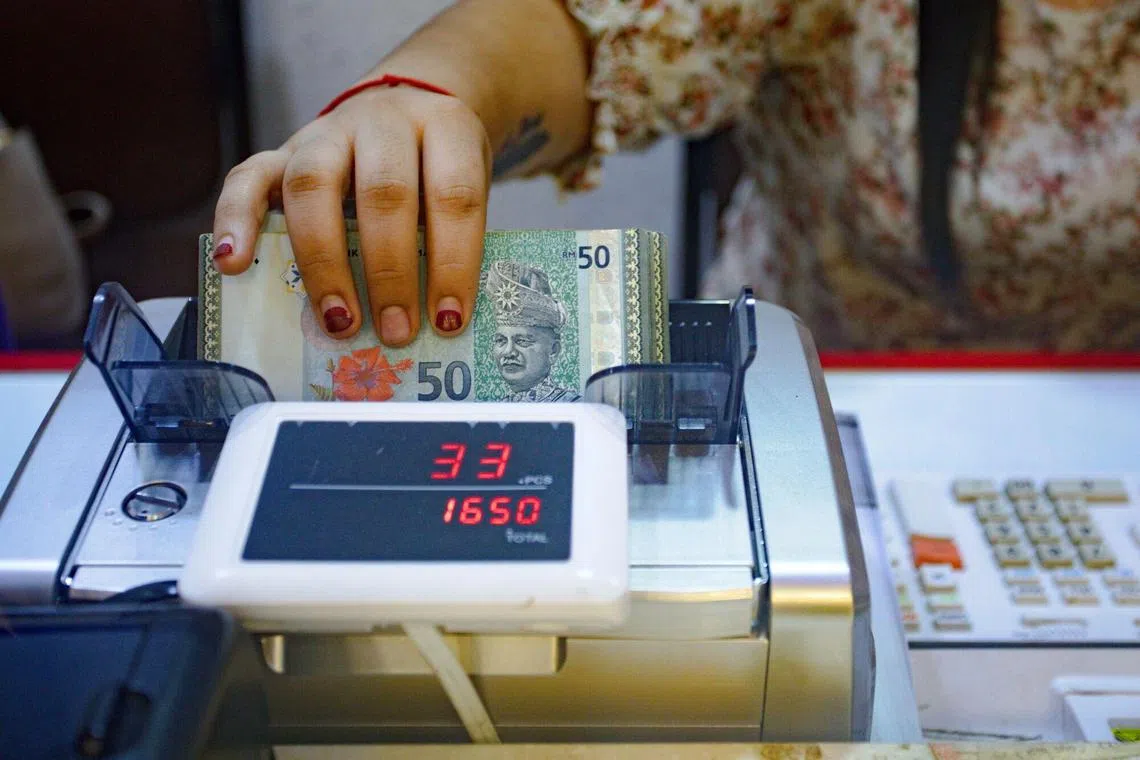
In the third quarter, the ringgit appreciated by nearly 15 per cent against the US dollar, with its nominal effective exchange rate (NEER) rising almost 10 per cent.
This appreciation was partly due to the US Federal Reserve’s shift towards easing monetary policy, reducing pressure on regional currencies.
However, the ringgit depreciated by 7.8 per cent against the greenback between Oct 1 and Nov 13, driven by a stronger dollar amid expectations of smaller US rate cuts.
The ringgit is up 3.1 per cent against the US dollar year-to-date (NEER is up 6.6 per cent). As at noon on Friday, the ringgit was trading at 4.4788 against the greenback.
Abdul Rasheed said future movements will depend on external factors, but Malaysia’s favourable macroeconomic outlook and ongoing structural reforms will support the ringgit over the medium term.
TRENDING NOW

China Investment Corp, PGIM’s 50% stake in Nex mall up for sale; asking about S$1.2 billion

Higher rates, weaker spending: Is the Philippines entering stagflation?

Singapore tech stocks plunge as Nasdaq bloodbath spills into region

OCBC wealth clients turn defensive amid market volatility as Q3 profit rises 3%

