Malaysia rolls out RM611 billion plan to lift wages, cut deficit and power digital shift by 2030
The country aims to catapult itself into the ranks of the world’s top 30 economies within the next 5 years


[KUALA LUMPUR] Malaysia has launched a RM611 billion (S$186 billion) master plan to catapult itself into the ranks of high-income nations by 2030, with aggressive bets on artificial intelligence (AI), semiconductors and green energy as key growth engines.
Unveiled by Prime Minister Anwar Ibrahim on Thursday (Jul 31), the 13th Malaysia Plan (13MP) earmarks RM430 billion in federal development spending, alongside RM120 billion from state-linked companies and RM61 billion in public-private partnerships.
It outlines a five-year road map – spanning 2026 to 2030 – to raise per capita income to RM77,200, reach up to 5.5 per cent growth in gross domestic product, and slash the fiscal deficit to below 3 per cent. The blueprint, themed “Redesigning Development”, was tabled by Anwar in parliament.
Central to the plan is the National Semiconductor Strategy – launched in 2024 – along with a RM1.2 billion push to move Malaysia beyond chip assembly and into design and front-end manufacturing.
To deepen its technology stack and build local intellectual property, the government will partner semiconductor design company Arm Holdings, as well as tech majors such as Amazon Web Services, Intel and Infineon.
Under its National AI Action Plan, Malaysia will pour investments into AI, data analytics and 5G infrastructure, with the aim of producing 5,000 digital entrepreneurs and extending 5G access to 98 per cent of populated areas. The digital economy is expected to generate 500,000 new jobs.
“Malaysia is currently the world’s sixth-largest semiconductor exporter. We plan to double down on this advantage,” Anwar said.
Further details, including a new electricity tariff structure aimed at reflecting actual generation costs, are expected to be released on Friday. The prime minister said that the new electricity rate will not hurt the economy.
““The next five years are critical for Malaysia to leap towards becoming a high-income nation while also nurturing a compassionate society and ensuring a high quality of life.””
Malaysian Prime Minister Anwar Ibrahim
A new US tariff rate on Malaysian goods is also expected on Friday, Anwar said, following a long-awaited phone call on Thursday morning with US President Donald Trump – just ahead of the Aug 1 deadline for a potential 25 per cent duty on the South-east Asian country.
“God willing, it will not be a burden on our economy,” he added.
More jobs and higher wages
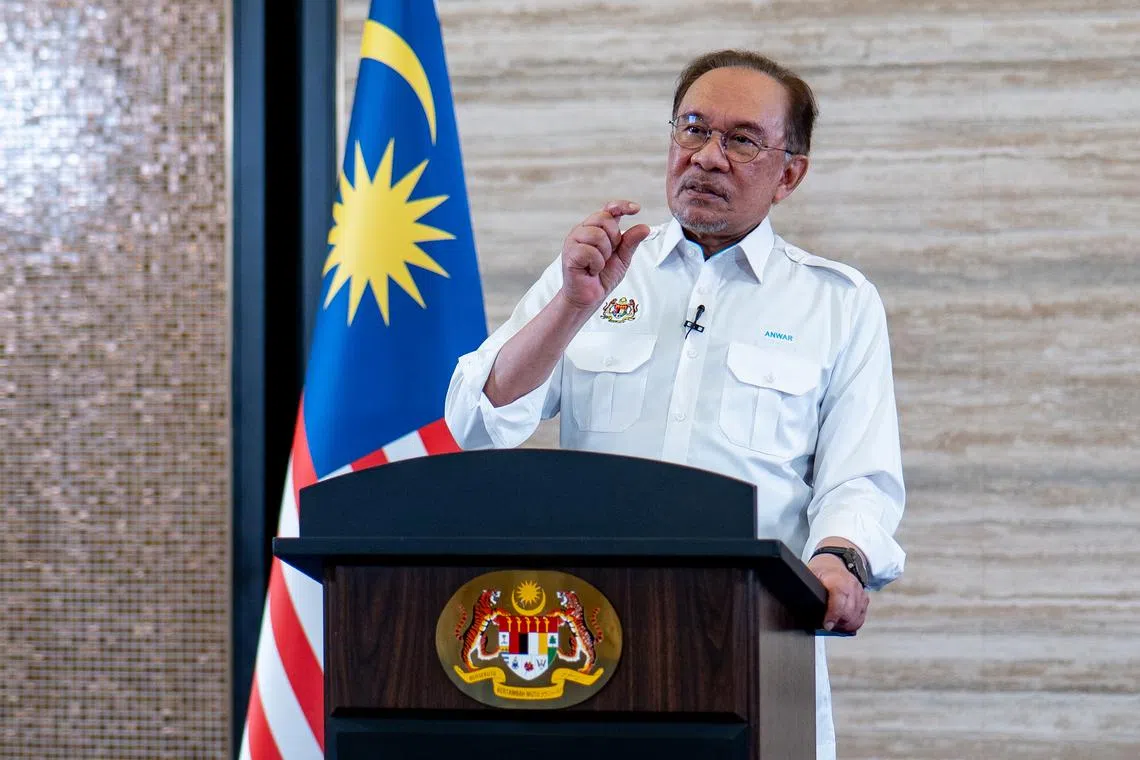
In addition to 500,000 roles in the digital economy, 13MP aims to create 700,000 new manufacturing jobs. “Collaboration between industry and technical and vocational education and training (Tvet) providers will continue to ensure skill readiness,” Anwar said.
The benchmark minimum wage for employees of government-linked companies and investment firms has been raised to RM3,100. The prime minister also noted that 95.6 per cent of Tvet graduates found employment within six months, with many earning more than RM1,700 a month.
The labour market is expected to improve, with the share of employee compensation to GDP reaching 40 per cent, and unemployment hitting a full employment rate by 2030. Inflation is projected to remain stable at between 2 per cent and 3 per cent annually.
With a sweeping reform agenda and ambitious growth targets, 13MP signals Malaysia’s intent to transition from a middle-income economy reliant on resource exports to one powered by digital innovation, green energy and value-added manufacturing.
The country aspires to rank among the world’s top 30 economies by 2030, a goal that will require sustained investment, disciplined governance and effective public-private collaboration.
“The next five years are critical for Malaysia to leap towards becoming a high-income nation while also nurturing a compassionate society and ensuring a high quality of life,” said Anwar.
Key priorities include strengthening the services, manufacturing and construction sectors, which drove an average GDP growth of 5.2 per cent from 2021 to 2024. Domestic demand, particularly private consumption and investment, rose 5.7 per cent annually over the same period.
Anwar also noted that Malaysia’s gross income per capita is projected to rise to RM77,200 by 2030, crossing the World Bank’s high-income threshold.

Green economy, halal and tourism opportunities
The 13MP road map also places a strong emphasis on sustainable growth. The government will expand renewable energy efforts, including hybrid hydro-floating solar projects and green hydrogen hubs such as the Kenyir initiative. It is also exploring nuclear energy as a long-term clean power option.
Rare-earth resources will be prioritised for domestic industrial use to foster midstream and downstream value chains, while the Lumut regasification terminal and power grid connectivity between Sarawak and Peninsular Malaysia will bolster national energy resilience.
Meanwhile, the blue economy – spanning fisheries, coastal tourism and marine biotechnology – is expected to attract more investments, with Sabah designated as a key hub.
In addition, 13MP intends to lift the halal sector’s exports to RM80 billion and raise its GDP contribution to 11 per cent. A new halal commission will be formed, supported by industrial parks in Melaka, Perak and Kelantan.
““Malaysia must liberalise its labour market and strengthen employment rights and trade unions.””
Dr Geoffrey Williams, economist and founder of Williams Business Consultancy
Tourism will also be a major growth lever, with the Visit Malaysia 2026 campaign expected to bring the sector’s contribution to GDP to 16 per cent. Last year, foreign tourist spending reached RM102.2 billion.
“The government will establish Special Tourism Investment Zones in Johor, Melaka, Negeri Sembilan and Sarawak, targeting culture, heritage and nature-based tourism,” said Anwar.
Growth catalysts
Although 13MP may lack headline-grabbing mega projects, analysts point out that its hefty RM430 billion development expenditure signals a ramp-up in public investment, especially from late 2025.
“We believe increased allocations under 13MP provide fresh impetus for infrastructure spending from the fourth quarter of 2025, accelerating into 2026 and 2027 ahead of the next general elections,” said Mak Hoy Ken, a senior analyst at CIMB Securities.
He expects East Malaysia to see heightened activity, particularly with Sabah and Sarawak holding state elections by 2025 and 2027, respectively. Likely beneficiaries include the Penang LRT, East Coast Rail Link, and infrastructure upgrades across Borneo.
Despite concerns over US chip export curbs, Mak anticipates strong momentum for data centre contracts, with six to seven projects worth RM1 billion to RM2 billion each. Revival in tender activity for logistics and industrial assets could also pick up once global trade tensions ease.
MBSB Research described the RM430 billion allocation as essential to supporting long-term projects without derailing fiscal discipline. It added: “13MP also addresses structural reforms in education, healthcare and housing while targeting a resilient, inclusive economy.”
Wages are another key plank. Economist Dr Geoffrey Williams, founder of Williams Business Consultancy, emphasised that wage reform must be paired with deeper labour market liberalisation to meet 13MP’s employment goals.
“Malaysia must liberalise its labour market and strengthen employment rights and trade unions,” he said, noting that Singapore’s tripartite model, where unions, government and employers work in tandem, should be studied closely.
He also called for the simplification of Malaysia’s progressive wage policy and proposed the introduction of a reverse income tax mechanism as a direct way to support middle-income earners.
“For workers earning below a certain benchmark, say RM3,100, government tax credits could be issued instead of income tax being collected. This would effectively raise take-home pay for lower-income employees while maintaining existing tax rates for higher earners,” he said.