



Malaysia’s March inflation steady at 1.8%, beats economists’ forecast
Core inflation is up 1.7 per cent on the year


[KUALA LUMPUR] Malaysia’s inflation rate rose 1.8 per cent year on year (yoy) in March, due to increasing prices of dining out, transport and household utilities, a Department of Statistics Malaysia (DOSM) report indicated on Thursday (Apr 25).
The inflation growth in March remained at the same pace as the previous month, and below the forecast of 2 per cent by 20 economists in a recent Reuters poll.
Core inflation, meanwhile, rose by 1.7 per cent yoy, slower than the 1.8 per cent increase in February.
The country’s inflation growth has remained at 1.5 per cent for three consecutive months since November before it climbed to 1.8 per cent in February, due to a few price adjustments on water and electricity tariffs as well as the implementation of a new consumption tax.
Economists expect Malaysia’s inflation to continue to climb in the coming months, supported by strong domestic consumption, but will maintain at a manageable level.
BMI, a unit of Fitch Solutions, expects the country’s inflation rate to average at 2 per cent over 2024, as consumer spending has returned to what Malaysian households are used to prior to the pandemic.
“Nevertheless, inflation in Malaysia has been relatively tame, after peaking at 4.7 per cent year on year in August 2022,” said BMI in a report.
OCBC senior Asean economist Lavanya Venkateswaran said the main risk to inflation in the coming months would be the timing and mechanism of the government’s fuel subsidy rationalisation policies.
“We will assess the implications of the impending announcement. For now, we maintain our 2024 average inflation forecast at 2.5 per cent,” she added.
RHB Research maintained its 2024 headline inflation outlook forecast at 3.3 per cent, assuming transport inflation remains manageable, due to the delay in removing a blanket fuel subsidy.
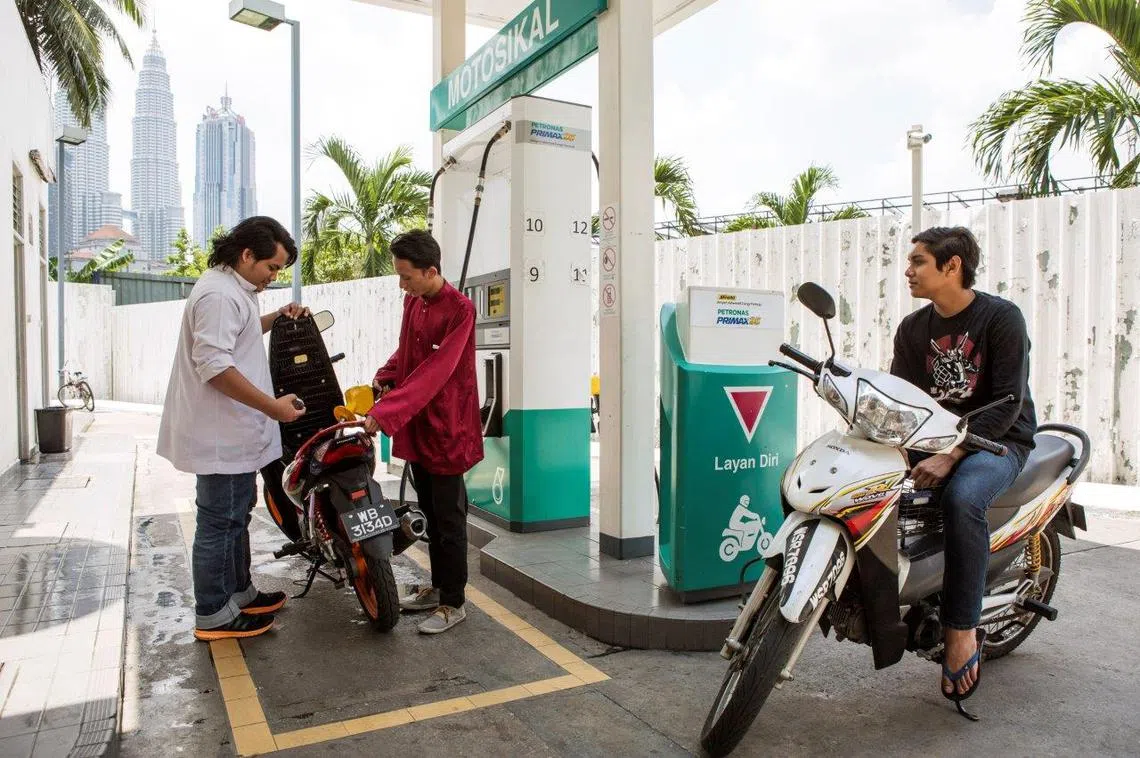
“As highlighted in our previous report, the increase in diesel and RON95 petrol prices is estimated to lift headline inflation by 0.25 to 0.35 per cent, should we assume a mere 5 per cent – RM0.10 (S$0.03) – increase in retail prices,” said RHB. RON95 petrol is subsidised fuel for Malaysians.
The research company added that the impact of higher transportation costs on the overall headline inflation momentum could be sizeable, as transport inflation accounts for 11 per cent of the consumer price index (CPI) basket, with fuel subcomponents alone constituting 6 per cent under that category.
DOSM chief statistician Mohd Uzir Mahidin said the increasing prices in restaurant and accommodation, household utilities as well as personal care and social protection expenses have contributed to rising inflation in March.
The DOSM report indicated that 337 out of 573 – or nearly 59 per cent – of items in the CPI experienced price increases in March. Among these, the prices of 10 items went up by more than 10 per cent, while the prices of 145 items declined.
Prices of food and beverages, which constitute nearly 30 per cent of the total CPI, recorded a slower increase of 1.7 per cent in March from a year earlier.
Prices of housing, water, electricity, gas and other fuels – contributing 23.2 per cent of the total CPI – increased 3 per cent in March.
For the first quarter of 2024, the country’s inflation rate increased 1.7 per cent, compared with 3.6 per cent during the same period last year.
Malaysia’s March inflation rate is lower than several Asia-Pacific countries, such as the Philippines’ 3.7 per cent, South Korea’s 3.1 per cent, and Indonesia’s 3 per cent.
Globally, the eurozone’s inflation continued to ease to 2.4 per cent, but the US inflation rate stood higher at 3.5 per cent in March.
TRENDING NOW

Could stablecoins be the future of money?

Once staunchly pro-China, Malaysian Chinese businesses are now distancing themselves from Beijing

Global expertise and tailored solutions: How affluent S’poreans can grow and manage wealth across markets

GIC-backed Bank Jago sees wealth management as next growth engine as Indonesian investor base grows

