Malaysia: South-east Asia’s data centre powerhouse amid global tech boom
Driven by billions in tech investments and Singapore’s short-lived moratorium on new data centres, Johor has emerged as the region’s fastest-growing DC market

[KUALA LUMPUR] MALAYSIA’S data centre development, which began sans pomp and fanfare 16 years ago in the south, has recently surged into prominence, particularly in Johor, fuelled partly by Singapore’s former moratorium on new data centres.
Riding the wave of a data centre boom that has drawn billions from global tech giants, Johor – Malaysia’s southern state – has become South-east Asia’s fastest-growing data centre market, boasting over 1.6 gigawatts (GW) of total supply, much of it added in the past three years.
“Johor is shaping up to be a key data centre market in Malaysia given its ample land bank and proximity to Singapore,” said a report co-authored by CGS International analysts Prem Jearajasingam, Chong Tjen-San and Dharmini Thuraisingam.
Although the Malaysian and Johor state governments have been targeting data centre investments for a decade, substantial progress was only made recently after major announcements by tech giants to set up data centres in the country, said Samuel Tan, a Johor Bahru-based veteran property consultant.
He recalled that when the first data centre opened in Nusajaya (now known as Iskandar Puteri) in Johor in 2008, few envisioned the significant role data centres would play in the country.
“Singapore has been the preferred destination for data centre investment in the South-east Asia region, due to its leading position as a financial and service hub, availability of technical expertise and concentration of global corporations,” he told The Business Times.
But it wasn’t until 2019, when the Singapore government imposed a three-year moratorium on new data centre developments due to concerns over land and power constraints and sustainability, that neighbouring countries began attracting investors’ attention.
Prior to the moratorium, there were around 60 data centres operating in Singapore, according to Structure Research. Although the moratorium was lifted in January 2023, the government has adopted a more selective approach in approving new data centre developments.
“(The moratorium) prompted a ‘Singapore Plus’ strategy, with providers looking into neighbouring South-east Asia 5 countries to expand their presence,” said DC Byte senior analyst Vivian Wong in a recent report.
Singapore stood out among Asean countries for its matured power grid infrastructure. The country was ranked first place among its Asean peers with the highest score of 75 per cent in the 2022 Smart Grid Index, followed by Malaysia at 71.4 per cent.
The remaining four Asean countries fall below the 70 per cent mark, with Indonesia having the lowest score at 44.6 per cent.
Mega DC deals
The US-based tech giant Nvidia’s announcement in December last year, to partner Malaysian conglomerate YTL Utilities to set up a data centre in Kulai in Johor, has given a boost to Malaysia’s data centre goals.
Several major announcements followed the Nvidia and YTL Utilities deal. Google pledged a US$2 billion investment to build its first data centre and Google Cloud region in Selangor, while Microsoft committed US$2.2 billion to establish its cloud and artificial intelligence (AI) infrastructure in Selangor and Johor.
“Johor grew from a baseline of less than 10 megawatt (MW) of live supply, with the majority of growth in total supply occurring in the last three years,” Wong said in the Global Data Centre Index report released in April.
The main data centre locations in Johor are Sedenak Tech Park, Nusajaya Tech Park and YTL Green Data Centre Park.
Tan said developers benefited from a bonanza by selling land parcels in these areas at record prices, particularly from late-2023. This monetisation enabled developers to quickly fill up industrial parks, accelerate development, or replenish their land banks for further expansion.
“Turn-key contractors also benefited by securing contracts to build data centres, which typically require higher specifications compared to standard factories and warehouses. Additionally, various sub-contractors across different fields have the opportunity to share in this growth,” he added.
Johor currently has around 30 hyperscale data centres, which contain at least 5,000 servers and occupy upwards of 10,000 square feet (sq ft) of physical space for each data centre.
Rising demand for computing power
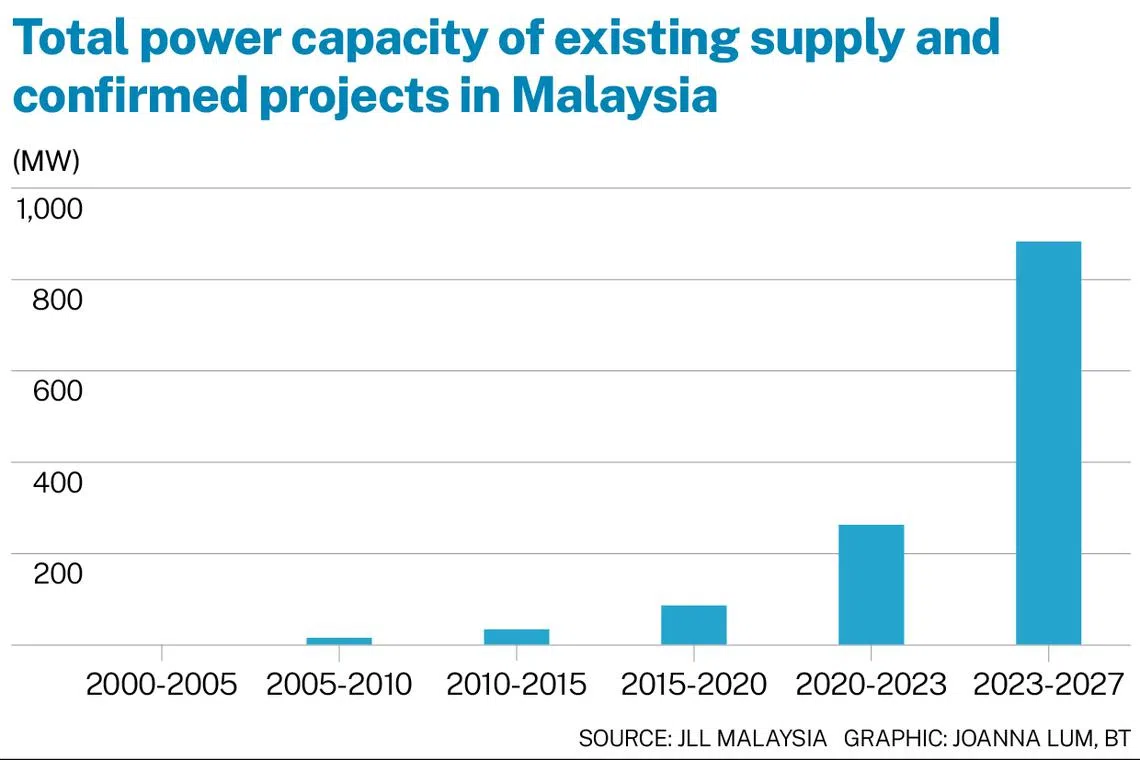
Malaysia’s data centre market is expected to expand at a 13.7 per cent compound annual growth rate from 2024 to 2029, with power capacity rising from 540-MW in 2023 to 1,360-MW by 2029, according to Knight Frank Research and Mordor Intelligence.
Total floor space used for data centres is projected to increase by 156 per cent to 7.7 million sq ft by 2029, from the current 3 million sq ft, equivalent to about 133 football fields.
JLL Malaysia head of research and consultancy Yulia Nikulicheva said the growing data centre demand is largely driven by the rapid adoption of cloud computing, Big Data analytics, Internet services, and AI.
“Companies fuelling this demand come from various industries, including e-commerce, financial services, telecommunications, and technology. In Malaysia, we see social media penetration as a key contributor to the growing demand,” she added.
As at 2022, Malaysia has a social media penetration rate of nearly 92 per cent, outpacing Singapore at 89.5 per cent, suggesting further growth potential for the data centre segment in Malaysia, considering that some of the largest users of data centres are tech companies operating social media platforms such as Meta and Google.
In line with this, Malaysia has also seen smartphone usage growing and remaining at consistently high levels since 2018. As at the third quarter of 2023, smartphone penetration in the country rose to 98.4 per cent, from 97.6 per cent in 2022.
“This will likely translate into higher demand for data centres in the country as more and more of the population start gaining convenient accessibility to the Internet,” said Nikulicheva.
Pull factors
Reliable power supply, grid network stability and adoption of smart grid technology are vital for seamless operation of data centres, said CGS International.
The research firm noted that the power-hungry nature of data centre operations also drove the operators to look at Asean countries which could offer lower power costs.
In the South-east Asia 5 countries, Vietnam has the lowest rate at US$0.06 per kilowatt hour (kWh), while Singapore has the highest at US$0.22 kWh. Malaysia, Indonesia and Thailand charge largely comparable rates at US$0.11 kWh.
Other than power consumption, cable connectivity is another key consideration for data centre operators as it provides the necessary bandwidth and speed to handle large amounts of data processed and transmitted.
According to TeleGeography, Singapore is the most connected nation among its Asean peers with 27 cable landings with 11 in the pipeline, followed by Malaysia, with 21 cable landings and four in the pipeline.
CGS International noted that Malaysia’s National Energy Transition Roadmap (NETR) has further enticed data centre operators to set up operations in the country, anticipating that the growing availability of renewable energy power supply could help them meet their sustainable goals.
In 2023, Malaysia’s renewable energy installed capacity stood at 10.4 GW. This translates into around 27 per cent of the country’s total installed power capacity, according to data from Natural Resources, Environment and Climate Change.
Under NETR, Malaysia aims to boost its renewable energy capacity to 31 per cent of total installed capacity by 2030, with projections for renewable energy capacity to reach 18 GW.