



Malaysia unveils tax relief measures, wider income reforms in US$112.5b 2027 spending boost
Economic growth this year is expected to come in at the upper end of the projected range of 4.8% to 5.3%
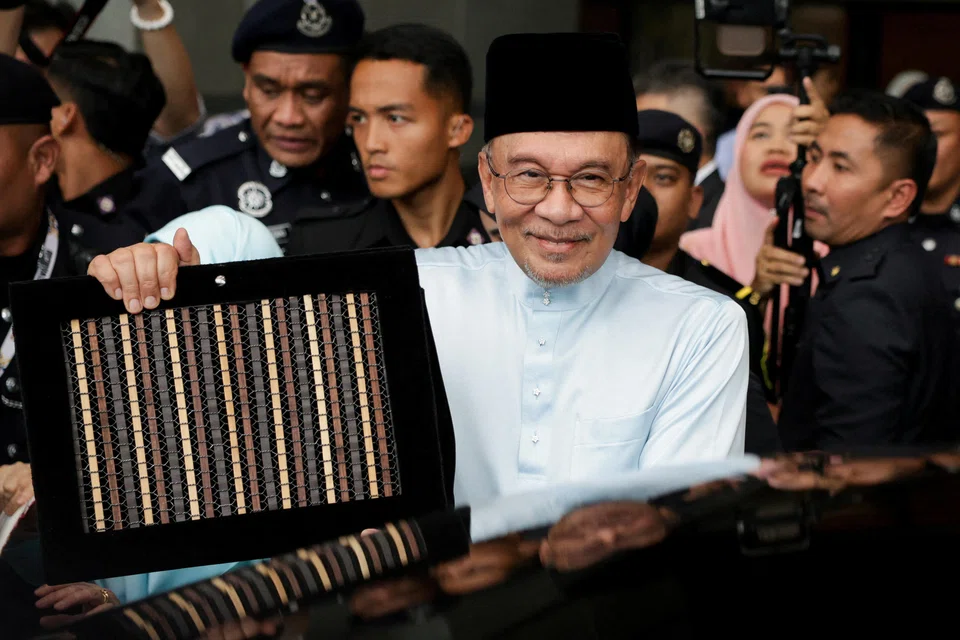
[KUALA LUMPUR] Malaysia unveiled a host of tax relief measures on Friday (Oct 9) and said it would raise minimum wages next year, as the government looked to boost household incomes and support small businesses ahead of a possible election despite growing fiscal pressure from a jump in global oil prices.
Speaking in parliament, Prime Minister Anwar Ibrahim proposed an expansionary budget of RM459.8 billion (US$112.48 billion) for 2027 and pledged to implement reforms that he said would allow the country’s strong economic growth to trickle-down to ordinary Malaysians.
“Our question is not just how the economy is to be built, but whether its growth will open up space for families to build savings, for workers to enjoy more dignified wages, for small businesses to continue to grow,” he said.
Anwar’s coalition has faced a series of setbacks in regional elections in recent months, with simmering tensions within his multi-party ruling alliance fuelling expectations of early national polls.
The next general election is not due until February 2028 but Anwar has said he may call for snap polls if internal divisions worsen.
The minimum wage, currently RM1,700 per month, would be raised to RM2,000 from June next year, though micro, small, and medium enterprises earning less than RM50 million a year would be exempted from the measure for now to allow for business adjustments to be made, Anwar said.
He said wider income reforms were also underway including a move to raise minimum salaries for semi-skilled workers and graduates to RM2,500 a month, to ensure they were compensated according to their ability levels.
The government would also expand individual tax relief from RM9,000 to RM12,000 a year, in the first such revision since 2010, he said.
Outlook for 2026 growth raised



Malaysia’s economy was expected to expand by between 4.2 per cent and 5.2 per cent from a year earlier in 2027, remaining resilient on sustained domestic demand, according to 2027 fiscal and economic outlook reports released with the budget.
Malaysia had in March raised its growth forecast for 2026 on a better-than-expected economic performance and hiked its projections further in its latest outlook.
Economic growth in 2026 was now expected to come in at the upper end of the projected range of 4.8 per cent to 5.3 per cent, faster than the previous estimate of 4 per cent to 5 per cent, the government said. The economy grew 5.7 per cent in the first half of 2026.
Headline inflation was forecast to range between 1.8 per cent and 2.8 per cent in 2027 from a revised estimate of 1.5 per cent to 2.5 per cent in 2026, reflecting carry-over effects and lagged transmission of higher energy, food and other input costs, it added.
Petronas increased dividends to government
The 2027 spending plan, an increase of 3.6 per cent over this year’s revised budget of RM444.1 billion, includes development expenditure of RM83 billion and operating expenditure of RM376.8 billion, according to the government reports.
Revenue was seen rising by 4.7 per cent to RM380.8 billion in 2027, from a projected RM363.6 billion this year on the assumption of resilient albeit moderating economic growth, the reports said.
State energy firm Petronas, a significant contributor to public coffers, will pay the government a dividend of RM32 billion in 2027, up from a revised estimate of RM27 billion this year. Petronas was initially due to contribute RM20 billion in 2026.
Malaysia‘s annual subsidy bill has ballooned amid higher energy costs from the US-Israeli war on Iran, prompting a narrow upward revision of its 2026 fiscal deficit target to 3.6 per cent of gross domestic product from 3.5 per cent, the reports showed.
Higher fuel costs are expected to push subsidies and social assistance spending up to RM74.5 billion this year, a jump of 34.7 per cent from 2025’s expenditure. In 2027, the government’s subsidy spend was forecast to decline marginally to RM72.7 billion.
Anwar, however, downplayed worries of fiscal slippage, saying Malaysia remained committed to its medium-term fiscal objectives. In 2027, the deficit was projected to decline to 3.3 per cent, he said.
“This does not represent a departure from fiscal consolidation. It demonstrates the value of having built the capacity to respond when circumstances demand it,” he said in the foreword to the fiscal outlook report. REUTERS
Decoding Asia newsletter: your guide to navigating Asia in a new global order. Sign up here to get Decoding Asia newsletter. Delivered to your inbox. Free.
Share with us your feedback on BT's products and services
TRENDING NOW

Mooted COE changes will solve category issues, but higher premiums likely: observers

Grab CEO’s wife Chloe Tong on life with Anthony Tan and finding her purpose

Once staunchly pro-China, Malaysian Chinese businesses are now distancing themselves from Beijing

Cliff Tan has 7 million followers and a 4-month waitlist. Why won’t he expand his business?

