Malaysia’s 2022 economic growth to surpass official projections: Finance Minister

Mindy Tan
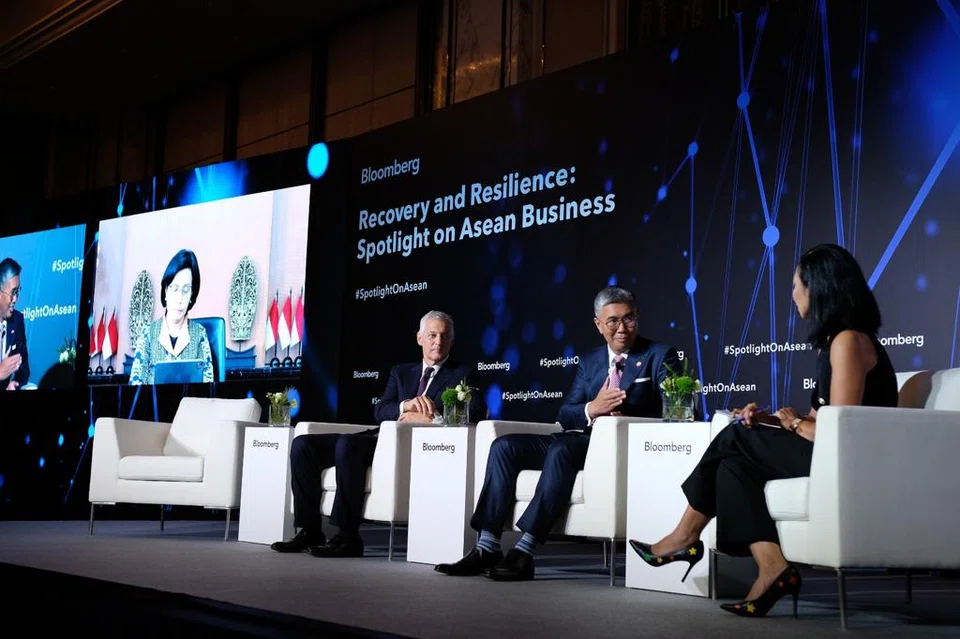
Malaysia’s Finance Minister Zafrul Aziz expects the country to beat its official growth estimates of between 5.3 per cent and 6.3 per cent for 2022, on the back of strong private consumption.
Speaking at the Recovery and Resilience: Spotlight on Asean Business forum in Singapore on Monday (Sep 12), he noted that Malaysia is likely to chart stronger growth in the third quarter of this year, after the economy expanded 8.9 per cent in the previous quarter.
The new full-year estimate for growth will be announced during the annual budget (on Oct 7), he said.
The minister pointed out that risks to recovery still remain. “We are facing various challenges including the strengthening US dollar and a slowing global economy,” he said.
Asked about the weakness in the ringgit, which fell to its lowest levels since the 1998 Asian financial crisis last week, Zafrul noted that the ringgit, as well as the Indonesian rupiah, have both “done well, relatively to other currencies”.
“Against the US dollar, of course not,” he said, even as he countered that the greenback has strengthened against all currencies due to the US Federal Reserve raising interest rates, among other reasons.

He pointed out that Malaysia’s fundamentals remain strong, with the country’s unemployment rate down to 3.7 per cent in July, from its peak of 5.3 per cent.
“Inflation in Malaysia is now around 2.8 per cent in the first 7 months (of 2022). Our monetary policy remains accommodative although Bank Negara Malaysia has increased the overnight policy rate by (another) 25 basis points to 2.5 per cent,” he said. “(This) is still lower than what it was before the Covid-19 crisis at 3 per cent to 3.25 per cent.”
The minister said that government subsidies have helped to maintain Malaysia’s rate of inflation. The economy has also benefited from being a net exporter of commodities such as palm oil, as well as being part of an integral supply chain of electrical and electronic products manufacturing.


“If the fundamentals of the economy remain strong, we should not be too fixated just on the performance of our currency versus one particular currency,” he said.
At the same session, Indonesia’s Finance Minister Sri Mulyani Indrawati shared with the audience that Southeast Asia’s largest economy posted a trade surplus for the last 27 months in a row, with the country’s reserves currently at a record high.
The government has made it easier to do business in the country, she said, citing the Ominbus Law on Job Creation alongside steps taken to strengthen and simplify the investment process.
“The dollar strengthened because of the policy of the Federal Reserve. (That) cannot be avoided. But we can increase our resiliency, which is not as vulnerable as when we had the taper tantrum in 2013,” she said.
Sri Mulyani added that while there continues to be severe pressure from rising prices, Indonesia’s inflation rate came down to 4.6 per cent in August, from 4.9 per cent in July. The underlying core demand-driven inflation is at 3 per cent, she said.
Standard Chartered group chief executive Bill Winters, who was also on the same panel, said that Indonesia - which holds the rotating chairmanship of the G20 this year - has done a lot to push the envelope on the green agenda.
“There is strong public-private partnership that could set new models for development, making Asean a truly global hub for sustainable finance and carbon markets. I am excited to reflect on the progress we have made over the past decades to get to where we are now,” he said.
Winters also said that despite worries of a global recession, the bank’s view is that the post-Covid economic recovery is still on track. He added that the medium to long term is “positive in any case, even if we have some additional bumps along the road”.
Giving his take on China, he said the world’s second-largest economy had a stumble in the second quarter and entered the third quarter on the back of ongoing lockdowns and problems, particularly in its real-estate sector.
“But the underlying dynamism of the Chinese economy remains quite strong. So I would continue to hope that when we get through this Covid period … that we would see a return to the kind of growth that could help to pull the global economy out of recession” he said.
Decoding Asia newsletter: your guide to navigating Asia in a new global order. Sign up here to get Decoding Asia newsletter. Delivered to your inbox. Free.
Copyright SPH Media. All rights reserved.