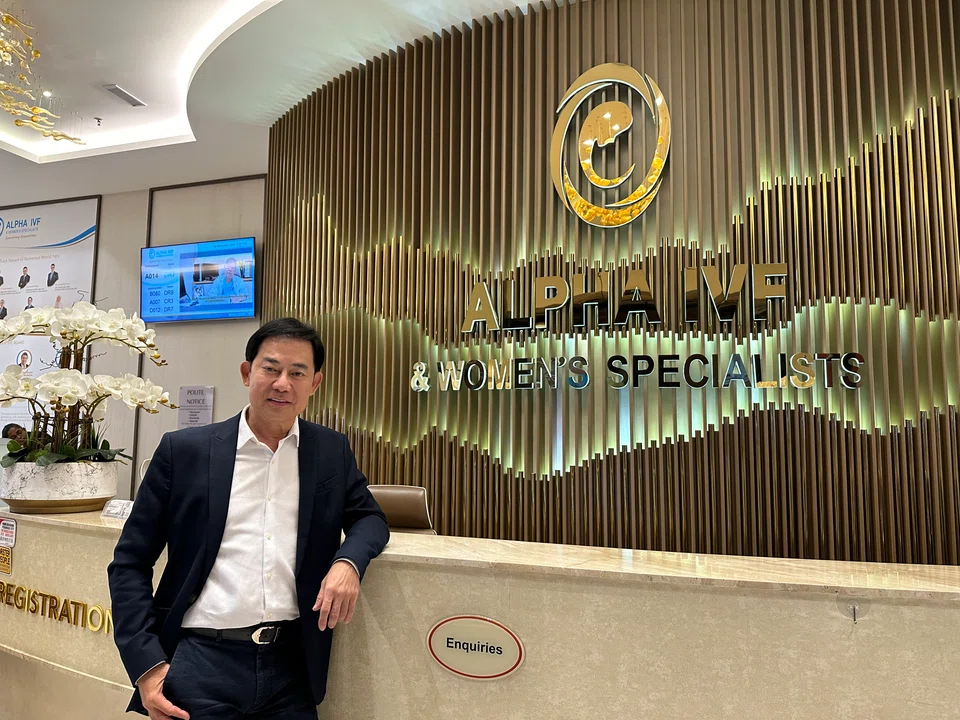
Malaysia’s Alpha IVF set to double centres in two years
The fertility care centre eyes growth in Indonesia, China and the Philippines

[KUALA LUMPUR] Malaysia’s Alpha IVF, the first fertility care centre listed on the country’s stock exchange, wants to more than double its network of centres across Asia by 2026, capitalising on rising demand for assisted reproduction services (ARS) and in vitro fertilisation (IVF) treatments.
The company, founded and led by Dr Colin Lee, went public in March this year, and is focusing its expansion on key South-east Asian markets, including Malaysia, Singapore, Indonesia and the Philippines.
“We plan to expand our network to... ideally nine (centres) within two years of our listings,” he told The Business Times.
Alpha IVF currently has four fertility care centres in Malaysia and Singapore. In Malaysia, it operates three facilities – Alpha IVF and Women’s Specialist and Alhaya Fertility Centre in Kuala Lumpur, as well as Genesis Specialist in Penang.
In Singapore, Alpha IVF established Alpha Singapore in 2016, a full-fledged centre comprising the Alpha IVF Centre and Alpha Women’s Specialists.
Rapid expansion
The group’s expansion plans in the region are gaining traction.
In September, the company signed a shareholder agreement with its stakeholders in the Philippines – veteran obstetrician and gynaecologists Dr Romerico Torres and Dr Maria Victoria Tan. This paved the way for Alpha IVF to have a full-fledged fertility centre in Manila, set to be operational next year.
In Indonesia, the company inked a tenancy agreement to set up a satellite clinic in Jakarta, to capitalise on the growing demand for IVF services in the country. For the financial year ended May 31 this year, Indonesian patients contributed just over 42 per cent of group revenue in Malaysia, having almost doubled from around 22 per cent four years earlier.
“(The company’s) revenue from Indonesian patients has grown tremendously over the years and is currently the major contributor to Malaysia’s operations,” said Dr Lee.
The Singapore operation is also seeing strong growth.
Dr Lee said Alpha Singapore has recently expanded with the addition of three veteran specialists to meet rising patient demand, positioning it as one of the largest IVF centres in the country with an annual capacity of up to 1,000 IVF cycles.
In the longer term, it hopes to also make inroads into China.
The group’s domestic and regional expansion plans will be funded by the initial public offering exercise that took place in the first quarter of 2024. Of the RM466.5 million (S$140.9 million) raised, RM116.6 million went to Alpha IVF, with RM72.8 million earmarked for its expansion plans.
Industry pioneer
Alpha IVF’s expansion comes at a time when fertility rates are declining.
According to the Organisation for Economic Co-operation and Development, fertility rates averaged around 1.6 across its member countries in 2022, well below the ideal rate of 2.1 children per woman required to maintain a stable population size.
Separately, a report by the World Health Organization released in 2023, indicated that around 17.5 per cent – roughly one in six people – experience infertility.
Dr Lee cited several factors for the low fertility rate, with key reasons being that many individuals are marrying later in life, and younger couples are often apprehensive about the high costs of living and education. As a result, they tend to delay starting a family to prioritise their careers and financial stability.
“For those who are financially prepared and eager to have children, health issues stemming from lifestyle choices and environmental factors may hinder their ability to conceive. Consequently, there is a growing demand for ARS to assist these couples in realising their dreams of parenthood,” said the industry veteran.
Being in the industry for over 40 years, Dr Lee is considered to be one of the top specialists in the IVF space in Malaysia, known for its achievements in the fertility treatment industry.
He began his medical career as a houseman at Westmead Hospital in Sydney in 1983, and later worked in various Malaysian hospitals. In 1988, he joined the National University Hospital in Singapore, advancing to senior resident and tutor in obstetrics and gynaecology.
In 1994, he founded Damansara Fertility Clinic, followed by the establishment of Damansara Women’s Specialist Centre (now known as TMC Fertility Centre) and Tropicana Medical Centre (now known as Thomson Hospital) in 1997.
TMC Fertility Centre and Thomson Hospital are part of Bursa Malaysia-listed TMC Life Sciences, which is a subsidiary of Singapore’s Thomson Medical Group.
Dr Lee was actively involved in the planning of multiple branches and led the company’s listing on Bursa Malaysia in 2005, before resigning in August 2010 and establishing Alpha IVF in 2011.
Under his leadership, the IVF centre achieved a remarkable 100 per cent post-thaw survival rate for over 10,290 frozen embryos using advanced freezing technology. This achievement has been recognised by the Malaysian Book of Records and is set to be submitted to the Guinness World Records.
Renowned for pre-implantation genetic testing, Dr Lee recently assisted a couple with the rare TBCD gene mutation in conceiving a child free of this condition.
Emerging trends
Despite the trend of declining fertility rates, Dr Lee remains optimistic about Alpha IVF’s future, anticipating a growing number of patients seeking medical assistance to conceive.
He highlighted industry estimates suggesting that one in every 800 individuals may require IVF services, with potential demand in Malaysia alone estimated at around 40,000 cases.
“The demand is rising, and people are becoming aware that there are options available for conceiving their next generation; however, affordability and accessibility remain significant challenges,” said the industry veteran.
He pointed out that in highly populated countries such as China and Indonesia, existing IVF centres are insufficient to meet the growing demand, prompting many individuals to seek treatment abroad.
In a thematic report on healthcare tourism issued in August this year, RHB Research noted that IVF services are among the most sought-after treatments attracting patients to Malaysia due to their higher success rates and competitive pricing.
On average, IVF treatment in Malaysia costs between US$3,000 and US$4,000 per cycle. In comparison, similar treatments in Indonesia range from US$2,985 to US$4,598, while costs in Singapore can reach between US$13,000 and US$15,000.
Read more in BT’s series tomorrow (Dec 25) on how Malaysia is leveraging hubs such as Penang and Selangor to rival the medical hubs of Thailand and Singapore
TRENDING NOW
Temasek’s Wan Chee Foong to helm PIL, Lars Kastrup to be board adviser
Chagee, Mixue and Luckin won the market. Sustaining their edge is the harder part
He built the Vingroup empire. Now South-east Asia’s richest man is handing some key roles to his sons
One-third of Singapore-listed firms at risk in severe AI downturn: MAS