



Malaysia’s CIMB is going after higher-tier affluents in Singapore and Thailand
Country’s second-largest bank targets to double wealth assets under management by 2030

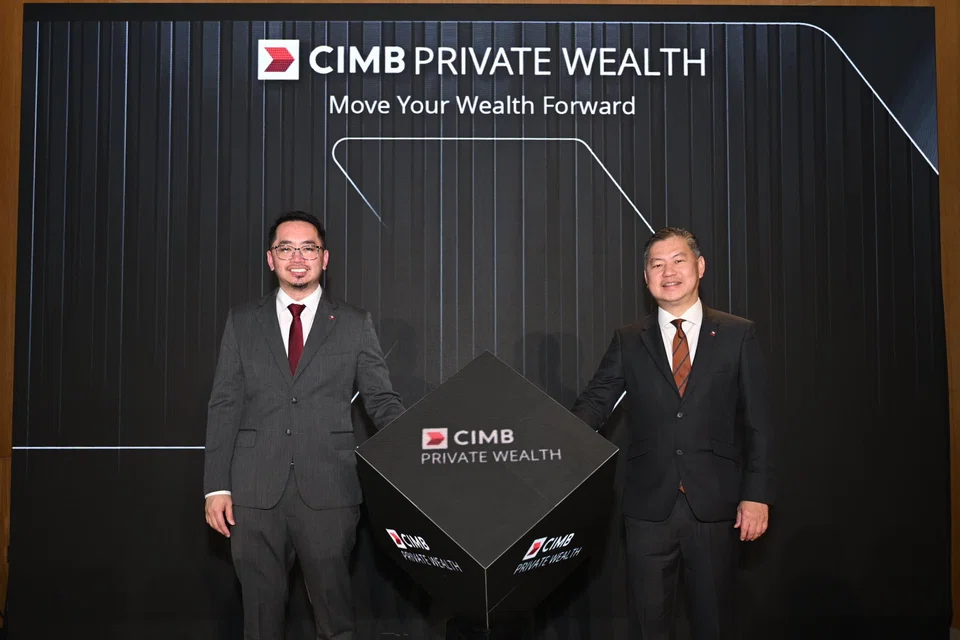
[KUALA LUMPUR] CIMB Group, Malaysia’s second-largest bank by assets and market capitalisation, plans to launch its private wealth business in Singapore and Thailand by the year’s end as part of a broader strategy to double wealth assets under management (AUM) by 2030.
This expansion follows the recent roll-out of its private wealth business in Indonesia earlier this year and in Malaysia on Monday (Jul 20).
Haniz Nazlan, CEO of group consumer banking at CIMB, said the expansion targets South-east Asia’s rapidly growing affluent segment.
He attributed this market’s growth to rising incomes, surging cross-border investments, and a major wave of intergenerational wealth transfer.
“Asean has grown into a US$4 trillion economy, delivering long-term annual economic growth of around 4 per cent – well above many developed markets,” he told the media at the private wealth business launch.
Driven by this momentum, the region’s affluent population is projected to grow 5 to 6 per cent annually, while the middle class is expected to make up 65 to 70 per cent of Asean’s population by 2030.
Daniel Cheong, head of consumer banking for Malaysia at CIMB, noted that the new private wealth service targets clients with a minimum of RM1 million (US$244,612) in AUM.
This sits above CIMB Preferred, the bank’s mass-affluent priority banking tier, which requires RM250,000.
Private wealth offers dedicated relationship managers, investment advisers, treasury solutions, succession planning, bespoke investment products and digital wealth capabilities.



A great rewiring of wealth
Haniz described the launch as a response to what he called the “great rewiring of wealth” taking place across Asean.
Affluent customers, he said, are increasingly asking broader questions than simply which investment products to buy.
“They want to know how to protect what they have built, how to prepare their children, how to access opportunities beyond their home markets, and how to make better decisions in an increasingly uncertain world,” he said.
The growing emphasis on wealth management comes as CIMB seeks to diversify its earnings away from traditional lending and build a more sustainable stream of fee-based income.
In the financial year ended Dec 31, 2025, the bank reported non-interest income of RM7.1 billion, an increase of 3 per cent from a year earlier. Fee and commission income also increased, with management attributing the improvement to stronger wealth-related activities.
The launch of CIMB Private Wealth marks another step in the bank’s six-year Forward30 strategy, which positions affluent banking as a key growth engine.
Haniz said CIMB’s wealth AUM stood at about RM250 billion last year, but declined to provide interim growth targets or customer acquisition numbers, saying it was still early in the roll-out of the Private Wealth proposition.
He noted that the bank’s ambition is to become customers’ primary financial institution by deepening relationships beyond traditional banking services.
While CIMB’s growth strategy is centred on expanding organically across its core Asean markets, Haniz said the group also remains open to other opportunities should they arise.
Responding to a question on whether the bank will pursue acquisitions to accelerate its wealth expansion in the South-east Asia region, Haniz declined to comment on market speculation.
“But of course, we are always open to opportunities if they make sense for the bank,” he added.
Experts’ guidance in volatile market
Central to CIMB Private Wealth’s proposition is a newly established Chief Investment Office, which the bank says will help affluent clients navigate increasingly volatile financial markets with professional, long-term advice.
Patrick Chang, chief investment officer for group consumer banking at CIMB, said expert guidance is more valuable than ever in the current investment landscape. “In today’s increasingly complex financial markets, simplicity matters,” he added.
Rather than encouraging clients to follow the latest investment trends or highest returns, the Chief Investment Office focuses on building diversified portfolios tailored to individual risk profiles and long-term financial goals.
“Customers ask us one simple question: ‘What should I do with my money?’” Chang said. “Our role is to translate market developments into long-term portfolio advice...
“Our focus is on portfolio construction and risk-adjusted returns, rather than chasing products or chasing returns,” he added. He noted that investors who focus solely on returns without considering risk could expose themselves to unnecessary losses.
Decoding Asia newsletter: your guide to navigating Asia in a new global order. Sign up here to get Decoding Asia newsletter. Delivered to your inbox. Free.
Copyright SPH Media. All rights reserved.
TRENDING NOW

Once staunchly pro-China, Malaysian Chinese businesses are now distancing themselves from Beijing

Looking beyond looming CEO succession, should UOB potentially pursue a transformative merger?

Could stablecoins be the future of money?

Grab CEO’s wife Chloe Tong on life with Anthony Tan and finding her purpose

