



Malaysia’s data centre dreams hit by tariffs, chip ban fears, trade tensions
But strong fundamentals and a wave of digital investments driven by Apac’s surging demand for data and computing could help the country still stand tall
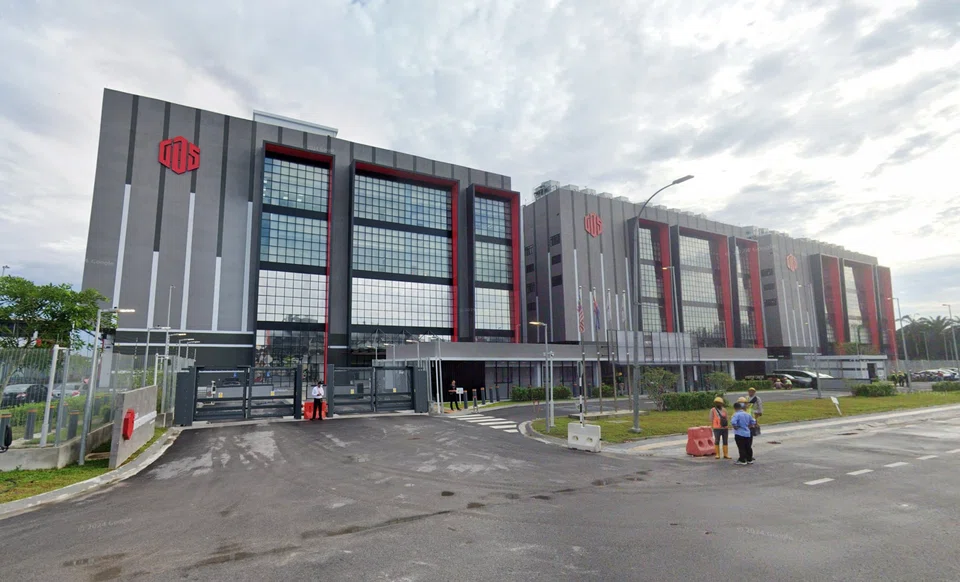
[KUALA LUMPUR] Rising electricity tariffs and the proposed US ban on artificial intelligence (AI) chip exports to South-east Asia are raining on the parade of Malaysia’s booming data centre sector, as the dual pressures force hyperscale operators to reassess the country’s value proposition as a digital investment hub.
Still, some observers reckon Malaysia’s dominant position in emerging South-east Asia is unlikely to be dramatically shaken, as demand for cloud computing remains robust.
While industry experts point out that the US move to curb AI chip exports from Malaysia – part of efforts to stop suspected smuggling into China – is still in a draft stage and remains speculative, its chilling effect, combined with a sharper-than-expected power tariff hike just this month, is already cooling the gold rush.
“Malaysia has seen some slowdown (since the) ‘gold-rush’ phenomenon in 2023 and 2024, which probably led to some point of diminishing return,” said Gary Goh, director and founder of data centre advisory firm Sprint DC Consulting.
He added: “Within the Asia-Pacific (Apac), locations such as Thailand, South Korea and Japan have seen a lot of investment this year.”
Power-hungry data centre operators in Malaysia are facing higher costs with the newly announced electricity tariffs targeting facilities with capacities above 100 megawatts (MW). According to reports, the move could drive energy costs up by as much as 10 to 14 per cent.
For a typical 100 MW hyperscale facility in Malaysia, the annual energy bill would have been about US$130 million to US$150 million before the recent tariff restructuring, noted Goh, adding that the new tariffs could push electricity bills up by 10 to nearly 16 per cent for a data centre running at average utilisation.
BMI said in a recent report: “This development is expected to have a negative impact on data centre projects in the short term as platforms put their pipelines on hold, in anticipation of further clarity on the price bands being employed to calculate the power bills.
“This risk is expected to be greatest for data centres targeting AI applications, as they also look to balance the impact of a potential restriction of US-supplied graphics processing units.”
Several major operators with projects exceeding 100 MW include DayOne, EdgeConneX, Yondr, AirTrunk, ST Telemedia and Vantage, according to the research unit.
“We do not expect these platforms to completely exit the market; rather, platforms will adapt their pipelines coming to market to comply with sustainability-linked standards,” added BMI.
Like Goh, BMI noted that investments could potentially shift to surrounding markets, such as Indonesia and Thailand, as investments gradually divert to less-regulated peer markets that can still service digitally mature economies.
Added layer of uncertainty
According to Goh, the recent tariff hike compounds existing cost pressures.
When Malaysian sites commit to 24/7 renewable-energy coverage to meet environmental, social and governance requirements, developers must underwrite 100 per cent of the renewable output while also paying for conventional standby capacity.
Goh noted that renewable energy often commands a premium, depending on oil price cycles, workload predictability, and whether the source is on-site or off-site – especially when compared to the current five-year low of conventional floating power prices.
“Malaysia’s power pricing volatility adds another layer of uncertainty for operators planning long-term power purchase agreements. Fuel surcharge jumped from 3.7 sen (1.2 Singapore cents) per kilowatt-hour in 2022 to 20 sen in 2023 – a 16.3 sen increase,” he pointed out.
The shine remains
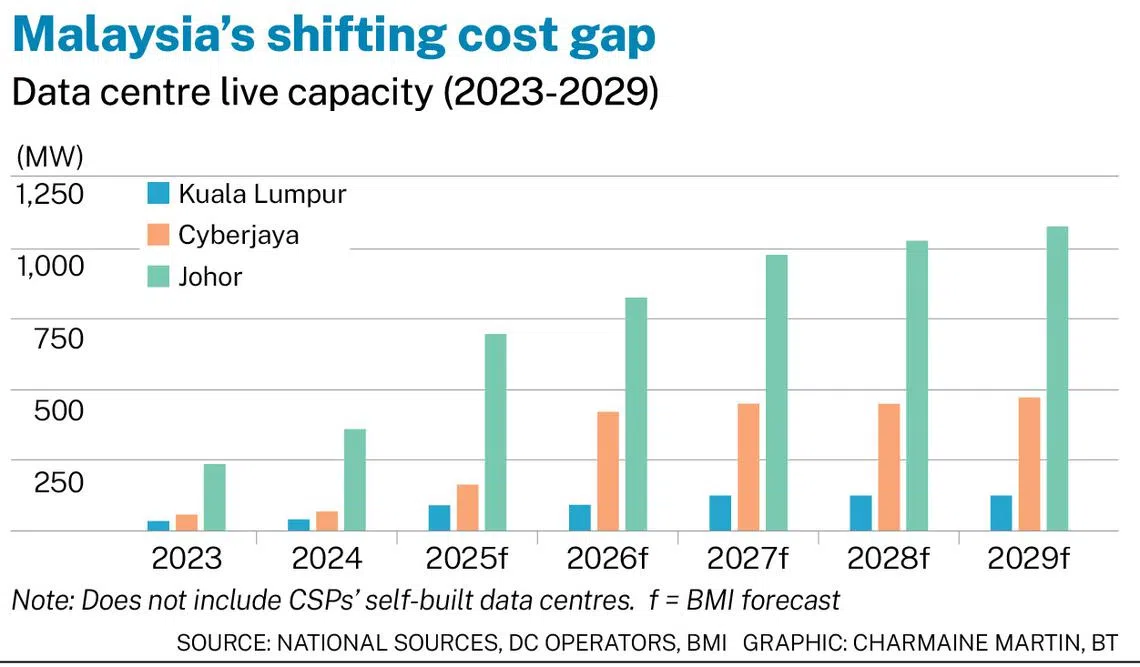
Between 2021 and 2024, Malaysia attracted 2 to 5 gigawatts worth of investment inquiries, led more by its proximity to Singapore, political stability, and whole-of-government support than by competitive electricity rates, Goh said.
Immediate-term cost pressures aside, he stressed that data centre investments follow a different timeline than typical commercial decisions. “Power prices are dynamic and short term; data centre investment is a 25-year decision (commitment),” he said, noting how Singapore continues to attract interest despite high tariffs and government-imposed moratoriums.
“Malaysia’s challenge is to make its long-term case compelling again,” he added.
For now, Malaysia remains a magnet for data centre investments.
Although the new power tariffs could pose short-term hurdles for data centre projects in Malaysia, BMI expects the country to retain its leading position in emerging South-east Asia on the back of strong demand for cloud computing.
According to Barclays, the rising demand for data and cloud computing is fuelling the need for power and water-intensive data centres across Apac. Annual foreign direct investment (FDI) in Apac data centres is projected to reach US$62 billion by 2030, up from US$35 billion in 2024.
Malaysia, together with India, stand out as the biggest relative beneficiaries. “As a percentage of gross domestic product, we think Malaysia will be the biggest beneficiary by the end of the decade, with a bump-up in FDI of potentially 0.4 per cent of GDP from current levels,” said the analysts.
Adapt, not exit
To mitigate the cost pressures, industry players are adapting through strategic partnerships and technological innovation rather than retreating from the Malaysian market.
In June, Bridge Data Centres signed a memorandum of understanding with South Korea’s SK Innovation to deploy AI-driven energy management, backup fuel cells and immersion cooling at a major hyperscale facility in Johor, based on a press statement.
“Our partnership with SK Innovation reflects our commitment to advancing green energy technologies for data centres, supporting our customers’ goals for sustainable and scalable growth,” said Kevin Guan, chief investment officer of Bridge Data Centres.
TRENDING NOW

Britain’s mansion tax shows the difficulty of targeting wealth

Once staunchly pro-China, Malaysian Chinese businesses are now distancing themselves from Beijing

The only common thing in S-E Asia is that we all eat rice: Cisco’s Asean president
Singapore data centre operator DayOne opts for US IPO at likely US$20 billion valuation

