Asean Business logo
SPONSORED BYUOB logo

Malaysia’s Forest City family office push gains traction, but ecosystem gaps remain

It has drawn notable early movers, including billionaire Chua Ma Yu’s CMY Capital and Yow Kee Family Office
Summarise
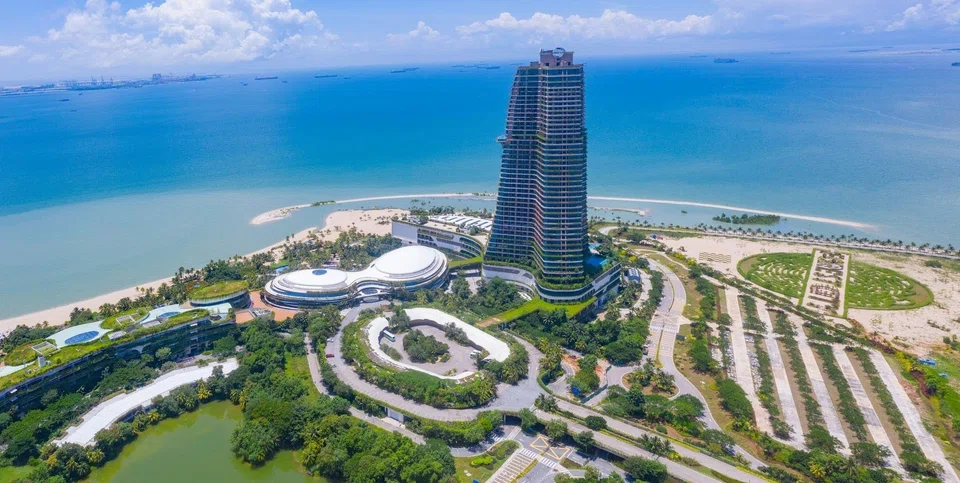
    • Forest City’s pitch is not to displace Singapore, but to offer a lower-cost complementary base across the Causeway.
    • Forest City’s pitch is not to displace Singapore, but to offer a lower-cost complementary base across the Causeway. IMAGE: COUNTRY GARDEN PACIFICVIEW
    Published Thu, Jun 25, 2026 · 01:23 PM

    [JOHOR BAHRU] Forest City’s family office push has moved past paper approvals, with Maybank-assisted early single family offices (SFOs) now operating and holding more than RM700 million (S$219.3 million) in assets under management, according to Malaysia’s largest lender Maybank.

    The bigger challenge now is whether a former ghost-town property project can turn early registrations into a large-scale functioning wealth-management ecosystem anchored by capital deployment, professional services and a meaningful on-the-ground presence.

    According to Maybank’s Malaysia head of wealth management, Lim Eng Ping, these elements are still building up as many families take a phased approach to implementation.

    “We are seeing strong traction from families, particularly domestic ones, exploring the JS-SEZ (Johor-Singapore Special Economic Zone) SFO scheme as part of a broader wealth structuring strategy,” Lim told The Business Times.

    The bank has to date supported the establishment of nine SFOs under the JS-SEZ SFO scheme and Forest City Special Financial Zone incentive package.

    Maybank’s Lim Eng Ping says: “We are seeing strong traction from families, particularly domestic ones, exploring the JS-SEZ SFO scheme as part of a broader wealth structuring strategy.” PHOTO: MAYBANK MALAYSIA

    Even so, it remains unclear whether Forest City has met, or is on track to meet, its RM2 billion AUM target by the end of 2026.

    The latest industry-wide data from the Securities Commission showed that nine family offices had received conditional approvals under the scheme, representing nearly RM670 million in indicative AUM as at April 2026. (*See Amendment note)

    Anusha Santhirasthipam, founder and CEO of corporate advisory firm Akshiya Global Ventures, told BT that the RM2 billion target could prove challenging, citing geopolitical headwinds, supply chain pressures around the Strait of Hormuz, currency volatility and shifting global alignments.

    These factors have led family offices and limited partners from Europe, the Gulf and North America to phase commitments more cautiously, she said.

    “Our investors are phasing incrementally over the 2027 to 2030 period. They are all long-term players.”

    Rising appeal of wider JS-SEZ area

    The Forest City scheme has already drawn some notable early movers.

    Among the early participants is CMY Capital, the family office of billionaire Chua Ma Yu, co-owner of The St Regis Kuala Lumpur and a cornerstone investor in major Malaysian initial public offerings.

    Another is Yow Kee Family Office, incorporated in December 2024, set up by David Chong, founder of regional trust and corporate services firm Portcullis Group.

    There is also growing interest in the wider JS-SEZ area. Maybank said it facilitated around RM20 billion in financing and investments across the zone over the past two years, pointing to wider banking activity around the corridor beyond the SFO scheme.

    Akshiya Global Ventures’ Santhirasthipam says: “Our investors are phasing incrementally over the 2027 to 2030 period. They are all long-term players.” PHOTO: AKSHIYA GLOBAL VENTURES

    Akshiya is in the middle of closing a US$300 million AUM deal for a European-backed private equity fund in the JS-SEZ between 2026 and 2028. The fund is focused on branded hospitality, lifestyle and medical tourism, Santhirasthipam said.

    Although the deal sits outside Forest City, she said it points to the kind of investment pipeline that could support the wider corridor’s wealth-management ambitions.

    Santhirasthipam describes the model she promotes as a “dual-HQ” structure, with a family office placing its client-facing leadership in Singapore while locating asset-holding structures, data infrastructure and back-end operations across the Causeway in Johor.

    This model, she said, allows families to maintain access to Singapore’s financial ecosystem while reducing operating costs.

    The city-state remains the region’s main family office hub. The Monetary Authority of Singapore rolled out a revised framework for SFOs which took effect on Jun 15, simplifying the process for them to establish operations in Singapore and streamlining documentation and reporting requirements.

    Forest City’s pitch is not to displace Singapore, but to offer a lower-cost complementary base across the Causeway.

    To qualify, a family office must maintain at least RM30 million in assets under management. At about US$7 million, the threshold is relatively low by regional standards, positioning Forest City as an entry point for families seeking a more cost-effective wealth-management base.

    How high-net-worth clients can benefit

    DBS views the Malaysia proposition for high-net-worth clients in two dimensions, said Lee Woon Shiu, group head of wealth, family office and insurance solutions.

    The first is the Forest City family office framework, under which family offices established in Forest City are allowed to have a portion of their assets managed in Singapore.

    “Once the structure is set up in Forest City, certain investment management activities can still be carried out from Singapore through DBS Private Bank, allowing clients to benefit from the strengths of both jurisdictions,” he said.

    The second is the wider JS-SEZ, where entrepreneurs can establish regional headquarters or legal entities in Singapore while locating manufacturing or other cost-sensitive functions in Johor.

    “Clients can tap Singapore’s strengths as a business and financial hub while benefiting from Johor’s cost advantages,” he added.

    The push comes as Asia-Pacific’s private wealth market continues to expand, sharpening competition among regional centres seeking to capture cross-border capital, fund structures and family office activity.

    Portcullis’ Chong told BT his firm has 10 people based in Forest City and around 50 in Kuala Lumpur. “Forest City is complementary to Singapore’s family office ecosystem, rather than a direct competitor,” he told BT.

    Portcullis’ David Chong says: “It took Singapore 20 years, so it may take Forest City at least 10 years to develop a real family office ecosystem.” PHOTO: PORTCULLIS

    But Chong is measured about what still needs to be built. “It took Singapore 20 years, so it may take Forest City at least 10 years to develop a real family office ecosystem,” he said.

    One gap, he noted, is that Singapore has developed a locally administered trust that is exempt from tax. “There is no equivalent in Forest City.”

    Maybank’s Lim said Forest City still needs to strengthen its professional services network, ensure policy consistency and clarity, and build confidence through successful early adopters.

    Amendment note: An earlier version of this article misstated the timing and framing of the Securities Commission Malaysia’s data on family offices under the Forest City scheme. The article has been amended to reflect SC’s Apr 22, 2026 statement that nine family offices had received conditional approvals, representing nearly RM670 million in indicative AUM as at April 2026.