Malaysia’s key economic hubs Penang, Kulim, Klang Valley poised to see rising activity from Johor-Singapore SEZ
It is expected to create around 20,000 skilled jobs, with anticipation that these jobs could command higher monthly salaries

[KUALA LUMPUR] Active Malaysian hubs such as Penang, Kulim and Klang Valley could stand to gain from the surge of activity driven by the Johor-Singapore Special Economic Zone (JS-SEZ), which promises to expand the nation’s pie rather than divide it.
“Rather than competing, regions like Penang, Kulim and the JS-SEZ will complement each other, creating a robust network of supply chains that attract multinational investments,” Penang-based Malaysia Semiconductor Industry Association president Wong Siew Hai told The Business Times.
He was commenting on whether the JS-SEZ could steal the thunder from other states in terms of wooing investments, given its proximity to Singapore as well as the string of incentives in the newly launched zone to sweeten its proposition.
Singapore and Malaysia signed a joint agreement on the JS-SEZ in January during a retreat by Prime Ministers Lawrence Wong and Anwar Ibrahim.
“Johor isn’t competing with other states. It is enlarging Malaysia’s economic cake,” said Lee Heng Guie, executive director of the Socio-Economic Research Centre.
The benefits, in fact, can be reaped both ways, observers said.
In recent weeks, Penang service providers are exploring setting up satellite offices in the zone to better serve their clients in Singapore, said Wong. This, he said, is being considered as many Singapore-based companies are reportedly considering relocating production facilities to Johor.
Penang, a highly industrialised and fast-growing state in Malaysia, is one of the world’s most important electrical and electronics manufacturing hubs and plays a key role in global manufacturing supply chains.
Its neighbouring district at the northern border Kulim, in the state of Kedah, is another up-and-coming hub and known for its flagship high-technology industrial park Kulim Hi-Tech Park.
The Klang Valley metropolis, where the country’s capital Kuala Lumpur is located, is one of Malaysia’s main economic centres.
Economy Minister Rafizi Ramli recently projected that the JS-SEZ could contribute up to US$28 billion annually to Johor’s gross domestic product, potentially positioning it as a rival to the Klang Valley as Malaysia’s primary economic engine.
Market observers told BT that Johor’s growth is not competition, but an opportunity for complementary development.
There is some precedence. Wong pointed out that while Penang has historically been a hub for technology investments, its success has already spurred spillovers to neighbouring states such as Kedah.
The JS-SEZ’s proximity to Singapore makes it a prime location for companies seeking to diversify their operations, said Koong Lin Loong, treasurer-general of the Associated Chinese Chambers of Commerce and Industry of Malaysia.
“The zone offers the perfect blend of Singapore’s infrastructure and Johor’s cost advantages,” he added.
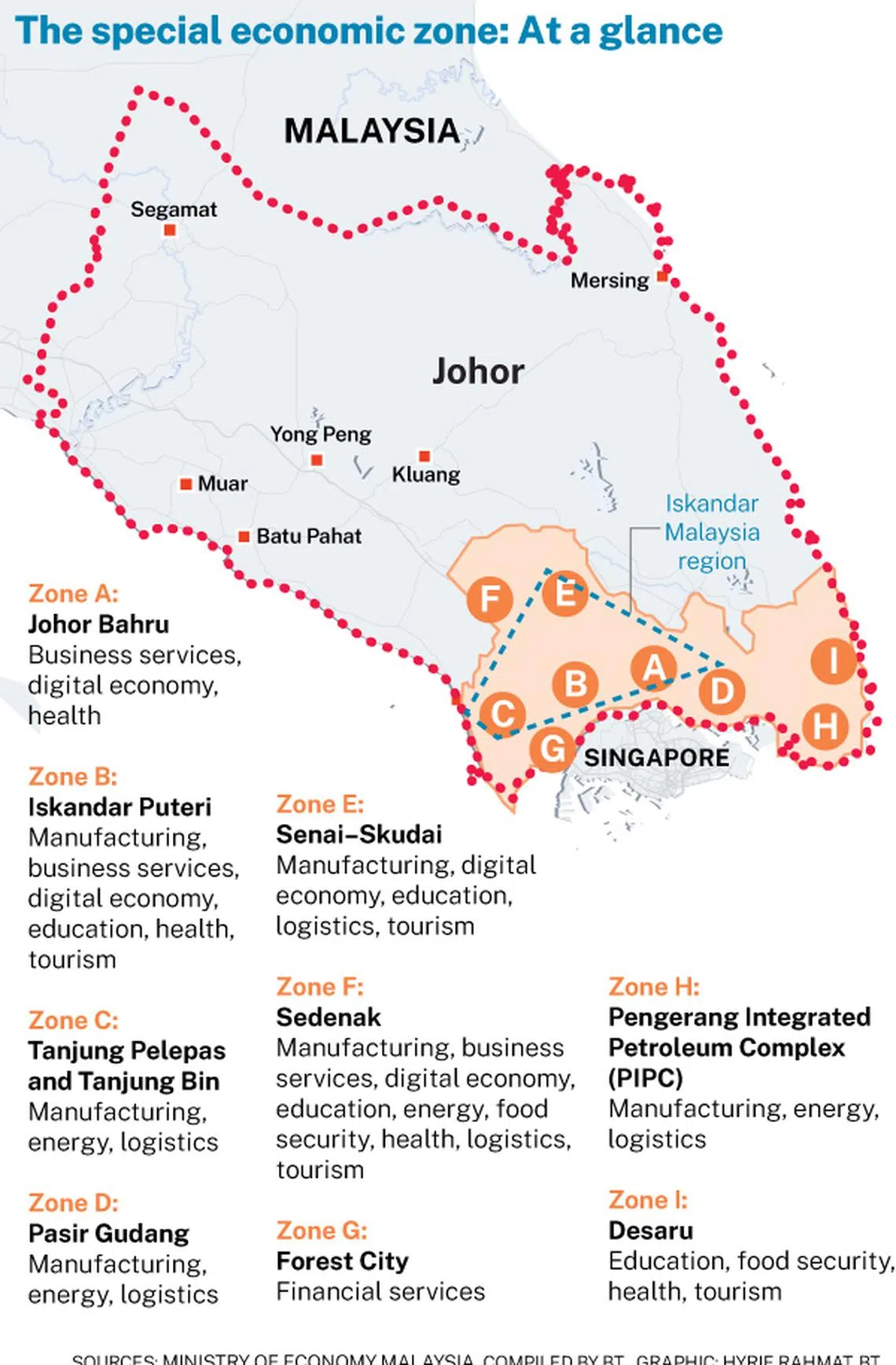
The JS-SEZ is aimed at attracting investments across 11 key sectors, including the digital economy, healthcare, logistics and energy.
In an earlier interview with BT, Rafizi highlighted that the JS-SEZ is expected to attract anchor investors within the next six to 12 months. This influx of investment is anticipated to kick-start infrastructure development and create a ripple effect that will draw in more medium and smaller enterprises.
The initiative is expected to have 50 projects in the next five years, with plans to expand to 100 projects over the next decade.
The JS-SEZ is expected to create around 20,000 skilled jobs, with anticipation that these jobs could command higher monthly salaries ranging from RM3,000 (S$915) to more than RM15,000.
Potential to attract chip makers
Wong noted that the collaboration would enhance Malaysia’s appeal for global investments, particularly in the semiconductor sector, which is projected to grow from US$520 billion in 2023 to more than US$1 trillion by 2030.
“The cake is large enough for everyone interested to have a piece. By establishing a closer relationship with Singapore, we hope to open more opportunities for Malaysia’s tech industries in higher-value projects.
“The JS-SEZ also holds potential for attracting new industries, such as integrated circuit design and wafer fabrication, which Malaysia has previously struggled to secure,” he said.
Malaysia has emerged as a key player in the global semiconductor industry, particularly in assembly, testing and packaging (ATP), accounting for 13 per cent of global semiconductor ATP. This makes it one of the largest hubs in the world alongside Taiwan, South Korea, Japan, the US and China.
Wong said the zone will bolster Malaysia’s supply chain resilience amid ongoing geopolitical tensions.
Lee pointed out that while there are more than 1,000 special economic zones globally, the JS-SEZ stands out as a unique cross-border initiative.
“This isn’t just about attracting Singaporean firms. It’s a platform for intra-Asean investments. However, both nations must ensure the necessary infrastructure and incentives are in place to maximise its potential,” he added.
A blueprint for South-east Asia
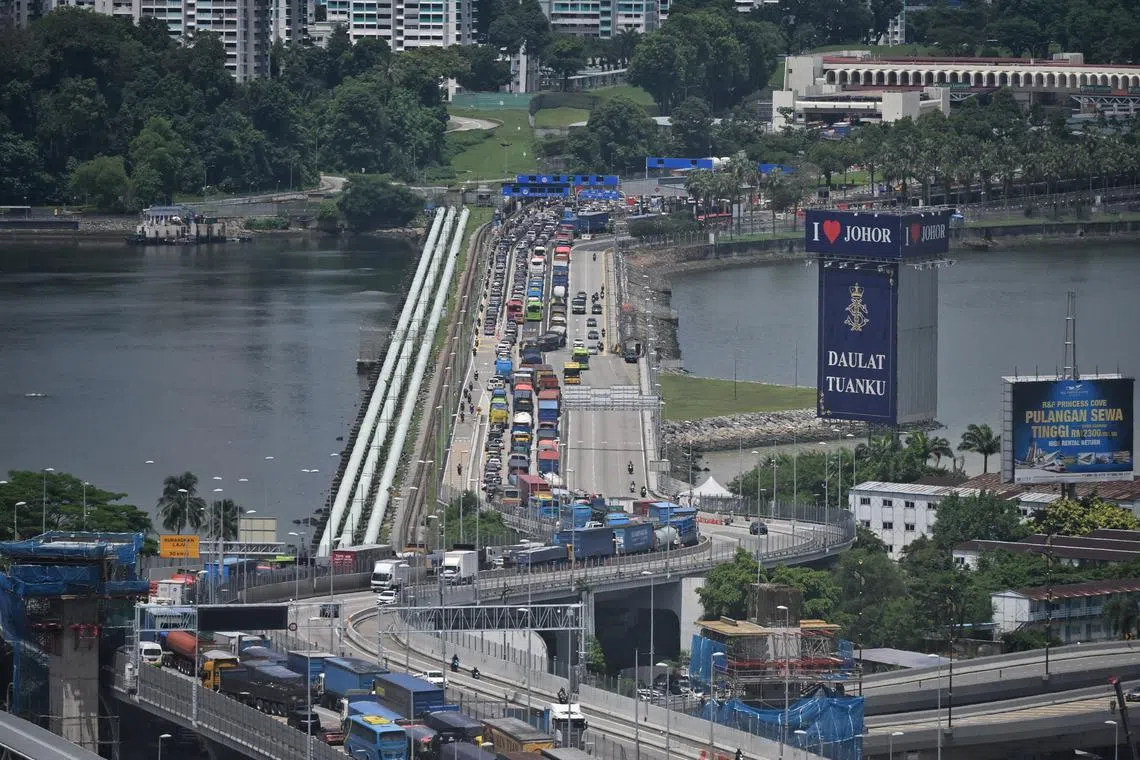
The JS-SEZ is expected to serve as a blueprint for bilateral collaboration in South-east Asia, demonstrating how two nations can achieve mutual economic benefits.
Lee and Koong expect similar initiatives to be established in the region, inspired by the success of the Johor-Singapore pact.
“By fostering collaboration between Malaysia and Singapore, the JS-SEZ is set to attract high-value investments, create resilient supply chains and serve as a model for regional economic integration,” said Koong.
The proposed SEZ covers more than 3,500 sq km, over four times the size of Singapore, and spans six districts – Johor Bahru, Iskandar Puteri, Pasir Gudang, Pontian, Kulai and Kota Tinggi. Malaysia has outlined nine flagship zones based on their strengths and potentials to drive growth.
As both governments finalise infrastructure and incentive plans, businesses and investors are eagerly awaiting further details.
“With the right execution, the JS-SEZ could transform Malaysia’s southern state into a global economic powerhouse while driving national and regional growth,” said Lee.