



Malaysia’s largest-ever budget is a prudent one with a ‘populist’ flavour
Tan Ai Leng
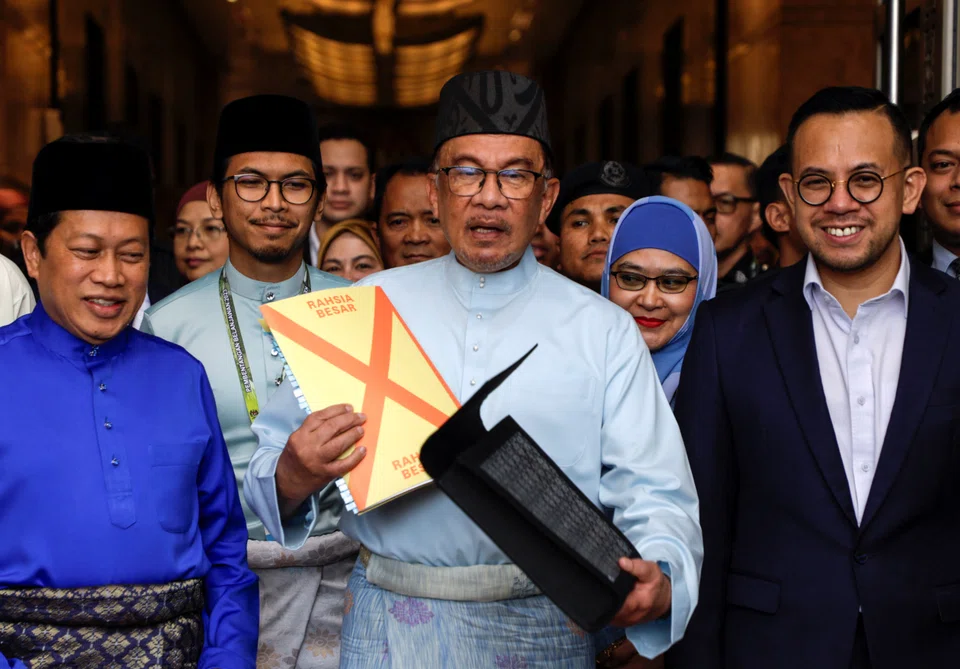
[KUALA LUMPUR] The first budget by Malaysia’s unity government, which Prime Minister Anwar Ibrahim unveiled in parliament last Friday (Feb 23), is notable for being the country’s largest ever, but analysts whom The Business Times spoke to feel it lacks a spark that’s needed to jumpstart the economy.
The RM388.1 billion (S$117.7 billion) budget was 4 per cent higher than the former Barisan Nasional’s government’s budget, which was tabled last October, just days before parliament was dissolved for a snap general election.
As promised earlier, Anwar said the government will spend in a pragmatic manner, with a focus on pursuing sustainable growth, fighting corruption and plugging leakages, as well as reducing social inequality through poverty eradication schemes.
Among the many initiatives that caught people’s attention were the implementation of excise duty on vape products and electronic cigarettes, a tax on luxury goods, tax reduction for middle-wage earners, and higher taxes for the wealthy.
There were also several policies that will help to draw investments, such as the declaration of a financial zone status for the Tun Razak Exchange in Kuala Lumpur and Iskandar Malaysia in Johor.
Anwar, who is also the finance minister, extended tax incentives for manufacturing firms that relocate to Malaysia. He also announced a 15 per cent tax rate for C-suite employees until 2024, as well as income tax and investment tax allowances until end-2025 for the aerospace industry.
Over the weekend as the budget measures were dissected, analysts and observers opined that the budget is a prudent one with a “populist flavour” that could help the unity government ahead of upcoming state elections later this year.
One business leader who requested not to be named said: “Nothing exciting (in the budget). It just offered what is needed now, especially for the preparation of the state elections.”
It is now nearly 100 days since Anwar’s government has been in office. Within the next few months, the governing coalitions will face another major test with six states – Kedah, Kelantan, Terengganu, Penang, Selangor and Negeri Sembilan – holding elections.
It will be crucial for the different political parties in the governing coalition to ensure they continue to have strong support from voters in the states, as this will help in the execution of current and future policies, while measures from the federal government could also be implemented at the state level.
Carmelo Ferlito, the chief executive officer of the Center for Market Education, said phrases like “tax the rich” or “tax luxury goods” may be useful to gain votes, but these are unlikely to produce any real benefits for the country.
“The same goes with the one-time RM500 injection to the Employees’ Provident Fund (EPF) accounts of two million people. There is an overall cost to the government, and it’s more of a measure with a populist flavour,” he said.
The government will contribute RM500 for EPF members aged between 40 and 54 years old who have less than RM10,000 in their accounts to rebuild their retirement funds. This scheme will require an allocation of nearly RM1 billion.
As things stand, Malaysia’s fiscal deficit is expected to narrow to 5 per cent of gross domestic product (GDP) this year, from 5.6 per cent in 2022.
CGS-CIMB Securities head of Malaysia research Ivy Ng said this is in line with the government’s targeted spending approach, as government expenditure is expected to decline 2.3 per cent to RM386.1 billion. The level of subsidies will go down to RM64 billion this year, from RM80 billion in 2022.
While robust economic growth and elevated commodity prices in 2022 helped to ease fiscal pressures through stronger revenue collections, Moody’s assistant vice-president Nishad Majmudar said Malaysia’s fiscal plans remain constrained by a narrow tax base relative to its rating peers, rigid spending commitments and a substantial reliance on oil and gas revenue.
“Plans to narrow the provision of subsidies to eligible households will be credit positive, but their beneficial impact on the fiscal outlook will become clearer only after a targeted subsidy programme is designed and launched,” he said.
UOB economists Julia Goh and Loke Siew Ting shared the same view, saying that domestic politics and this year’s state elections could sway the decision on subsidies.
Meanwhile, PwC Malaysia’s tax leader Jagdev Singh noted that the revised budget was glaring as it lacked comprehensive measures on Malaysia’s commitment to achieve net-zero emissions by 2050.
The introduction of a carbon tax was mentioned in the previous budget last October but it was not raised in Anwar’s revised budget.
“As the ESG (environmental, social and governance) agenda becomes more prominent among Malaysia’s corporates, with some even implementing an internal carbon pricing policy, it would have been impactful to incentivise companies to adopt strategies to manage climate-related business risks and transition to a low-carbon economy,” he said.
TRENDING NOW

Grab CEO’s wife Chloe Tong on life with Anthony Tan and finding her purpose

What role can Japan play in Asean’s future?

He built the Vingroup empire. Now South-east Asia’s richest man is handing some key roles to his sons

Asean’s challenge is to become resilient against global geopolitics: former Indonesia trade minister

