



Malaysia’s latest budget is a responsible one but lacks punch: analysts

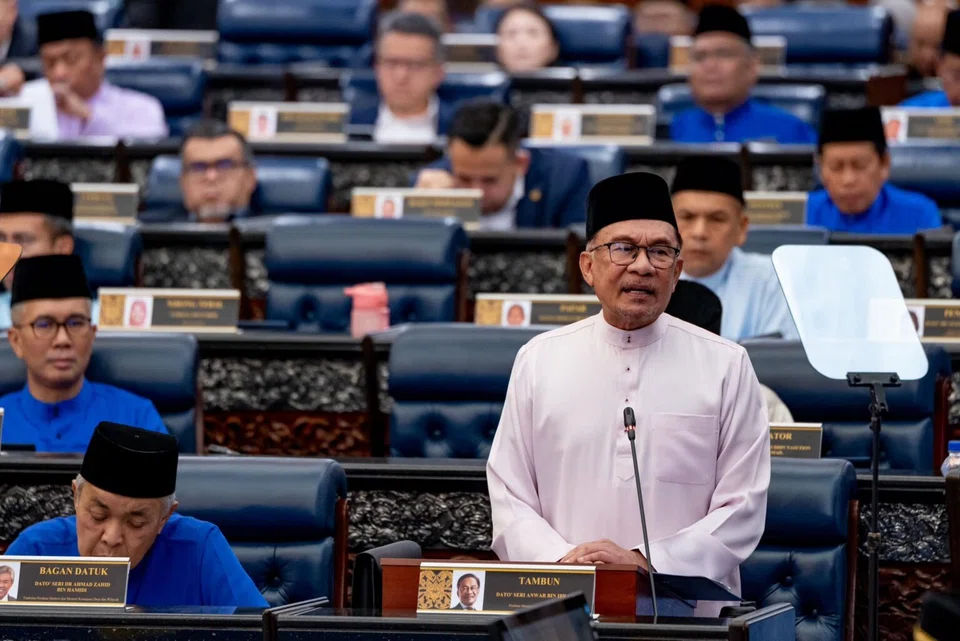
[KUALA LUMPUR] Malaysian Prime Minister Anwar Ibrahim unveiled a RM393.8 billion (S$113.6 billion) Budget 2024 last Friday (Oct 13), with the aim of fixing the leakages through fiscal reforms while maintaining the country’s economic growth momentum.
While the largest-ever Budget was widely described as a “responsible and neutral” one by analysts and economists, many pointed out how the measures were largely geared towards medium and long-term growth, and lacking in any short-term catalysts.
EY Malaysia tax leader Farah Rosley observed that the Budget measures aimed to strike a balance between stimulating growth and fostering an inclusive and equitable society.
OCBC Bank’s senior Asean economist Lavanya Venkateswaran said the Budget showed the Malaysian government is “walking the talk” of establishing a path to better fiscal health over the medium term.
Among the many tax initiatives announced by Anwar, who is also finance minister, were a capital gains tax for the disposal of unlisted shares based on net profit at 10 per cent; an increase in the services tax rate to 8 per cent, from 6 per cent currently; a higher excise duty on tobacco and sugary drinks; and a luxury goods tax of 5 per cent to 10 per cent.
These measures, coupled with the implementation of targeted fuel subsidies to replace the current blanket subsidy, will help reduce spending on subsidies and social assistance, said Lavanya.
Higher inflation
Given the government’s fiscal consolidation agenda, Lavanya estimated that Malaysia’s inflation rate will fall between a wider range of 2.1 per cent and 3.6 per cent in 2024.
RHB also revised its forecast on Malaysia’s consumer price index (CPI) for next year, with projections of headline and core CPI revised upwards to 3.3 per cent (from 2.7 per cent previously) and 3.6 per cent (from 3.2 per cent), respectively.
The country’s year-on-year headline and core CPI increased 2 per cent and 2.5 per cent, respectively, in August.
RHB economist Chin Yee Sian and associate research analyst Wong Xian Yong said the Budget reinforced their views for Malaysia’s gross domestic product (GDP) growth to accelerate next year.
For 2024, the government’s official forecast is for the economy to expand by 4 per cent to 5 per cent – in line with the World Bank’s 4.3 per cent estimate – although Anwar said last Friday that he was confident that the 5 per cent target could be achieved.
Winners and losers
Chehan Perera, managing director and head of market research at CGS-CIMB Securities, said the growth projections could be met if large-scale catalytic projects under the National Energy Transition Roadmap are rolled out in a timely manner.
“We maintain that policy clarity and continuity is badly needed for Malaysia to transition to a sustainable high-growth path that will help in attracting investment, creating more jobs and increasing incomes,” he said.
CGS-CIMB stayed heavily weighted on the construction, real estate, utilities, automotive and banking sectors, as the coming Budget spending maintained “strong domestic bias”.
Maybank Investment Bank chief economist Suhaimi Ilias shared a similar view, noting that the construction and infrastructure sectors were the biggest winners, thanks to higher allocations and new projects.
These projects include five more stations under the Klang Valley light rapid transit development (RM4.7 billion), a nationwide flood mitigation programme (RM11.8 billion), and the development of Penang’s light rapid transit (RM10 billion).
He said the aviation and consumer sectors are also winners, riding on a higher allocation to boost tourism.
The gaming sector, meanwhile, is the “clear loser” due to a higher service tax rate of 8 per cent, with the likelihood of casino operators needing to absorb the additional cost, said Suhaimi.
In a report, Standard Chartered Bank (Singapore) gave a positive view on Malaysia’s sovereign debt market outlook, mainly driven by the government’s plans to reduce the fiscal deficit to 4.3 per cent in 2024, as compared to 5 per cent this year.
According to the bank’s economists Edward Lee and Jonathan Koh, the proposed fiscal deficit was lower than the 4.6 per cent indicated earlier by Economy Minister Rafizi Ramli.
“More importantly, the government estimates a reduction of subsidy and social assistance spending to RM52.8 billion in 2024, from RM64.2 billion in 2023. Structural changes include the removal of subsidies for the top 10 per cent of electricity users and the floating of poultry and egg prices,” they wrote.
In addition, the government will introduce new revenue measures, including the hike on services tax, that are expected to raise revenue by 0.2 per cent of GDP per annum. “These measures together signal a strong fiscal consolidation intent, in our view,” they said.
FBM KLCI, ringgit stay muted
Malaysia’s record Budget was notable for the upcoming new taxes and subsidy rationalisation, although observers said these have yet to spur much interest in the performance and outlook of the local stock market and the ringgit.
The FTSE Bursa Malaysia Kuala Lumpur Composite Index was largely flat at the end of the first trading day after the announcement.
At the opening bell on Monday, the index started 0.3 per cent higher at 1,445.36 points, but lost momentum afterwards. It ended the day at 1,438.96 points, 0.4 per cent or 5.1 points lower than last Friday’s close.
As for the ringgit, it extended its downward trend on Monday as investors turned their attention to the stronger US dollar amid the escalating conflict in the Middle East.
At 5 pm on Monday, one US dollar was trading at RM4.74. The ringgit has depreciated 7.7 per cent against the greenback since the start of the year.
TRENDING NOW

One-third of Singapore-listed firms at risk in severe AI downturn: MAS

‘Not done’: Keppel CEO Loh Chin Hua transformed the group, but says there’s ‘still a lot to do’

He built the Vingroup empire. Now South-east Asia’s richest man is handing some key roles to his sons

‘We don’t want to stay as we are’: CEO Patrick Ng builds a more resilient Huationg

