


Asean Business logo
SPONSORED BYUOB logo

Malaysia’s Musang King eyes the throne in China after durian fallout in Thailand

Beijing has tightened rules on Thai shipments following recent yellow dye scandal; Malaysia’s tree-ripened fruits seen enjoying strong demand in booming market there

Summarise
Tan Ai Leng
Published Tue, Mar 25, 2025 · 05:06 PM
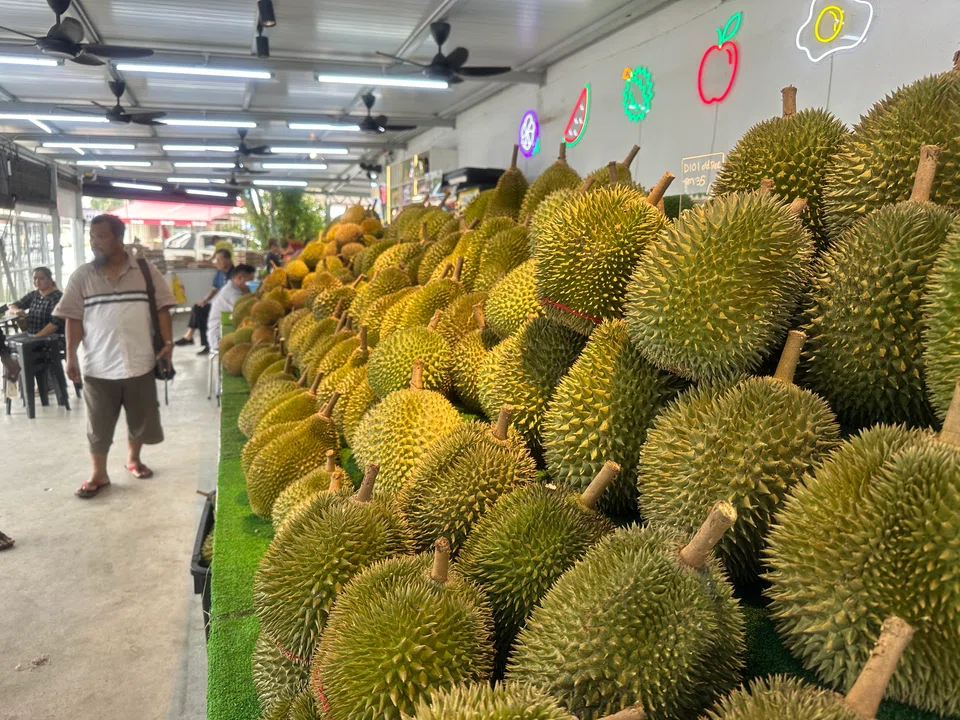
    • Despite the positive outlook, Malaysia’s durian production capacity remains a limiting factor.
    • Despite the positive outlook, Malaysia’s durian production capacity remains a limiting factor. PHOTO: TAN AI LENG, BT

    [KUALA LUMPUR] Malaysia’s durian exporters may soon strike gold in China, after the world’s top durian importer tightened rules on Thai shipments tainted by a yellow dye scandal last month.

    Nearly 65,000 kg of Thai durians were destroyed over contamination with a carcinogenic colourant.

    The stricter regulations now require additional lab tests for pre-harvested durians – an approach used by major exporters like Thailand and Vietnam – potentially delaying their shipments.

    But Malaysia’s tree-ripened durians, picked only after they fall naturally – a traditional harvest method – could now enjoy a smoother path into China’s booming market.

    “Unlike Thailand and Vietnam, we wait for durians to fully ripen and fall naturally before collecting them,” said Edwyn Chiang, secretary-general of the Malaysia International Durian Industry Development Association, in an interview with The Business Times.

    “Since our durians are already ripe, there’s no need for artificial colouring or ripening agents,” he added.

    Thailand and Vietnam durians dominate China’s durian import market, accounting for over 99%. PHOTO: BT FILE

    Lim Chin Khee, an adviser at Durian Academy, which trains Malaysian growers, expects rising demand for Malaysian durians in China, particularly for the premium Musang King variety.

    “Malaysia focuses on quality over quantity, whereas Thailand dominates the mass-market with Monthong durians. With the temporary halt on Thai durian exports, we anticipate increased interest in Malaysian durians,” he said.

    China rejected and disposed of tens of thousands of Thai durians after they were found to be contaminated with Basic Yellow 2, a synthetic dye used to enhance the fruit’s colour. The dye, classified by the World Health Organization as carcinogenic, triggered food safety concerns, prompting tightened measures.

    As a result, all fresh durians imported into China must undergo safety testing at customs.

    A fruitful gap to fill

    Despite the positive outlook, Malaysia’s durian production capacity remains a limiting factor.

    “Even though plantation activities have expanded, durian trees take at least seven years to bear fruit,” Chiang noted. “Last year, Malaysia exported around 450,000 tonnes of durians, and we expect a modest 5 per cent increase in exports this year.”

    China durian imports setting new historical high in 2024

    • Volume: 1.6 million tonnes (up 9.4 per cent year on year) 
    • Value: US$7 billion (up 4 per cent year on year)

    Top durian exporting countries to China (market share):

    • Thailand: 57.4 per cent
    • Vietnam: 42.1 per cent
    • Malaysia and the Philippines: 0.5 per cent

    China’s voracious appetite for durians saw it import nearly 1.6 million tonnes worth close to US$7 billion in 2024, with the market largely dominated by Thai and Vietnamese fruit, according to news and analysis portal Produce Report.

    While Thailand accounted for 57 per cent of these imports, down from 68 per cent in 2023, Vietnam’s market share rose to 42 per cent from 33 per cent in 2023, reflecting its aggressive expansion in the sector.

    The Philippines and Malaysia accounted for the remaining 0.5 per cent of China’s durian imports. The Philippines saw a significant increase, exporting US$32.5 million worth of durians last year – a surge of 144 per cent from a year earlier.

    Indonesia is expected to join the bandwagon this year, with negotiations to allow frozen durian exports ongoing and pending an agreement, to be signed with China, in March or April.

    Juicy luxe market

    Malaysia Agriculture and Food Security Minister Mohamad Sabu showcased the first batch of fresh durian in Shenzhen, China in August last year. Malaysia's fresh Musang King is packaged as luxury fruit in China. PHOTO: MOHAMAD SABU/FACEBOOK

    Malaysia, which gained approval to export fresh durian to China in June 2024, shipped its first batch in August. Over the following five months, the country’s fresh durian exports totalled over US$5.7 million.

    Malaysia’s premium durians, including Musang King and Black Thorn, were distributed as luxury fruits to 16 major Chinese cities, including Beijing, Shanghai, Shenzhen, Guangzhou and Chengdu. The fresh durians were sold at over US$80 per fruit.

    BMI, a Fitch Solutions company, in a report in February forecasted increasing competition in the durian market as Malaysia and Vietnam challenge Thailand’s dominance.

    Vietnam, in particular, has seen a surge in durian exports, with volumes growing at a compound annual growth rate of 22.8 per cent over the past five years. In 2024, Vietnamese durian exports reached US$3.3 billion.

    While Malaysia’s durian industry may struggle to rapidly scale up production, the country’s reputation for high-quality, naturally ripened durians will drive sustained demand in China’s premium market, said Durian Academy’s Lim.



