



Malaysia’s stock market, ringgit under pressure as Anwar, Muhyiddin tussle to form government
Tan Ai Leng
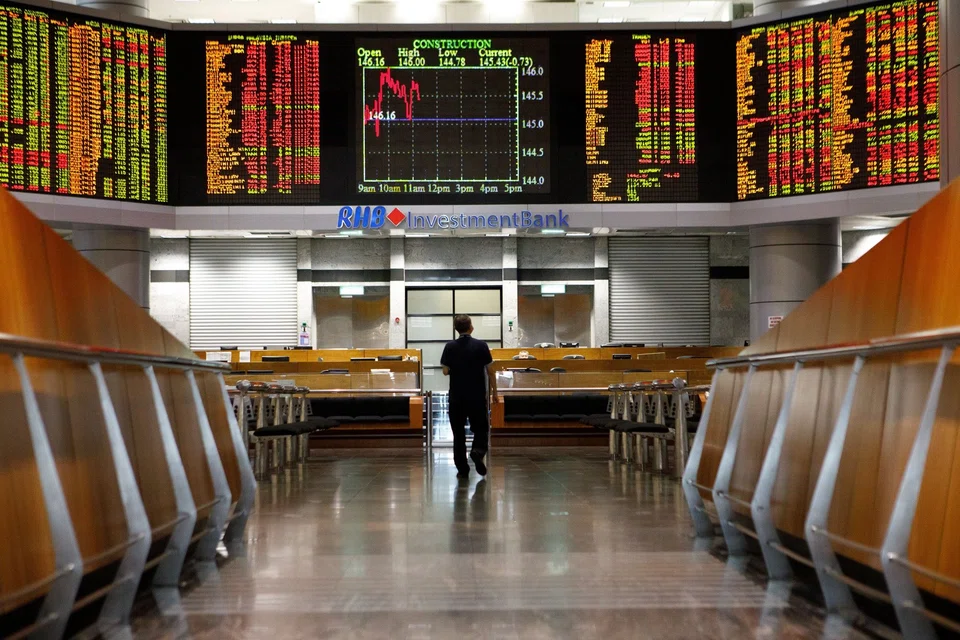
[KUALA LUMPUR] Malaysia’s stock market and ringgit endured a rough ride on Monday (Nov 21), the first trading day after a hotly contested 15th general election that led to the country’s first hung parliament and continued uncertainty over who would form the next government.
The benchmark FTSE Bursa Malaysia Kuala Lumpur Composite Index (KLCI) fell by as much as 18 points , or 1.2 per cent, to 1,431.54 – from last Thursday’s close of 1,449.32. The index closed marginally lower at 1,447.96 points at 5 pm.
The downtrend saw 510 decliners and 378 gainers, while 362 counters were unchanged and 48 counters suspended. Turnover stood at 4.29 million units worth RM2.5 billion (S$749 million).
Top losers included brewery, gaming, consumer and plantation companies. Counters such as Heineken Malaysia, Carlsberg Brewery Malaysia, Genting Bhd and Genting Malaysia saw their share prices suffer a decline of between 5 per cent and 8 per cent.
The fight to form the next government continued on Monday as the various political parties and coalitions engaged in deal-making in a desperate bid to amass the minimum 112 parliament seats.
The palace extended the original deadline by a day for the coalitions to present their numbers to form the government and propose their candidate for prime minister. The coalitions have until 2 pm on Tuesday to do so.
Pakatan Harapan (PH), a coalition led by opposition leader and former deputy prime minister Anwar Ibrahim, secured the most seats (82) out of 219. Perikatan Nasional (PN), led by former prime minister Muhyiddin Yassin, was in second place with 73.
Caretaker prime minister Ismail Sabri Yaakob’s long-ruling Barisan Nasional (BN), which pushed hard for the snap polls to be held, won just 30 seats.
On Sunday evening, Muhyiddin announced that PN had managed to gather support from East Malaysia’s Gabungan Parti Sarawak and Gabungan Rakyat Sabah – they secured a total of 29 seats – to form a new government with BN.
However, Anwar also said the PH coalition has secured sufficient seats to form the next government after he and PH leaders met up with BN’s top guns including BN chairman Ahmad Zahid Hamidi.
Market analysts cautioned that the forming of a new government could entail higher regulatory risks, especially to sin sectors that are dependent on policy implementation. For example, the licences of numbers forecast operators (NFO) might not be renewed in some states controlled by Parti Islam Se-Malaysia (a component party of PN coalition).
Alexander Chia, head of RHB Regional Equity Research, expects Malaysia’s equity market to trade cautiously this week. He feels that a possible PN-led government will affect the gaming, brewery and tobacco sectors as the “regulatory risks spike higher”.
“We expect investors to re-focus on fundamentals, with a preference for non-politically aligned, large-cap value stocks,” he said.
CGS-CIMB Securities’ head of Malaysia research Ivy Ng noted that banks, gaming, construction and brewery sectors would see negative share price reactions if a PN-led government was formed.
Nevertheless, both PN- and PH-led governments are positive for consumer, pharmaceutical and infrastructure spending in Sarawak, she added.
UOB Kay Hian also downgraded the sin stocks – especially casino, NFO and brewery stocks – to underweight.
Market analysts slashed their KLCI target for the end of 2022 to as low as 1,450 points due to the ongoing political uncertainties.
In a report, Kenanga Research cut their year-end KLCI target by 3 per cent to 1,450 points (from 1,500 previously), noting that the aftermath of “Sheraton move” incident in 2020 – which left the country without a functioning government – caused the KLCI to drop by as much as 4.6 per cent to 1,467 points on March 2, 2020.
The research firm added that the forming of a coalition government means that it will be challenging for future new policies’ implementation and structural reforms.
Hong Leong Investment Bank also lowered their year-end KLCI target to 1,470, from 1,540 previously.
The investment bank said a hung parliament election outcome is unprecedented for Malaysia. And accompanied by political risk premium, the knee-jerk sell impact could be cushioned by a 10.5 per cent slide from the year-to-date high of 1,620.
CGS-CIMB’s Ng anticipates the market to react negatively and there are also concerns that political infighting may happen again after the forming of a new government.
She observed that when the opposition parties did well against Barisan Nasional (BN) in 2008 and 2018, the KLCI fell 3 per cent and 6 per cent one month after the 12th and 14th general elections, respectively.
However, Ng expects the volatile market to last for only a short period as the new government will take steps in institutional and political reforms in the long run, the KLCI target has been cut to 1,484 points for end-2022 to reflect short-term political uncertainties.
Vincent Khoo, the head of research in UOB Kay Hian Malaysia, said on Monday that he foresees the unexpected results will create major investor jitters, which will cause KLCI to fall to 1,400 or below.
In view of short-term volatility, the investment bank revised the year-end KLCI target to 1,490 points from 1,585. “Nevertheless, we continue to take the optimistic view that KLCI will trend up towards year-end, to rejoin the global equity uptrend as US core inflation eases.”
Separately, the ringgit also traded lower against the US dollar on Monday, dropping 0.7 per cent to RM4.58 (from RM4.55 a day earlier).
Kenanga Investment Bank’s head of economic research Wan Suhaimie told The Business Times that the weakening ringgit is partly due to the fluid political situation but the main reason for depreciation is because of rising concerns of recession and further monetary tightening by the Fed.
“Now it’s too early to predict (the ringgit trend) but if the hung parliament situation prolongs, the probability of the ringgit hitting RM5.00 level against the US dollar will rise,” he added.
MUFG Bank’s senior currency analyst of global markets research Jeff Ng agreed that global headwinds are still the main factor that influences regional currencies’ movement, including the ringgit.
Although the political instability played a part in the ringgit’s weakening, he noted that the impact should be short-term and will gradually fade off after a new government is formed by the leading coalitions – PH and BN – which have experience in running the country.






