


Masan’s retail arm banks on omnichannel reach to cement dominance in Vietnam
But it will take a while for the country’s largest retail chain to make that segment of the business a key profit contributor
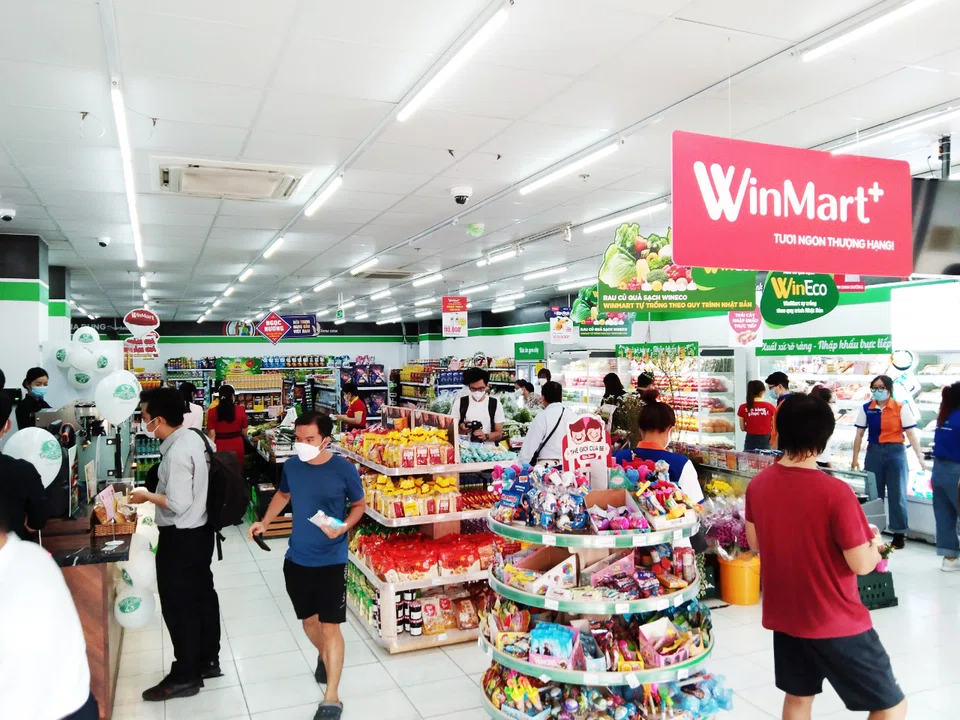
[HO CHI MINH CITY] Vietnamese consumer giant Masan’s retail grocery chain WinCommerce is doubling down on expanding its omnichannel presence, a move that could challenge pure e-commerce players in the country’s online grocery retail space, which has plenty of room to grow.
WinCommerce plans to roll out its e-grocery strategy in stages, starting with the digitisation of customer interactions through a membership programme, Masan’s co-head of strategy and development Le Ba Nam Anh told The Business Times.
Masan – among the top three biggest conglomerate private sector companies in Vietnam in terms of market capitaliation – produces some of the country’s top brands of instant noodles, beverages and seasonings.
The next phase involves continuing to enhance WinCommerce’s logistics network and omnichannel supply and demand forecasting to enable a seamless online and offline shopping experience.
So far, the retailer, which operates roughly half of Vietnam’s minimarts, has registered nearly nine million customers under its membership scheme and offers online shopping services across 130 WinMart supermarkets.
Anh told investors last month that WinCommerce will deploy e-grocery services across thousands of WinMart+ minimarts by end-2025 or early-2026.
He did not give a specific revenue target for the online channel but pointed out that in more developed markets, e-grocery accounts for 5 to 10 per cent of sales.
“The Vietnam market still has got some time to go till that point,” he said. “Consumers still prefer to touch and feel their grocery produce.”
Preference for brick-and-mortar shopping
In Vietnam, the share of e-commerce revenue from the retail sector was about 8 per cent last year, according to a report issued by the trade ministry. This means that the vast majority of transactions are still taking place at brick-and-mortar stores.
This is not unique to Vietnam. Another report by Boston Consulting Group showed that traditional trade, primarily at mom-and-pop stores, remained the largest grocery retail channel across South-east Asian countries, making up about 73 per cent of the region’s total grocery retail sales.
The second-largest channel was modern trade, which includes sales from supermarkets, hypermarkets, minimarts, and convenience stores. This channel accounted for about 12 per cent of the total grocery retail sales in Vietnam, 23 per cent in Indonesia, 28 per cent in the Philippines and 49 per cent in Thailand.
“The modern grocery retail industry in Vietnam is still far behind that of other South-east Asian countries,” analysts at Ho Chi Minh City-based Viet Dragon Securities Corporation noted in a recent report, adding that this made the country “fertile land” for modern retail chains.
They observed that Vietnam has attracted an influx of domestic and international grocery retail players in recent years, despite the sluggish growth forecast for Vietnam’s grocery retail market, with a compound annual growth rate of 2.8 per cent until 2028.
WinCommerce plans to launch 400 to 700 new stores this year and hopes to double its offline store count to 8,000 by 2028. Rival Bach Hoa Xanh, a unit of Mobile World Investment Corporation, is also planning to open 100 new locations in Ho Chi Minh City in 2024.
“We believe there’s still plenty of room to scale our store footprint in Vietnam,” Anh said, pointing to the fact that WinCommerce’s network of 3,700 minimarts and supermarkets is still a far cry from the 15,000 to 20,000 outlets of some dominant retail chains in Thailand and Indonesia.
Grocery e-commerce at play
As the Covid-19 pandemic forced shoppers to go online, e-commerce and ride-hailing players such as Sendo, Tiki, and Grab entered the online grocery market, delivering fresh food and other necessities to Vietnamese customers with just a tap on their mobile phones.
“It is a ‘blue-ocean’ market,” Tran Hai Linh, the chief executive and co-founder of Sendo, told BT in a recent interview. “If we are on the same trajectory (with online grocery), I think we will achieve profitability a lot sooner than if we just do e-commerce marketplace.”
However, this plan could be challenged by the efforts of big retailers like WinCommerce to extend their reach beyond offline avenues.
Experts say these retail networks could have an edge over pure e-commerce players as they have inventory already frontloaded to stores close to end-consumers.
“Fulfilling e-commerce orders through in-store pickup and delivery within the vicinity would be faster than most e-commerce platforms. It can also embed customer experience into the stores,” said Li Jianggan, chief executive of Singapore-based venture firm Momentum Works.
These retailers could, however, face obstacles in terms of constantly acquiring and retaining online customers, Li said. The root challenge also lies in the determination of the retailer’s leadership to win the e-commerce play and overcome organisational inertia to support innovation.
Revisions to IPO plan
Masan, one of the country’s largest conglomerates, acquired its retail chain WinCommerce from VinGroup in 2019.
In 2022, the group said it was considering an international initial public offering (IPO) for its unit The CrownX within the next 18 to 24 months. The CrownX consolidates WinCommerce and consumer goods company Masan Consumer Holdings.
Masan has however shifted gears and is now seeking a share sale for Masan Consumer, a subsidiary in which Masan Consumer Holdings holds a majority ownership of nearly 94 per cent.
Anh said that Masan Consumer is “considering a potential IPO due to its track record”. In addition, the share sale is expected to “determine the intrinsic value” of the company and its parent, Masan Group.
In 2023, Masan Consumer Holdings accounted for nearly 65 per cent of gross profit and 92 per cent of total earnings before interest, taxes, depreciation, and amortisation of The CrownX.
The market capitalisation of Masan Consumer on Vietnam’s Unlisted Public Company Market was about 140.7 trillion dong (S$7.5 billion) on Jul 19, higher than that of Masan Group on the country’s main bourse.
Meanwhile, WinCommerce also aims to achieve net profit after tax in the latter half of this year, a milestone it hit only once in 2021 since Masan acquired the retail chain from Vingroup.
“WinCommerce needs a bit more time to achieve a sustainable net profit profile,” said Anh. “When that time comes, there are various options we can pursue to unlock the value of The CrownX.”



