Middle East crisis deals fresh blow to Philippine growth outlook
Decades of reliance on oil imports has left the country’s economy vulnerable to global market shock
[MANILA] The Philippines faces a fresh economic hit from the Middle East crisis, with officials warning that surging oil prices could drive inflation as high as 8.6 per cent, drag growth down to 3.5 per cent and squeeze households already reeling from steep fuel cost increases.
The warning comes after President Ferdinand Marcos Jr declared a state of national energy emergency, making the Philippines the first country to take such a step in response to the Middle East conflict, as the oil-importing nation scrambles to contain the fallout from soaring global fuel prices.
The executive order (EO), issued on Tuesday (Mar 24), also makes it the Philippines’ first national crisis declaration since the 2020 pandemic.
Now, concern is mounting over the economic fallout of sustained oil price volatility for a country dependent on imported fuel.
The Department of Economy, Planning, and Development (DEPDev) forecasts that inflation will reach between 7.3 and 8.6 per cent in 2026 under a worst-case scenario in which crude prices hit US$200 per barrel for six months. Food inflation is projected at 6.1 per cent and non-food inflation at 10 per cent.
“We could potentially return to the high inflation of last year, and that is what we need to prevent,” DEPDev secretary Arsenio Balisacan said in a Senate hearing on Tuesday.
The risk is not merely inflation but stagflation: a combination of rising prices, slowing growth, and weakening employment.

Balisacan described the scenario as a potential “triple whammy” of elevated oil prices, a possible ban on overseas Filipino worker deployment and reduced government spending. Together, these could drag gross domestic product growth down to 3.5 per cent this year, from a pre-crisis target of 5 to 6 per cent.
Estimates from DEPDev suggest higher inflation and weaker remittance inflows could erode household purchasing power and depress domestic demand.
In a worst-case scenario, remittances are projected to fall by as much as 167.5 billion pesos (S$3.6 billion), while unemployment may rise to 5.84 per cent and poverty incidence to 12.55 per cent.
This leaves policymakers grappling with a difficult trade-off. Cutting excise and value-added taxes on fuel could provide immediate relief at the pump, but at a steep fiscal cost.
The Department of Finance has warned that removing excise taxes alone could result in a revenue shortfall of 136 billion pesos in 2026, potentially constraining spending on infrastructure and social services.
Supply chain crisis
Energy secretary Sharon Garin maintains the Philippines has sufficient fuel supplies to last through mid-May, or about 45 days of oil reserves.
But John Baybay, a strategy consultant and the founder and principal of Nucurv, told The Business Times that the country’s dependency on oil imports places it in a precarious situation.
The Philippines imports about 90 per cent of its oil requirements, making it “more vulnerable to shocks due to supply chain dependence on foreign crude”, he said. In contrast, “Malaysia and Indonesia are net or partial producers with domestic output”.
These countries can “extend supply through production”, Baybay added.
“This is a supply chain crisis. Unlike the pandemic with its demand constraints, this is about supply constrained by logistics.”
Renato Reyes, president of Bayan – a group representing the interests of marginalised sectors – said the Marcos administration fails to strike at the root causes of the crisis.
Oil price volatility is but a symptom of the country’s sensitivity to global and local pressures: from the Middle East conflict and the blockage of the Strait of Hormuz, to a weakening peso and the realities of a deregulated oil industry.
Yet, the Philippines continues to be “heavily reliant on imported oil and has not embarked on building its own national industry”, Reyes said.
“There is no transparency in pricing. We have no idea how prices are determined except for movements in the world market. The automatic price adjustments and heavy consumer taxes on oil have made Philippine prices among the highest in the region, (along with) Singapore,” he said.
With soaring fuel costs threatening livelihoods across sectors, a nationwide strike is set for Mar 26 and 27 to demand urgent government intervention to stabilise the broader economy. Over 100,000 participants are expected to gather in 20 locations.
“The people are neither comforted nor assuaged by the government’s response to the crisis,” Reyes said.
Impact on households
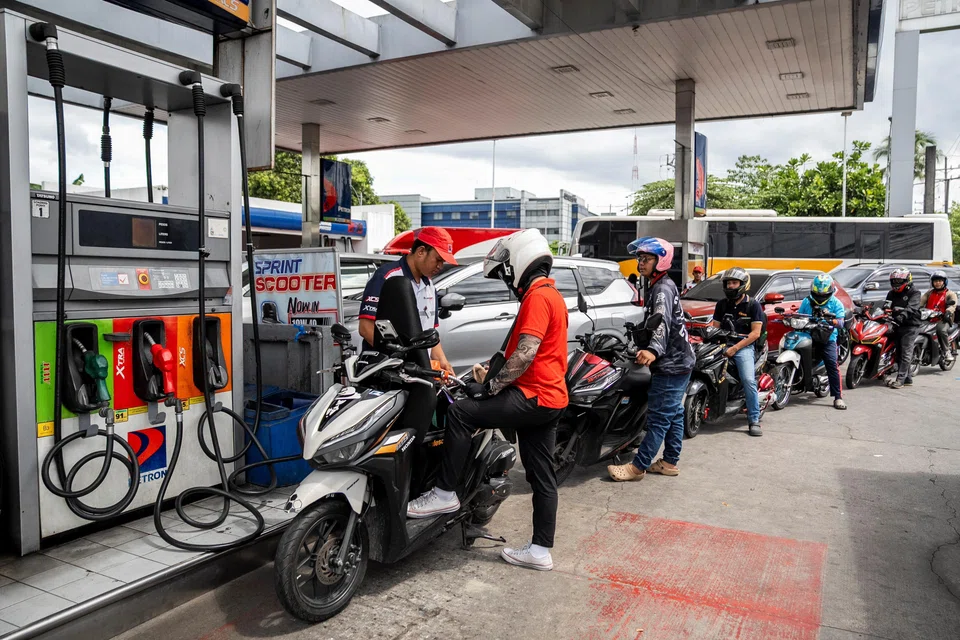
Domestic oil companies are scheduled for another price hike this week. Industry forecasts indicate diesel prices will rise by 11.88 pesos per litre, while kerosene is expected to climb by 13.66 pesos. Petrol prices are also projected to increase by 6.47 pesos per litre.
These adjustments follow record-breaking hikes from a week ago, which saw diesel jump by as much as 23.90 pesos per litre and petrol by up to 16.60 pesos.
Prices in late February, prior to the start of the conflict, were relatively stable. Diesel was retailing between 60.60 pesos and 81.14 pesos per litre, while petrol prices ranged from 55.20 pesos to 76.24 pesos. Kerosene, meanwhile, maintained a price spread of 97.90 pesos to 121.49 pesos per litre across Metro Manila.
Last week, however, diesel prices climbed to a range of 91.35 pesos to 126.20 pesos per litre, while petrol prices rose to between 74.60 pesos and 100.40 pesos. Kerosene saw the most volatile shift, with the high end of the retail bracket reaching 143.79 pesos per litre.
Ordinary Filipinos are feeling the sting.
“We don’t own a car; we use public transport. But dropping off and picking up our kids from school already costs us 20 per cent more,” said Otep Tugano, a father of two from Cavite.
Joel Montecalvo, a fisherman from Quezon province, said he no longer makes enough money from his catch. “Almost all my earnings go towards diesel and gasoline,” he said.
Ann San Pedro, a manager at a supermarket chain in Bulacan, anticipates an increase in foot traffic from people stocking up on basic goods such as rice amid price increases.
The Marcos administration has opted for a mix of targeted interventions. The EO authorises the Department of Energy to implement fuel allocation plans and emergency procurement measures.
It also establishes the Uplift programme, which extends subsidies and other livelihood support to people in crisis, from transport workers, farmers, and fisherfolk to displaced local workers and overseas Filipinos forced to return home.
Under a 2.5-billion-peso fuel subsidy programme, for example, more than 245,000 transport operators and drivers are set to receive aid: 10,000 pesos per unit for bus operators and 5,000 pesos each for drivers.
This patchwork of government solutions has drawn criticism.
“The EO does not address the basic problem of runaway oil prices and its effects on the mass transport system and other sectors in the country,” Reyes said, noting the absence of concrete steps to suspend oil taxes and enforce price controls.
Meanwhile, the 10 billion pesos earmarked for farmers and fisherfolk, when divided among over four million beneficiaries, will only amount to 2,325 pesos per recipient. “This is barely enough,” he said.
As a middle-class household, Tugano’s family has seen the prices of basic commodities rise amid the fuel crisis. “The government doesn’t seem to have control over the situation. This is what hurts Filipinos the most,” he said.