



Most Asean nations get softer US tariffs, mitigating growth risks ahead of Aug 7 hikes
But the 40% levy on transhipped goods now applies beyond Vietnam – a move analysts largely see as aimed at China
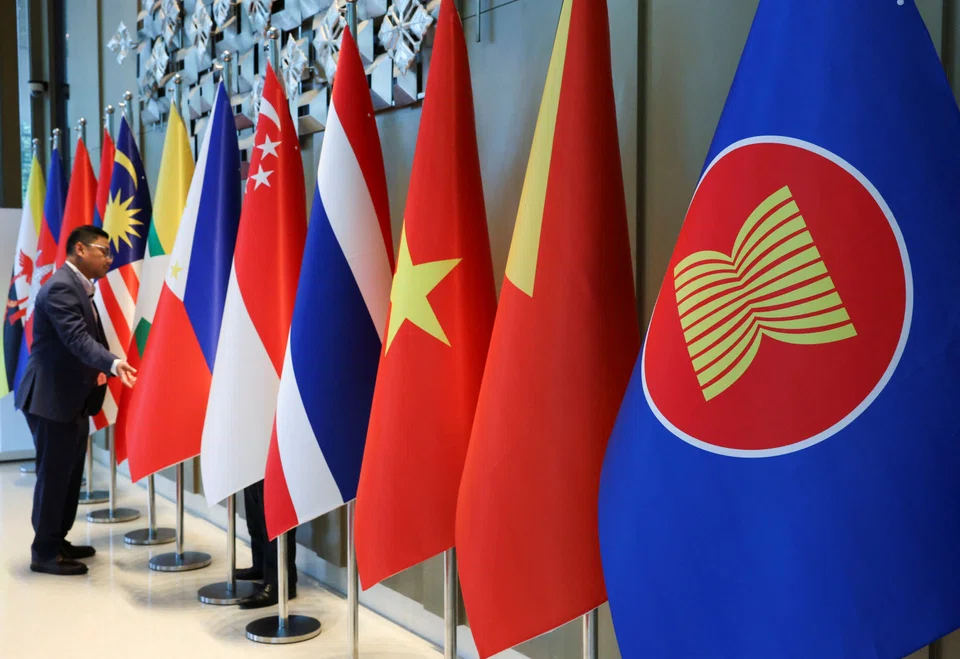
MOST Asean countries have secured reductions of the US reciprocal tariffs ahead of the prior Aug 1 deadline for the higher tariffs to kick in, following months of intense deal-making and significant market access, trade and investment concessions.
According to US President Donald Trump’s executive order unveiled on Thursday (Jul 31), Singapore remains subject to a baseline rate of 10 per cent; the majority of South-east Asian economies face duties of between 19 and 20 per cent, which will now start on Aug 7.
Rahul Bajoria, Asean and India economist at BofA Securities, told The Business Times: “This is a better outcome than what was anticipated, but the rate of tariff is still much higher than what the status quo was.
“The Asean region saw a lot of front-loading of exports, so some payback is unavoidable, but with a better growth outcome, we see a respectable scope for GDP (gross domestic product) growth in the region.”
Laos and Myanmar bear the heaviest burden in the region. Despite reduced tariffs of 40 per cent each, they still face one of the highest rates the United States has imposed on its global trading partners.
Dozens of other countries have been hit with tariffs ranging from 10 to 41 per cent, and goods from nations not specifically listed will be levied a universal US import tax of 10 per cent.
The 40 per cent tariff on transhipped goods now applies not only to Vietnam, but also to other countries – a move analysts largely see as aimed at China. However, uncertainties remain surrounding the rules of origin used to identify targeted shipments, as well as upcoming sector-specific tariffs.
Maybank senior economist Chua Hak Bin said: “‘China + 1’ is not dead, as all Asean countries will face lower effective tariff rates than China. China’s multinational corporations (MNCs) will likely consider having an alternative base, given China’s high effective tariff rates of over 35 per cent.”
The Trump administration also signalled that “meaningful” agreements with certain nations are forthcoming, potentially leading to revised duties, as the US seeks to bring more trading partners in line with its economic and national security priorities.
“Don’t assume this is the end of the story. Trump regards this as an ongoing reality show,” noted Stephen Olson, former US trade negotiator and visiting senior fellow at Iseas-Yusof Ishak Institute. “Developing countries, especially those in South-east Asia hoping to pursue export-led development models, will be especially hard hit.”
Radhika Rao, senior economist at DBS, echoed this viewpoint, emphasising that despite better clarity on the country-specific tariffs, the new rates are two to six times higher than the average implied most-favoured-nation rates in 2024, suggesting significant economic impact for both the region and the US.
However, China’s stronger-than-expected economic performance and its potential rapprochement with the US could mitigate the risk of a negative growth shock for the Asean region, added Bajoria of BofA Securities.
BT has compiled key developments from the following Asean nations to examine the implications of the latest tariff landscape:
Singapore: ‘Sweet spot’ with lowest rate
Singapore will continue to be subject to a 10 per cent baseline tariff on exports to the US, the Ministry of Trade and Industry (MTI) said on Friday (Aug 1).
“MTI has confirmed this understanding with the Office of the US Trade Representative,” a ministry spokesperson said, referring to the US’ executive order released on Jul 31 (Eastern time).
“We are closely monitoring developments and will seek clarification from our US counterparts as necessary,” the spokesperson added.
The relatively low baseline tariff rate of 10 per cent should bring some relief to exporters in Singapore, economists said.
“Singapore is in a sweet spot and ‘can live with it’, as her reciprocal tariff is the lowest in Asia,” said Dr Chua, echoing similar remarks by the Republic’s Prime Minister Lawrence Wong earlier this week.
But companies looking to launch investments are likely still “in a holding pattern” as they assess the frequent changes in tariff policies, noted Denise Cheok, head of South-east Asia economics at Moody’s Analytics.
Trump’s tariff letters state that the levies may change “depending on our relationship with your country”, noted Bernard Aw, the Asia-Pacific chief economist at credit insurer Coface. “The certainty is that uncertainty will remain,” he added.
With the fluid situation, he said that companies likely have two plans ongoing – a short-term one to mitigate uncertainties, and a long-term plan to adjust to the new economic realities.
The long-term one would entail reorganising logistics and shifting production, among other things.
Even so, MNCs already in the city-state would likely maintain their presence, said Dr Chua. MNCs caught in a higher-tariff country may consider Singapore as a part of their supply chain.
Still, Cheok estimates the baseline tariff could shave about 0.5 percentage point off Singapore’s GDP. “With close trade partners attracting much higher tariffs, the hit to GDP from direct tariff-related disruptions would come in closer to about 1 percentage point,” she said.
She added that beyond the headline 10 per cent, a key concern for Singapore is sectoral tariffs, especially on pharmaceuticals, which dominate Singapore’s exports to the US.
Since the Singapore economy is highly dependent on trade, the indirect effects of tariffs on global export demand remain a key factor to the outlook, said Cheok.
Dr Chua added that he expects Singapore’s export and GDP growth to slow in H2, but not contract, given the reciprocal tariff deals, the low baseline tariff and a likely extension of the US-China trade truce.
Reported by Sharon See from Singapore
Vietnam: First, but not best
While Vietnam was the first Asean country to strike a trade deal with the US by granting “total access” to its market, its tariff outcome is no more favourable than that of most regional peers.
Washington set a 20 per cent levy on goods imported from the South-east Asian country, with which the US ran a trade deficit of US$123.5 billion last year – the highest in Asean and third-highest globally.
While this was a significant reduction from the previously announced 46 per cent, it remains slightly higher than the 19 per cent imposed on Malaysia, Indonesia, Thailand, Cambodia and the Philippines.
According to S&P Global’s latest purchasing managers’ survey released on Aug 1, new export orders for Vietnam’s manufactured goods contracted for the ninth consecutive month in July.
While manufacturers remained optimistic about output growth over the coming year, sentiment fell to a three-month low – well below the series average – because of concerns over how the US tariffs weighed on the outlook.
Still, the manufacturing sector returned to expansion in July after three months of decline, with firms securing enough domestic business to lift total new orders back into growth.
Maybank analysts wrote in a recent note that Vietnam’s steady roll-out of private-sector reforms would cushion the impact of of the tariffs on external trade by promoting domestic investment and boosting the country’s competitiveness as a destination for foreign direct investment.
An improved business environment – characterised by reduced red tape, a more predictable legal framework, better education system and stronger local firms – is expected to broaden Vietnam’s value proposition beyond being merely a low-cost destination, they added.
Reported by Jamille Tran from Ho Chi Minh City
Malaysia: Level playing field
Just before the Aug 1 deadline kicked in, the US reduced the reciprocal tariff imposed on Malaysian imports to 19 per cent, down from the earlier 25 per cent rate, bringing the South-east Asian country in line with its regional peers. It also removes a key overhang for exporters, particularly in the electrical and electronics, as well as glove sectors.
Hong Leong Investment Bank wrote in a note that from a trade standpoint, the harmonised US tariff rates across Asean ensure that Malaysia is not at a relative disadvantage.
Ken Low, head of dealing at Moomoo Malaysia, noted that the tariff reduction offers short-term optimism. While the new rate is less damaging than the previous one, it remains on a par with that of its regional peers, and continues to pose a hurdle to the competitiveness of Malaysian exports.
In a statement on Friday, Malaysia’s Ministry of Investment, Trade and Industry (Miti) stressed that the US-Malaysia tariff agreement was reached without compromising on key “red-line” issues such as excise duty and bumiputra equity quotas, thus protecting the country’s sovereign economic policies.
At a media briefing on Friday evening, Miti Minister Tengku Zafrul Aziz said that Malaysian semiconductor and pharmaceutical exports would remain exempt from US tariffs.
Under the deal, the Malaysian government confirmed that 61 per cent or 6,911 items of its new trade arrangement’s tariff lines with the US would have zero tariffs. Malaysia and the US are expected to issue a joint statement on the tariff agreement over the weekend.
Tengku Zafrul clarified there is no agreement or request from the US for exclusive access to Malaysia’s rare earths, despite such minerals being central to US trade talks globally.
To address the trade deficit with the US, Malaysia will make major procurements, including the purchase of another 30 Boeing aircraft valued at US$9.5 billion, he noted.
Miti said the government worked with Bank Negara Malaysia to model tariff scenarios and would implement targeted measures to support affected exporters and small and medium-sized enterprises.
Reported by Tan Ai Leng from Kuala Lumpur
Indonesia: Room to breathe
Indonesia, which is grappling with domestic economic pressures, has secured a final US tariff rate of 19 per cent on its exports, easing fears of the fallout from President Trump’s Apr 2 rate of 32 per cent.
While still nearly double the 10 per cent baseline applied during the reprieve, the revised rate offers some relief as the country grapples with domestic economic pressures.
Indonesia’s tariff rate remains lower than Vietnam’s, a key regional rival in labour-intensive sectors like textiles and footwear. As the US ranks as Indonesia’s second-largest export market, analysts believe the reduced tariffs could boost trade and protect labour-intensive industries from economic challenges.
The deal was reached following an agreement between President Prabowo Subianto and Trump to open Indonesia’s vast market of 280 million consumers to US goods.
Indonesia, which runs a US$17 billion trade surplus with the US, will eliminate tariff barriers on more than 99 per cent of goods coming in from the US, and commit to purchasing US$2.5 billion in agricultural products and US$15 billion in energy supplies.
Citi’s research team sees the agreement as having a net dovish impact on the Indonesian economy. While the shift in import sources may slightly weigh on the trade balance, the broader macroeconomic effects are expected to be manageable. Risks to the rupiah remain, but are likely to stay contained as long as Indonesia’s commodity export prices remain stable.
Reported by Elisa Valenta from Jakarta
Cambodia: Double cuts to match peers
Cambodia cheered the “great news” of a 19-per-cent tariff on its US exports – a cut from the earlier 36 per cent and a significant drop from the original 49 per cent, which would have devastated its manufacturing sector and jarred its economy.
The kingdom’s Prime Minister Hun Manet took to Facebook on Friday morning to praise the “excellent outcome”, but analysts BT spoke with cautioned that Cambodia is not yet out of the woods.
Adam Ahmad Samdin, an economist at research firm Oxford Economics, said that transhipments, the definition of which is left to the discretion of the US authorities, remain a bugbear for Cambodia, because its production is heavily reliant on Chinese inputs.
The nation’s post-pandemic economic expansion has been picking up speed, and annual growth has surpassed 5 per cent, but the double whammy of US tariffs and recent border disputes with neighbouring Thailand has clouded its outlook.
Adam acknowledged that the reduced levy mitigates a substantial amount of downside risk to Cambodia’s growth, noting that there remains scope for more immediate near-term support, as the kingdom improves its public debt ratio and rebuilds its fiscal space.
Maybank economist Brian Lee added that border tensions will weigh on tourism, particularly in border areas, such as Poipet. Thailand is Cambodia’s top source of international tourists.
Nevertheless, the revised tariff brings Cambodia in line with its Asean neighbours and is lower than the rate imposed on its regional competitors (such as India) in the garment space, said Lee.
He added that the risk of a sharp pullback in foreign direct investment is now reduced.
The house expects Cambodia’s growth to slow from 6 per cent in 2024 to 5 per cent this year and 4.6 per cent next year.
Reported by Goh Ruoxue from Singapore
TRENDING NOW

Singapore identifies 7 firms responsible for haze fires, notices issued urging action: Grace Fu

Could stablecoins be the future of money?

Singapore should prepare for prolonged haze until November, says Grace Fu

High Court rules against Julius Baer’s Singapore trust arm in US$50 million family trust dispute

