As MSCI review looms, Indonesia’s stock market reforms test investor confidence
The exchange is set to delist 18 companies, whose shares have been suspended for months

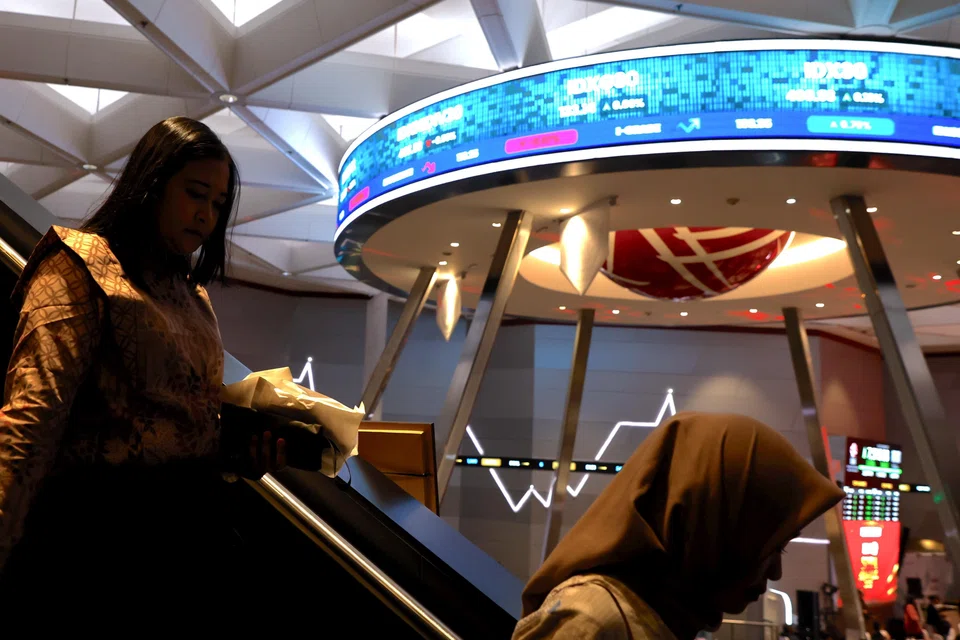
[JAKARTA] The Indonesia Stock Exchange (IDX) is set to delist 18 companies by the end of this year as part of a market clean-up effort. The move could test investor confidence even as regulators push ahead with reforms to improve transparency and strengthen the credibility of South-east Asia’s largest equity market.
Analysts said the wave of delistings reflects a necessary step in cleaning up the market, though the process could cause discomfort for investors in the short term.
“Rising delistings can hurt confidence in the near term, especially for retail investors stuck in suspended stocks for too long,” said Mohit Mirpuri, senior partner at SGMC Capital.
“But longer term, forced delisting is healthy, it removes weak, illiquid, non-compliant names and should improve overall market quality,” he added.
The 18 companies together have a market capitalisation of about 1.8 trillion rupiah (S$133 million) – roughly 0.01 per cent of the Indonesian market’s total value of about 13,000 trillion rupiah.
The relatively small value reflects the fact that most of the affected companies have been suspended for long periods, traded at very low prices or have seen little trading activity for years, which has significantly eroded their market valuations.
Dormant stocks
Of the 18 companies, seven are being delisted after being declared bankrupt, while the remaining 11 have had their shares suspended for more than 50 months, which the exchange deems as dormant stocks.
The exchange has given the companies time to conduct a share buyback before the delisting takes effect in November this year.
Among the more prominent names facing delisting is Sri Rejeki Isman, better known as Sritex, once one of Indonesia’s largest textile producers before it collapsed under a heavy debt burden.
Another is Sugih Energy, an integrated energy firm whose past investors included global financial institutions such as Credit Suisse and Indonesia’s state energy giant Pertamina.
The company’s shares have been suspended since July 2019 after it was hit by years of financial losses and a mass resignation of its board of directors.
I Gede Nyoman Yetna, director at the IDX, said the exchange may delist a listed company if it faces significant financial or legal problems that threaten its business continuity and it fails to show adequate signs of recovery.
Before deciding to delist a company, he said, the exchange undertakes a series of supervisory and guidance measures, giving issuers the opportunity to improve their performance while closely monitoring their progress.
“The process is intended to alert companies to address their problems while also serving as an early warning to investors about potential risks,” Yetna said.
A fresh test
The removals come as global index provider MSCI has warned that Indonesia risks being downgraded from emerging to frontier market status if transparency and accessibility concerns are not addressed by May.
The firm said on Monday (Apr 20) it would maintain curbs on Indonesian equities and delay index changes in its May 2026 review. MSCI said it will provide further clarity on its evaluation of Indonesia’s market reforms in June, when it releases its next market accessibility review.
Harry Su, managing director at brokerage firm Samuel Sekuritas, said the wave of delistings could unsettle retail investors, who make up the majority of participants in Indonesia’s equity market.
The number of retail investors in Indonesia has surged from just 3.9 million in 2020 to more than 20 million today, the largest pool in South-east Asia, with more than half of them aged under 30.
“Retail investors are often the ones trapped in stocks that face prolonged suspensions,” he said, noting that this can lead to frustration and financial losses.
Such experiences may also discourage participation in the market and dampen liquidity, as investors become more cautious about smaller or less transparent companies, he added.
Indonesian market authorities recently said they have now completed the full set of reforms requested by MSCI, including measures to improve disclosure, liquidity and market governance.
This includes publishing a list of stocks with highly concentrated shareholdings to give investors clearer visibility into companies where shares are held by only a few investors.
A shake-up in conglomerate stocks
Beyond the current wave of delistings, the exchange’s stricter rules on public share ownership could also reshape Indonesia’s corporate landscape, long dominated by powerful conglomerates that keep a tight grip on their listed entities.
The IDX has raised the minimum free float requirement to 15 per cent from the current 7 per cent, meaning at least that proportion of a company’s shares must be held by public investors.
The rule will be implemented gradually: listed companies with a market capitalisation above five trillion rupiah have until 2028 to comply, while smaller firms have until 2029.
Companies with highly concentrated ownership structures, particularly those controlled by large conglomerates, may need to adjust to comply.
Samuel Sekuritas’ Su noted that conglomerate firms with tightly held shareholding structures could face challenges meeting the 15 per cent free float requirement, potentially increasing the risk of regulatory scrutiny or even delisting if they fail to adapt.
“Looking ahead, we may see structural changes within conglomerates as they adapt to evolving market expectations,” he said. “This could involve increasing free float by offering additional shares to the public or simplifying group structures to make them more transparent.”
But others argue the rule is unlikely to trigger widespread problems because companies are being given several years to comply.
Mirpuri said most credible issuers should be able to meet the new standard, as the implementation will be phased in gradually rather than imposed immediately. Rather than threatening corporate control, the policy is primarily aimed at improving liquidity and making Indonesian stocks more investable for institutional investors, he said.
Over time, conglomerates may respond by increasing public share ownership, simplifying group structures or spinning off business units into separate listed entities.
“Better structure usually means better liquidity, better price discovery and stronger investor confidence,” Mirpuri said.
IPO momentum remains strong
The reforms come at a time when regulators are also seeking to maintain momentum in new listings after Indonesia’s stock market experienced a surge of initial public offerings in recent years.
Mirpuri said stricter governance standards do not necessarily discourage companies from going public. In fact, he said clearer rules could improve the quality of IPOs by encouraging companies to list with stronger governance and more investor-friendly structures.
As at the end of the first quarter, the IDX said 53 companies are currently in its initial public offering pipeline, with the potential proceeds from these planned listings estimated at around 1.38 trillion rupiah.
Meanwhile, total funds raised in Indonesia’s capital market had reached 51.96 trillion rupiah as at end-March this year, reflecting continued fundraising activity despite tighter market reforms.