Asean Business logo
SPONSORED BYUOB logo

MUFG looks to leverage regional partners to grow Asean corporate banking business 

Bank’s network in S-E Asia said to give it strong local capabilities and thus a ‘huge competitive advantage’

Tan Nai Lun
Published Mon, Oct 28, 2024 · 05:00 AM
    • Richard Yorke, head of global corporate and investment banking for Asia-Pacific at MUFG, says that the bank's ability to provide clients with a complete range of solutions sets it apart from other foreign or local competitors.
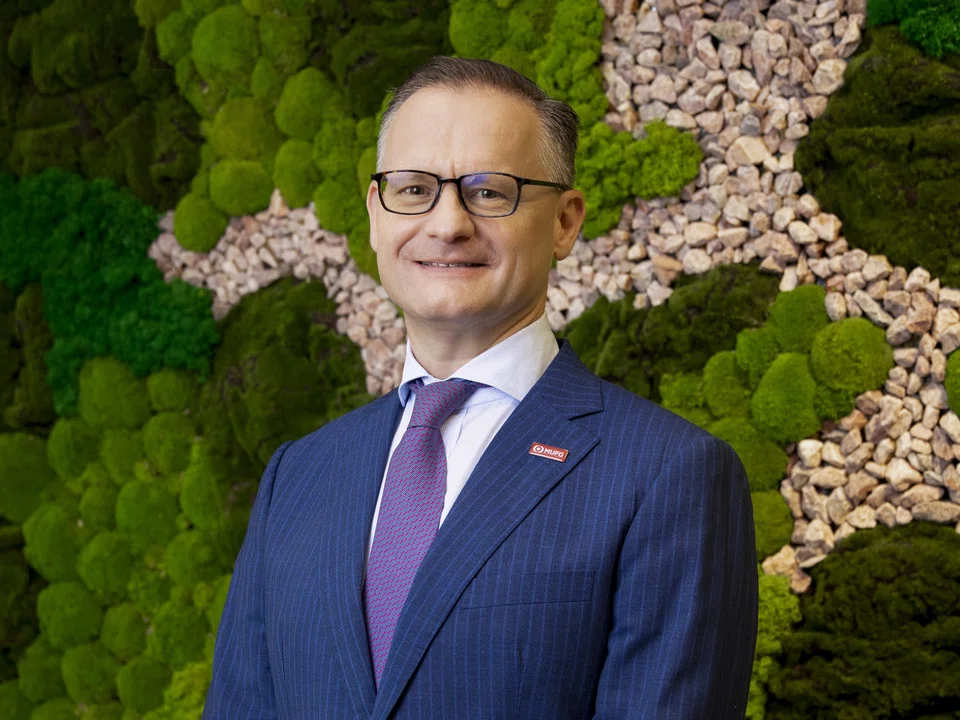
    • Richard Yorke, head of global corporate and investment banking for Asia-Pacific at MUFG, says that the bank's ability to provide clients with a complete range of solutions sets it apart from other foreign or local competitors. PHOTO: MUFG

    MUFG is already known as Japan’s largest bank. In South-east Asia, it now wants to be more than just that.

    Richard Yorke, head of global corporate and investment banking for Asia-Pacific at MUFG, noted that it is also a significant shareholder of several regional banks.

    The Japanese banking group operates in 18 markets in the Asia-Pacific region under the MUFG brand.

    Now, it is looking to leverage its network of partner banks in Asean to propel its corporate banking business in the region. Its ability to provide clients with a complete range of solutions sets it apart from other foreign or local competitors, Yorke said.

    “There are things that foreign banks can offer in a market, but there are also a lot of things which only make sense to local commercial banks, because the foreign banks don’t have the scale,” he noted.

    MUFG has, since 2012, invested more than US$14 billion in four regional banks in Asean, as it views the region as a key market alongside Japan.

    It has a 19.7 per cent stake in Vietnam’s VietinBank; 76.8 per cent stake in Thailand’s Bank of Ayudhya; 20 per cent stake in the Philippines’ Security Bank Corporation; and a 92.5 per cent stake in Indonesia’s Bank Danamon.

    This has allowed MUFG to have strong local capabilities, on top of what the bank can provide through its MUFG branches in these markets, Yorke added.

    Furthermore, MUFG also has a 22 per cent stake in Morgan Stanley, which brings additional capabilities to the overall banking group, he said.

    “It’s a real partnership in both directions – leveraging each other’s competitive strengths to give the best solution to clients.”

    Yorke noted that, over the years, the bank has focused its efforts on a limited number of clients so that it can understand them more and better leverage its network.

    This is especially as corporates in the region increasingly look for certainty in their relationships with their banks.

    He observed that every few years – such as during the Covid-19 pandemic – several foreign financial organisations will reconsider their concentration in Asia, which can be very disconcerting for clients.

    “We made a very deliberate strategy of focusing deeper on fewer names, so that when there’s a sudden event, we can’t change the event, but we can hopefully understand the impact of that on their business better than other people,” he said.

    Meanwhile, Yorke noted that clients have also become more comfortable breaking up the region into smaller groupings, and looking for banks that have a particular strength in a grouping or a country.

    This gives MUFG a “huge competitive advantage” because it means that clients can rely on the group’s partnerships when choosing banking services, rather than go to two different banks, Yorke added.

    Japan Inc

    MUFG is also looking to ride on its dominant position in Japan and the strength of its Japanese business, Yorke said.

    He noted that Japan is particularly strong in certain sectors that are very big areas of focus at the moment, such as the logistics, hospitality, data centre and real estate sectors.

    Investors may also find opportunities amid the Japanese stock exchange’s attempt to revitalise the market, or among a growing generation of Japanese entrepreneurs looking to sell their businesses.

    Meanwhile, the yen remains attractive. “It has suddenly gotten much bigger – before it was Japan outbound; now it’s Japan inbound, as well as Japan outbound,” he said.

    Given that MUFG is already the largest bank in Japan, it has more customer relationships that it can leverage across the region than other banks.

    On the economic outlook, Yorke noted that the bank is starting to see deals get done, given the clarity on the interest rate trajectory.

    “You’re seeing that clients who may have postponed some of their investment decisions are now making those decisions,” he said.

    He also sees a focus on the diversification of supply chains, and in some cases, the reshoring of supply chains.

    “People generally are optimistic about growth, and with interest rates falling and the kind of certainty in the market, that’s increased the sense of optimism,” he added.