



Net foreign selling of Vietnamese stocks may ease ahead of potential market upgrade in 2025
Set against a strong inflow of FDIs, the sell-off by foreign investors points to divergent views on the country’s growth outlook, analysts say


[HO CHI MINH CITY] Robust foreign direct investment (FDI) inflows have stood in contrast with a shrinking proportion of shares owned by foreign investors in Vietnam’s stock market. This proportion fell to a 10-year low following consistent net selling since 2023.
This points to foreign investors’ divergent views on the country’s short-term and long-term growth drivers.
Quan Trong Thanh, head of research at Maybank Investment Bank Vietnam (MSVN), said: “Normally when FDIs come in, it would raise the attention for portfolio investments to follow.”
That has not been the case so far, but if things unfold in Vietnam’s favour, one catalyst would be the upgrade of the country’s stock market from “frontier” to “emerging” status in 2025.
Improved status needed
Thanh added: “The market upgrade is really needed for foreign financial investors to get the mandate to fully invest in the country, but it hasn’t progressed in a way they have been expecting.”
The MSCI and FTSE indices, both prominent global benchmarks, currently categorise Vietnam as a frontier market, which restricts many funds, family offices and other investors from investing in its listed companies.
Thanh said a market upgrade could fan new interest from equity investors in China and Malaysia – both significant sources of FDI in recent years – in addition to the current main sources South Korea, Thailand and Taiwan.
Vietnam, one of Asia’s fastest growing economies, has maintained its strong FDI profile, as investors are optimistic about its long-term growth drivers such as stable economic policies and sound fundamentals.
New FDI pledges in the first seven months of this year grew nearly 11 per cent year on year to surpass US$18 billion, on the back of a substantial 32 per cent year-on-year jump in registered FDI to US$37 billion last year.
Most of this was ploughed into the manufacturing sector.
Meanwhile, foreign investment funds and investors have been consistently unwinding their positions in Vietnam’s US$270 billion stock market due to concerns over short-term challenges.
Since 2023, foreigners have sold an estimated US$3.5 billion in Vietnamese stocks, including over US$2.4 billion in the first seven months of this year, going by MSVN data.
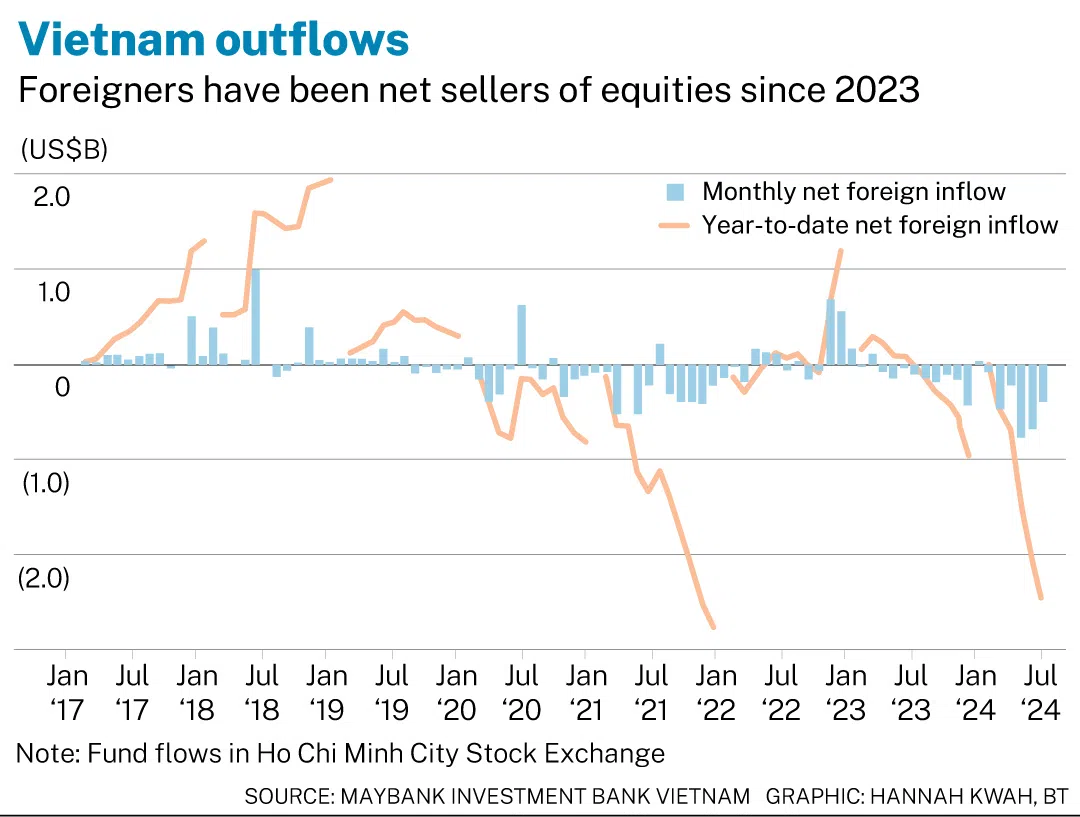
Analysts attribute the selling spree to the funds’ profit-taking and portfolio rebalancing, which has entailed a pivot from less-efficient markets, amid geopolitical uncertainty and the US Federal Reserve’s tight monetary policy.
The hawkish monetary policies in the US have put pressure on Vietnam’s financial market, exacerbating interest-rate differentials between the two currencies and contributing to the 4 per cent year-to-date depreciation of the Vietnamese dong against the greenback.
Adding to the mix are some negative internal developments in Vietnam, including turbulence in the corporate bond and real estate markets and the delayed launch of the new trading system known as KRX.
There have also been unprecedented government personnel changes in the last two years; and political uncertainty is lingering even now because of a fresh shakeup of senior positions, including the election of a new president in October and the departures of two deputy prime ministers.
Analysts expect net selling to persist in the next three months, and for volatility to prevail amid mixed economic signals across the global markets and as investors adjust their portfolios.
However, they reckon the intensity could subside in the last quarter as the macro-environment and political stability improve.
If Vietnam’s stock market is upgraded – possibly next March or September – net buying could potentially return in the first quarter of 2025.
Peter Redhead, who leads the equity research team at Ho Chi Minh City Securities Corporation, said at a recent Fitch Ratings’ conference: “The fundamentals are there. The international investors are willing to come back. They are just waiting for positive sentiment to kick in.”
To upgrade or not
Vietnam’s stock market, the smallest among the main South-east Asian economies, has been on FTSE’s watchlist for a reclassification since 2018.
Data compiled by MSVN showed that as at March 2023, there were 470 funds with total assets under management of US$890 billion invested in emerging markets following FTSE and MSCI classifications; these included Vietnam’s regional peers, Indonesia, Malaysia, Thailand and the Philippines.
A reclassification in the FTSE’s emerging market basket could potentially attract immediate investments of between US$1.7 billion and US$2.5 billion into Vietnam, SSI Securities Corporation estimates.
However, analysts also warned of potential volatilities upon the upgrade, as the market would become more vulnerable to foreign retail investors’ sell-offs of exchange-traded funds (ETF) during economic disturbances.
Barry Weisblatt, head of research at VNDirect Securities, said: “A lot of the money that is expected to come to Vietnam after an upgrade is from ETFs. These are not sticky, long-term investments; investors can easily switch to other funds as global economic conditions change.”
But on a long-term horizon, funds allocated to emerging markets tend to stay. The World Bank anticipates that, by 2030, the stock-market upgrade could bring up to US$25 billion in new investments from international investors to the Vietnamese stock market.
The final step for Vietnam’s FTSE upgrade is the removal of the requirement for upfront funding by equity investors; the country’s authorities are expected to grant this approval next month.
The inclusion of Vietnam’s equity markets in MSCI’s emerging market indices, which are benchmarked by the majority of global funds, is expected to happen between 2026 and 2028.
The country still needs to tackle the challenges stemming from the accessibility of the market for global capital flows, including foreign ownership limits, said a June report by the American index provider.
Sovereign rating
Foreign investors currently hold about 14 per cent of shares in the Vietnamese equity market. Daily trading volume is still dominated by retail investors, accounting for about 80 to 90 per cent of the total liquidity.
“We need to get more institutional money to come in, to give a balance of the market structure. The market would be less volatile, with more rational analysis, and more investable,” MSVN’s Thanh said.
Attracting foreign institutional investors also depends on the availability of attractive stocks, which Vietnam still lacks, amid a tepid market for initial public offerings (IPOs) and the sluggish privatisation of state-owned enterprises in recent years, analysts say.
So far, traditional, old-economy stocks from sectors such as banking and real estate are still dominant in terms of both number and market cap in Vietnam.
FiinGroup, a Vietnam-based financial-data provider, noted in its July report that an upgrade of sovereign credit rating is also critical because foreign institutional investors typically invest across various asset classes when entering a new market.
It wrote: “This will not only contribute to higher liquidity but also, more importantly, attract capital from foreign institutional investors, both equity and long-term debts, for corporate growth.”
In June, American credit-rating agency Fitch Ratings affirmed Vietnam at “BB+”, a notch below the investment grade of BBB-, with a stable outlook. The rating horizon is typically between 12 and 18 months.
Sagarika Chandra, Fitch Ratings’ primary sovereign analyst, listed two main re-rating triggers for Vietnam.
The first is its ability to sustain robust growth, backed by a strong policy framework that tackles the challenges of an increasingly complex economy. The other is a reduction in the nation’s public-finance risks stemming from its large banking and public sectors.
“We are taking off two notches from the sovereign rating model precisely for these two factors. If we see an improvement, that could be a way for us to upgrade the rating,” she said.






