



‘No consensus for now’ within Asean to recognise Myanmar election, says grouping’s chair

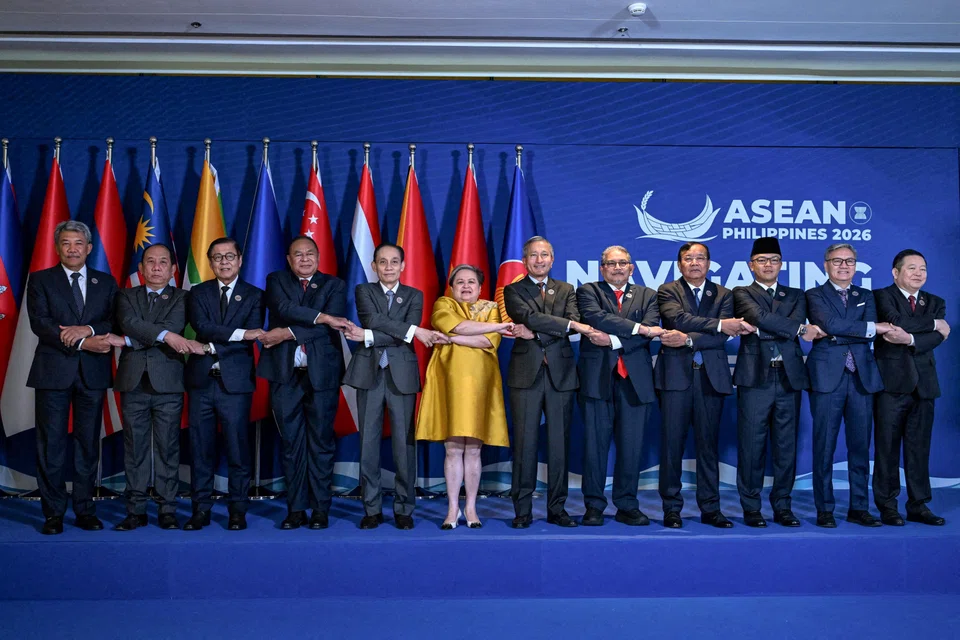
The election has been widely criticised by watchdog groups as an exercise to rebrand army rule
[CEBU] Asean does not recognise Myanmar’s recent election held by its military government “for now”, given a lack of consensus on the matter within the grouping, said the Philippines’ Foreign Secretary.
“There is no consensus on endorsing these elections,” said Ms Theresa Lazaro in a Jan 29 press conference after the Asean Foreign Ministers’ Retreat held in Cebu City, the opening salvo of the Philippines’ chairmanship of the grouping.
Pressed on whether that position could change, she acknowledged that some member states are “looking into the outcome of the elections”, describing the situation as “evolving” and pointing to “nuances and permutations” that could shape future policy decisions.
The election, which concluded on Jan 25 and was conducted by Myanmar’s military government, has been widely criticised by watchdog groups as an exercise to rebrand army rule.
Even before the results were out, the junta-backed Union Solidarity and Development Party was declared the winner.
At the press conference, Ms Lazaro reiterated that Asean does not recognise Myanmar’s military government, which seized power in a February 2021 coup that plunged the country into a protracted civil war.
While Asean has barred Myanmar’s military leaders from high-level meetings, lower-level diplomats have been allowed to join talks. In Cebu, Myanmar was represented by its Permanent Secretary of Foreign Affairs.
Yet, Asean member states’ views on how to engage with Naypyitaw still vary.

Singapore’s Foreign Minister Vivian Balakrishnan in a Facebook post said meaningful political progress in Myanmar requires the end of hostilities, inclusive dialogue and participation by all stakeholders.
“These preconditions are necessary for a government with legitimacy and a measure of popular support to emerge,” he said.
Thai Foreign Minister Sihasak Phuangketkeow told reporters in a separate interview on Jan 29 that Bangkok viewed the Myanmar election as a potential opening for dialogue.
“It’s not a perfect election, but we hope that it will be the start of a transition,” he said, adding that the focus should be on continuing dialogue, reconciliation and the peace process beyond the polls “so that we’ll really have sustainable peace”.
Thailand’s border dispute with Cambodia was also a prime topic of concern during the foreign ministers’ meeting. The two nations had agreed on a ceasefire on Dec 27, 2025, ending three weeks of clashes that killed dozens of people and displaced around one million on both sides.
“We have to make it a durable ceasefire so we have a solid foundation to move forward in our relationship. But at this moment, of course, it’s about building trust and confidence, and that takes the efforts of both sides,” Mr Sihasak said.
Dealing with Myanmar
Analysts say the exchanges during the foreign ministers’ retreat reflect a familiar tension within Asean: holding a common line as a grouping while allowing space for pragmatic interpretations at the national level.
Since the coup in Myanmar, Asean has anchored its response to the civil war there on a Five-Point Consensus calling for an end to violence; dialogue among all parties; humanitarian assistance; and the appointment of a special envoy – commitments the junta has largely ignored.
Dr Moe Thuzar, coordinator of the Myanmar studies programme at the Singapore-based ISEAS – Yusof Ishak Institute, described the Five-Point Consensus as “the only intervention tool Asean has at the moment” in responding to the crisis.
She pointed to tangible consequences already imposed for non-compliance, including the downgrade of Myanmar to non-political representation at Asean summits and ministerial meetings, and the deferral of its turn as Asean chair.
In 2026, Asean leaders blocked Myanmar from assuming the grouping’s rotating chairmanship amid the ongoing crisis. The Philippines, initially slated to become chair in 2027, took over instead.
“The annual reviews of the Five-Point Consensus since 2022 are public reminders of the Myanmar military as one of the key parties responsible for the conflict in Myanmar,” Dr Thuzar told The Straits Times.
However, the Philippines’ own handling of Myanmar during its Asean chairmanship year has also come under scrutiny.
Ms Lazaro’s visit to Naypyitaw earlier in January, followed later by a Jan 22 meeting in the Philippines with representatives from various Myanmar political and ethnic groups, have sparked questions about optics and sequencing.
Dr Abdul Rahman Yaacob, a senior fellow at Verve Research, which specialises in South-east Asian policy and security affairs, said: “What was Manila’s strategic thinking in meeting the junta? Were the other members of the Asean troika group to deal with the Myanmar crisis informed about the visit?
“These are key questions that, if not addressed sufficiently, may lead other members of Asean to have concerns regarding Manila’s chairmanship of Asean.”
Asean’s handling of Myanmar is coordinated in part through a troika made up of the previous, current and incoming chairs, namely Malaysia, the Philippines and Singapore. The troika is a mechanism designed to ensure continuity in the grouping’s response and support implementation of the Five-Point Consensus.
At the press conference, Ms Lazaro defended her recent engagements with Myanmar stakeholders. “The reason why I went there in such an early time (is) because I don’t want to endorse the election,” she said, referring to her first official visit to Myanmar on Jan 6. The military-led government held a three-phase election on Dec 28, 2025, and Jan 11 and 25, 2026.
She said she then hosted the Myanmar stakeholders’ meeting in the Philippines days after her visit to Naypyitaw.
“So if that is not the way to balance things, I don’t know how (else to call it),” she said.
Manila’s balancing act
The Myanmar debate has unfolded alongside Asean’s push to inject momentum into negotiations with China on a long-delayed Code of Conduct (COC) in the South China Sea, another test of the grouping’s credibility.
Ms Lazaro said the Philippines wants a code that is not only concluded, but also meaningful and anchored in international law.
The COC’s technical working group is set to hold monthly meetings in 2026 in a bid to meet its 2026 deadline.
Political scientist Aries Arugay, a senior visiting fellow at ISEAS – Yushof Ishak Institute, said this poses an even bigger challenge for Manila, which has competing claims against Beijing over the South China Sea along with Brunei, Malaysia, Vietnam, and Taiwan.
He warned that leaning too heavily on its interests in the South China Sea dispute would undermine Manila’s credibility as Asean chair, but excessive caution could also dilute those same interests.
“The Philippines must do a balancing act, ensuring that while we promote our interest on the South China Sea issue while we’re Asean chair, we’re also sensitive about building new points of consensus among Asean members here,” he said.
As Asean’s top diplomats continued talks over the stalled COC on the disputed waterway, Philippine Coast Guard spokesman Jay Tarriela has been embroiled in a bitter war of words with the Chinese Embassy in Manila in the past few days.
This prompted 15 senators on Jan 26 to sign a resolution condemning the embassy’s attacks against Commodore Tarriela.
On the same day, the embassy dared Philippine President Ferdinand Marcos Jr to expel Beijing’s new ambassador to Manila, Mr Jing Quan, adding that lawmakers could simply declare the Chinese diplomat as a persona non grata.
Mr Marcos’ spokeswoman Claire Castro, however, said in a separate press briefing on Jan 29 that a persona non grata declaration would be an “option of last resort” for the Philippines.
“It is hoped that the Department of Foreign Affairs would be provided with ample space to perform its functions and to sort out issues with foreign counterparts through dialogue and consultation rather than through public discourse, in accordance with the President’s vision and guidance as the architect of Philippine foreign policy,” Ms Castro said. THE STRAITS TIMES
Decoding Asia newsletter: your guide to navigating Asia in a new global order. Sign up here to get Decoding Asia newsletter. Delivered to your inbox. Free.
Copyright SPH Media. All rights reserved.
TRENDING NOW

Britain’s mansion tax shows the difficulty of targeting wealth

Once staunchly pro-China, Malaysian Chinese businesses are now distancing themselves from Beijing

The only common thing in S-E Asia is that we all eat rice: Cisco’s Asean president

Singapore data centre operator DayOne opts for US IPO at likely US$20 billion valuation

