The only common thing in S-E Asia is that we all eat rice: Cisco’s Asean president
Tay Bee Kheng says her role is to help the US company understand this region in a simplified manner

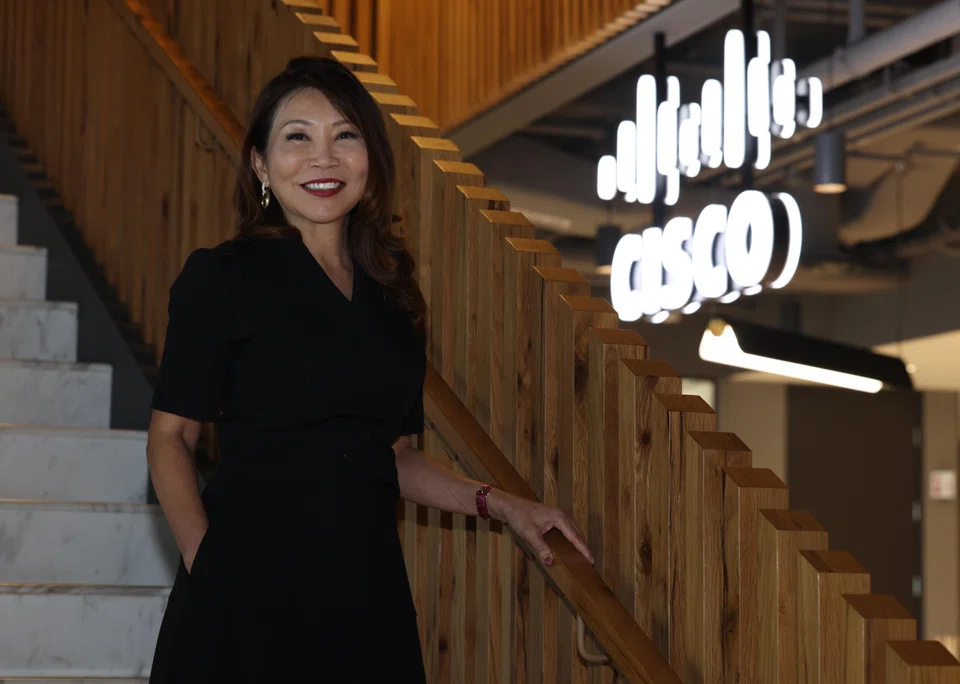
[SINGAPORE] South-east Asia can sometimes be an enigma for multinational corporations. They recognise the enormous economic potential of the region, yet some still view it as a homogenous bloc instead of 11 individual economies with their own cultures, forms of government and at different stages of growth.
“There’s nothing in common in Asean, except for one thing – rice,” said Tay Bee Kheng, Cisco’s Asean president.
Tay, who has been with Cisco for a decade, sees her role as that of a bridge – to simplify Asean’s complexity for her counterparts and bosses in San Jose, California, and to remind them of the region’s potential for Cisco.
“A lot of companies from Europe to America and even the Asia-Pacific like to view Asean as one bloc because that gives them simplicity,” Tay said. “But Asean has 11 countries, many languages and an ever-changing political landscape which will influence the economic growth of a country. Actually, there’s nothing in common.”
She explained that her value-add as Cisco’s Asean chief lies in identifying specifically what each market needs, and presenting that to her global bosses. If they were aware of all the complexities of the region, they would not need an Asean leader in the first place, she argued.
“For example, there’s the data centre build-out in Malaysia or the artificial intelligence ambition of the Vietnam government, or even the Singapore government pushing agencies to use AI. These are the things I will communicate first to highlight the opportunities,” said Tay.
She added that apart from these more prominent examples, there are also other aspects of Asean’s potential that may be overlooked.
“The Philippines is catching up. Although we have not seen the AI build there at this moment, not having seen it yet means that it is growing in the next 12 to 24 months, because I don’t think they will (want) to be lagging behind.”
Tay, who was appointed president of the South-east Asian arm of the multinational technology giant in November 2021, joined Cisco in 2016. She has more than two decades of experience across Apac and Japan, with multinational corporations such as HP and IBM.
Cisco Systems was founded in December 1984 by Stanford University computer scientists Leonard Bosack and Sandy Lerner, who pioneered the concept of a local area network, or LAN.
The American company develops, manufactures and sells hardware, software, telecommunications equipment and other high-technology services and products focused on high-speed networking, integrated cybersecurity and AI.
AI-driven growth
Cisco, like most tech firms, has been benefiting from AI demand in recent times, and is also expecting AI demand to continue to drive growth.
Its revenue for the most recent quarter, the three months ended Jul 25, rose 18 per cent year on year to US$17.3 billion.
The company said there was “record-high demand” for Cisco technology due to a surge in enterprise cloud and infrastructure spending. There was also significant momentum and higher expectations for AI infrastructure from hyperscalers.
Revenue for Apac, Japan and Greater China grew 14 per cent year on year in the same period. While Tay declined to reveal specific information about South-east Asia, citing the company’s policy, she noted that there is a similar double-digit growth trend reflected in Asean.
The growth opportunities for Cisco are arguably driven by AI. Tay said that 92 per cent of businesses in Asean plan to deploy AI agents within a year, but only 16 per cent are fully ready to leverage AI, citing data from Cisco’s 2025 AI Readiness Index that surveyed 8,000 AI leaders across 30 markets and 26 industries.
Meanwhile, more manufacturing operations are being set up in South-east Asia – particularly Vietnam, Thailand and Malaysia – as companies look to diversify operations due to continued geopolitical friction between China and the US. This presents an opportunity for Cisco to step in to offer its network and security solutions.
“A lot of our solutions are now focused on AI. Because frontier AI security defence can no longer solely rely on humans anymore, we need to mix agentic with human experience to defend a company,” Tay added.
Cisco’s proposition for tapping this AI build-out in South-east Asia lies in its stack of capabilities that include network, security, compute and observability, she said.
Tay also pointed out that the increasing desire for sovereign AI is another area of opportunity for Cisco.
For example, the company partnered with Indonesia’s Indosat and Nvidia to establish Indonesia’s first AI Center of Excellence in June 2024, an initiative aimed at advancing the country’s AI future. This includes training its population and building local data infrastructure.
And in June this year, Cisco partnered with Equinix, an American data centre company, to provide solutions for enterprises in Singapore that require secure and in-country storage for certain types of data.
“The opportunity is there because a lot of companies realise that traditional infrastructure and networks are not able to support the agentic era, so they’re in the cycle of modernising the infrastructure,” Tay said.
“The other thing is AI also poses a lot of security threats, so that is creating another opportunity for us as well.”
Three questions with Tay Bee Kheng, Cisco’s Asean president
Q: Was there a pivotal moment in your career or personal life that changed your approach to leadership?
Rather than a single moment, there have been a few key experiences that shaped me. My biggest test was balancing a demanding career and parenthood and having to do that singlehandedly for a period of my life. That taught me valuable lessons on holding space for different parts of my life, staying present and focusing on the task at hand when it matters most. It also shaped my leadership style to be more authentic, empathetic and resilient.
What is one piece of “unconventional wisdom” you swear by, but which most business schools would tell you is wrong?
A mantra I live by is living life with no fear, no guilt and no regret.
Too many people shrink from fear of judgment, but I think you should have the courage to speak your mind, even if it’s not popular or what someone wants to hear.
And don’t wait until you’re 100 per cent ready for a role. If you wait for perfection, you’ve already missed the opportunity. Real growth happens when you’re in the role, learning and growing with it. You eventually find new and efficient ways of doing things, even if it’s not the most conventional.
When you feel burnout creeping in, what is your non-business-related “panic button” activity or routine that reliably resets your focus?
I’m big on self-care. I stick to a strict 10 pm bedtime. That hour is sacred. I go through a deliberate skincare ritual, including red light therapy, to physically and mentally wind down. Often, I’ll pair this with a good book to completely unplug.