Asean Business logo
SPONSORED BYUOB logo

Palm oil stocks drop on Indonesian export ban; analysts expect further spike to international prices

Tan Nai Lun
Tan Nai Lun

Published Mon, Apr 25, 2022 · 12:12 PM
    • Shares of plam oil counters fell on Monday (Apr 25) after Indonesia announced it would ban the export of palm oil from Apr 28.
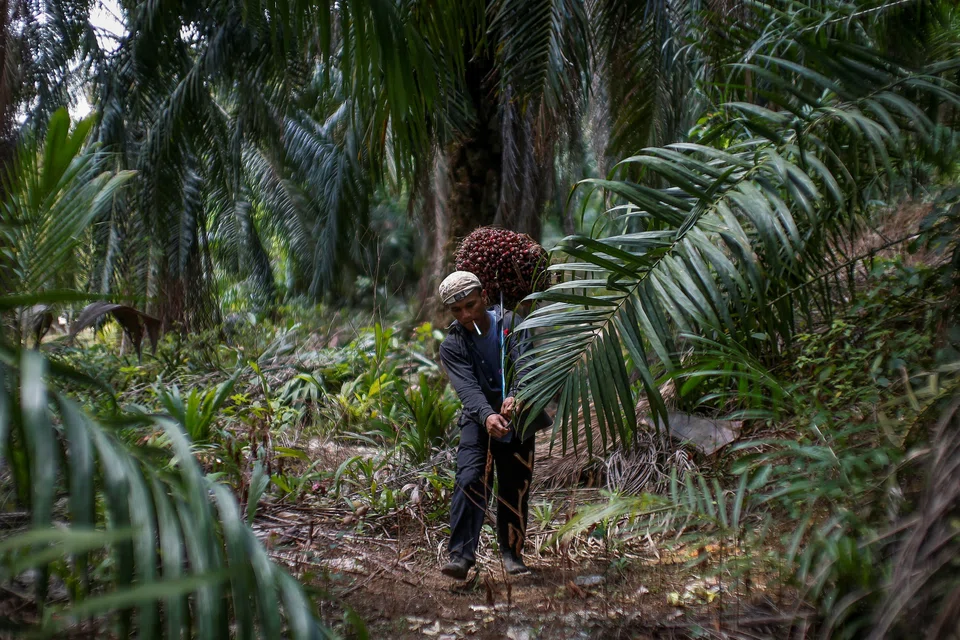
    • Shares of plam oil counters fell on Monday (Apr 25) after Indonesia announced it would ban the export of palm oil from Apr 28. PHOTO: REUTERS

    SHARES of palm oil counters listed on the Singapore Exchange (SGX) fell on Monday (Apr 25) after Indonesia announced it would ban the export of palm oil from Apr 28.

    Among the counters, Bumitama Agri saw the largest decline, losing as much as 17 per cent or S$0.145 to trade at an intra-day low of S$0.71 at 11.38 am.

    This was followed by Kencana Agri , which fell as much as 11.9 per cent or S$0.035 to an intra-day low of S$0.26 at 9.10 am.

    Golden Agri-Resources reached an intra-day low of S$0.32 at 9 am, losing 7.2 per cent or S$0.025, while First Resources was trading at an intra-day low of S$2.11 at 9.31 am, down 6.2 per cent or S$0.14.

    Meanwhile, Wilmar International fell 1.8 per cent or S$0.08 to an intra-day low of S$4.46 as at 4.55 pm.

    At market close, Bumitama Agri was down 12.9 per cent or S$0.11 at S$0.745; Golden Agri-Resources was down 4.4 per cent or S$0.015 at S$0.33; First Resources was down 5.3 per cent or S$0.12 at S$2.13; while Wilmar International was down 1.5 per cent or S$0.07 at S$4.47. On the other hand, Kencana Agri recovered to gain as much as 17 per cent or S$0.05 to end the day at S$0.345.

    Indonesia last Friday said it will ban all exports of palm oil from Apr 28 amid a shortage of cooking oil supply in its domestic market.

    This comes after the major exporter had already banned palm oil exports earlier in January. While Indonesia later lifted restrictions in March, crude palm oil (CPO) prices were driven up during the initial ban amid a global supply shortage. 

    Analysts expect the April ban will continue to drive high CPO prices in the international market, with companies that have a higher exposure to Malaysia-based producers the bigger beneficiaries. Malaysia and Indonesia are the world's largest producers of palm oil.

    Amid the soaring global prices, UOB Kay Hian (UOBKH) said this provides a short-term trading opportunity for Malaysia-focused companies, as the market will likely ride on the short term pent-up demand for Malaysia palm oil that will drive Malaysia CPO prices further.

    Meanwhile, companies with Indonesia exposure are likely negatively impacted as prices in the Indonesia domestic market are likely suppressed until the ban is lifted.

    UOBKH said Indonesia domestic prices will likely “drop significantly” as the ban will lead to an oversupply of CPO domestically. The research team noted that Indonesia’s domestic market only made up around 35 per cent of its total palm oil production, with the household cooking oil market only making up around 8 to 9 per cent.

    Maybank also expects storage tanks will “overflow” within 1 to 2 months with the ban, with domestic CPO prices moving towards subsidised cooking oil prices of around 14,000 rupiah per litre compared to its current CPO price of 16,563 rupiah per kilogramme.

    Nevertheless, analysts noted that the ban is likely temporary, which should allow prices to correct quickly once the restrictions are lifted.

    Maybank expects the ban will be lifted by the end of 2022, which coincide with the industry’s seasonal peak output period in the second half of 2022. As Indonesia floods the global market with its accumulated inventory, this could trigger a sharp price correction, the research team said.

    As for RHB, while its research team expects CPO exporters in Indonesia would suffer from the ban, it is sceptical that the ban will drive down domestic prices in Indonesia, as there is no guarantee the additional supply will be released to the market.

    It said CPO refiners may decide to hold back their refined oil stocks to benefit from the higher prices when the government lifts the ban, noting that refined oils can be kept for up to 18 months after packaging.

    In the meantime, it expects vegetable oil prices will spike as a result of this news, but said prices should reverse quickly should Indonesia change its stance.