


Asean Business logo
SPONSORED BYUOB logo

Philippine peso nears critical 58-per-dollar mark amid regional currencies sell-off

The country – which was last year’s top Asean performer with the fastest growth – has seen its currency take one of the worst hits from increased volatility as Fed rate cut expectations are adjusted

Goh Ruoxue
Published Mon, Apr 29, 2024 · 05:00 AM
    • A weak currency spells trouble for local consumers and businesses in the Philippines, especially since the country is a net importer.
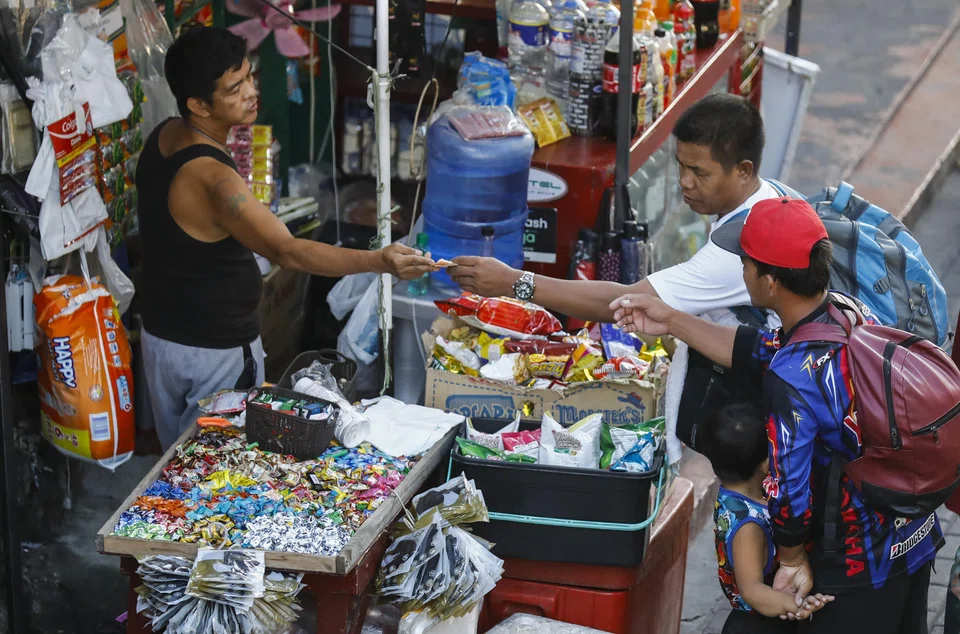
    • A weak currency spells trouble for local consumers and businesses in the Philippines, especially since the country is a net importer. PHOTO: EPA-EFE

    THE Philippine peso, currently at a fresh 17-month low, has declined on a par with the regional average amid a sell-off in South-east Asian currencies. Although the Philippines’ central bank is not widely expected to intervene, analysts warn that pressure could mount if the currency significantly underperforms its peers.

    The peso has tumbled more than 4 per cent this year and was hovering around 57.8 against the US dollar last Friday (Apr 26) amid still higher-for-longer interest rates and escalating geopolitical tensions.

    At current levels, the beleaguered currency is dangerously close to a key 58 mark, which it last traipsed past in September 2022 when the United States Federal Reserve lifted rates by 75 basis points to tame inflation.


    MUFG Bank’s senior currency analyst Michael Wan noted in an Apr 25 report that Bangko Sentral ng Pilipinas (BSP) has been “surprisingly hands-off” in intervening to temper recent currency volatility, given that it stepped in during the second half of last year at the 57-per-dollar level to prevent further weakening.

    Wan said: “We think we are much closer to levels (that will prompt) more aggressive BSP intervention, given concerns about the potential foreign exchange pass-through to domestic inflation.”

    With a revival of the higher-for-longer narrative, escalating geopolitical tensions, increasing risks of oil price spikes, a persistently feeble yen and China’s patchy economic recovery, the South-east Asian currency is headed down a slippery slope.

    Analysts at MUFG Bank warn that the 58 mark will be the first level to watch, followed by the 59 threshold.

    The Philippine finance minister said on Apr 25 that the central bank does not intend to hike interest rates despite the peso’s weakness against the US dollar. This is more or less in line with the BSP governor’s comments in the past weeks that monetary easing will likely come in the fourth quarter of this year or the first of next.

    OCBC foreign exchange strategist Christopher Wong said that any interest rate movement by the Philippines will continue to hinge on inflation. He does not expect the BSP to hike interest rates unless inflation unexpectedly exceeds its target range.

    Although inflation in the Philippines accelerated for the second straight month in March as rice inflation hit a fresh 15-year high, it is widely expected to remain within the central bank’s target range of between 2 and 4 per cent.

    Moreover, as Standard Chartered’s economist and currency analyst for Asia Jonathan Koh pointed out, the BSP is likely monitoring its foreign exchange from nominal and real effective exchange rates bases and not just against the US dollar.

    As long as the Philippine peso is not sharply underperforming compared with its peers, intervention pressures could lessen, said Koh.

    Effect of the greenback’s prowess

    The Philippine peso could, however, seize some respite if upcoming US data paints a gloomier picture.

    Said Wong: “The recent run of strong US data has built up expectations that upcoming reports may exceed expectations. Hence, any disappointing print on US data may potentially dent the USD’s momentum and provide a breather for Asian currencies.”

    US manufacturing data will be released on May 1, alongside the Fed’s interest rate decision after its meeting, followed by jobs data on May 3.

    Wong added that the house expects the US dollar to trend slightly lower towards the year-end as the Fed finishes tightening and likely eventually embarks on a rate-cut cycle, which would dial back the greenback’s heat on regional currencies.

    “A more entrenched disinflation trend and further easing of labour market tightness, and activity data in the US are some of the drivers that would nudge the Fed closer to a pivot and the USD to trade lower,” he said.

    MUFG Bank analysts on Apr 25 revised their USD-Philippine peso forecasts to 58.2 from 56 for Q2 2024; to 57 from 55.7 for Q4 2024; and to 56.5 from 55 for Q1 2025.

    The house expects the BSP to delay its first policy rate cut to the first quarter of next year, compared with its earlier forecast of this year’s third quarter.

    Weak peso pressures 

    A weak currency largely spells trouble for local consumers and businesses.

    Standard Chartered’s Koh explained: “Given that the Philippines is a net importer, a weaker Philippine peso could lead to higher imported inflation and that will impact consumer spending.”

    As purchasing power decreases and disposable household incomes shrink, consumption will fall, dragging aggregate demand down with it and dampening the nation’s economic growth.

    The Philippines was Asean’s star performer last year, charting the strongest growth of 5.6 per cent. It is expected to continue its growth trajectory and expand at least 6 per cent this year.

    For businesses, currency volatility creates multiple challenges, especially for those that rely on imported raw materials.

    A weak peso means that more of it is required to purchase the same amount of foreign currency, which translates into higher import costs, reduced profit margins, and decreased competitiveness. This could potentially mean even higher prices for consumers.

    Wong concluded: “Like most Asian currencies, the Philippine peso may stay under pressure should the widening yield differentials in favour of the US continue, (which) remains a real risk, especially when Philippine officials indicated that the peso’s decline will not prompt the BSP to raise rates.”


