



Prabowo’s economic play: balancing Indonesia’s growth with economic discipline
Ahead of his inauguration on Oct 20, the 72-year-old faces huge challenge to deliver strong growth and maintain fiscal discipline

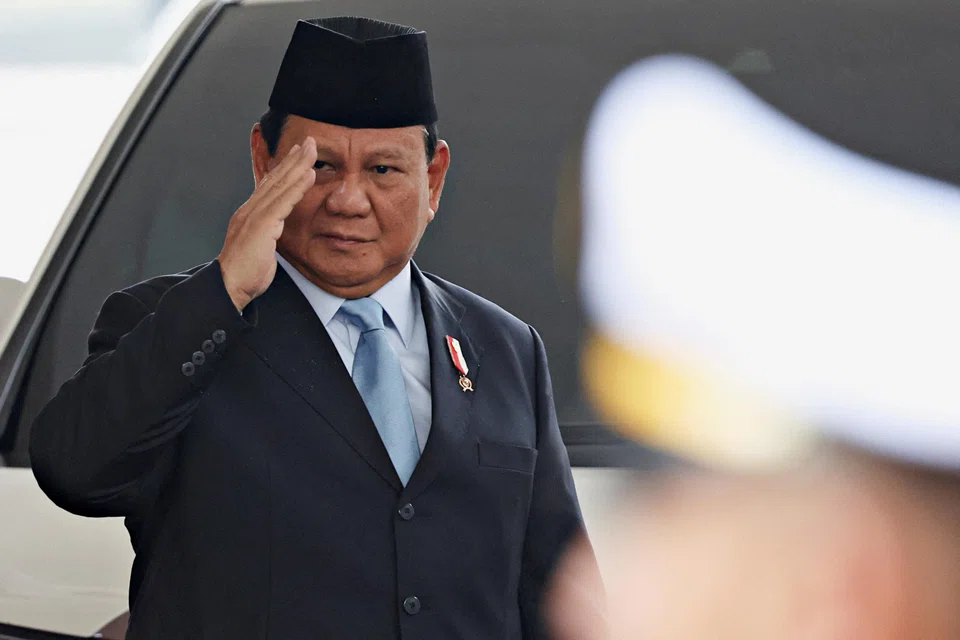
[JAKARTA] With less than two weeks to go until his inauguration, Prabowo Subianto – who will be sworn in as Indonesia’s next President on Oct 20 – faces high-stakes expectations to deliver on his ambitious pledge to spur economic growth while maintaining fiscal discipline.
Market watchers are zeroing in on how the 72-year-old seasoned politician will navigate these opposing forces, especially as he prepares to unveil a new Cabinet with unprecedented authority over policy decisions that will shape the country’s economic landscape.
“Balancing fiscal discipline and boosting economic growth will be one of Prabowo’s biggest asks,” Henry Wibowo, head of Indonesia research and strategy at JPMorgan, told The Business Times.
Prabowo wields greater authority over his Cabinet compared to previous administrations, thanks to a recent decision by outgoing President Joko Widodo, backed by parliament, to remove the cap on the number of ministries. This change allows Prabowo to expand his Cabinet without limitations.
After his inauguration on Oct 20, Prabowo will have up to 14 days to form his Cabinet – a process that will be closely monitored by the business community and investors, due to its potential impact on regulatory policies and economic direction.
Martyn Terpilowski, investor and founder of Jakarta-based geospatial and data analytics company Bhumi Varta, said: “Prabowo’s Cabinet appointments will be critical for businesses to watch, as most regulatory frameworks that govern business operations will be decided at the ministerial level.”
Private-sector push
In his first year, Prabowo aims to drive food security, industrial growth, education, healthcare and digital transformation. He will also push for more private-sector involvement to accelerate development.
But he will also face tough policy battles left by his predecessor, including a proposed VAT (value-added tax) hike to 12 per cent and a revamp of fuel subsidies – decisions that could spark public backlash and worsen inflation, putting his economic agenda to the test.
Burhanuddin Abdullah, a key adviser to Prabowo and a former central bank governor, said that the president-elect plans to reduce energy subsidies while providing cash assistance to low-income families.
By implementing more targeted energy subsidies, the new government could save up to 200 trillion rupiah (S$16.7 billion), which would fund new initiatives, including providing free nutritious meals for children and pregnant women.
Until now, the subsidy has been provided directly to Pertamina, the state-owned fuel producer, rather than being distributed to consumers.
“We want to improve the database to ensure that direct cash transfers are given to the poor families who are eligible (rather than being allocated to commodities),” Abdullah said.
Prabowo may also inherit the critical task of deciding whether to proceed with relocating the capital from Jakarta to Nusantara in Kalimantan, as Widodo has yet to sign the presidential decree that would officially give the green light for the move.
Media Wahyudi Askar, public policy director at the Jakarta-based think tank Center of Economic and Law Studies, said: “This indicates that the future of the project will largely rest in Prabowo’s hands.”
The outgoing administration and parliament have recently approved a budget of 3,621 trillion rupiah for Prabowo’s first year in office, which includes funding for the continued development of the new capital.
Prabowo’s pledge to continue the costly Nusantara capital project, along with his plan to provide free lunches for 80 million students, have raised concerns among investors and rating agencies about Indonesia’s fiscal stability and debt levels.
Fiscal risks
Thomas Rookmaaker, head of Asia-Pacific sovereigns at Fitch Ratings, told BT that while the incoming administration plans to widen the fiscal deficit to 2.53 per cent in the 2025 budget, the rating agency still views Indonesia’s medium-term fiscal risks as elevated.
The agency forecasts that Indonesia’s budget deficit could rise to 2.9 per cent, nearing the legal limit, next year.
Over the past decade, Indonesia’s fiscal policy under Widodo has been praised for its prudence, maintaining the budget deficit below the legal ceiling of 3 per cent of gross domestic product – even throughout the challenges of the Covid-19 pandemic.
Widodo leaves behind a relatively stable economy with controlled debt levels, but low tax revenues and limited fiscal space continue to pose significant challenges for the incoming administration.
From January to August, Indonesia’s state revenues fell 2.5 per cent, and the fiscal deficit is expected to reach 2.7 per cent of GDP by year-end, surpassing the initial estimate of 2.29 per cent.
Finance Minister Sri Mulyani Indrawati attributed the drop in revenues to weak exports and a slowing economy, which have led to lower tax collections.
China, Indonesia’s largest trading partner, is facing a slowdown marked by weaker growth and reduced domestic demand, sounding alarm bells. With China accounting for more than 20 per cent of Indonesia’s total exports, the government is preparing for a potential downturn that could hit key sectors.
Fitch’s Rookmaaker noted that should Prabowo’s administration outline a clear strategy for increasing the tax collection, it could enhance sentiment surrounding Indonesia’s sovereign ratings. However, he warned that any deviation from fiscal prudence could jeopardise these ratings.
The challenge of boosting state revenue through taxation also comes at a critical time, as South-east Asia’s largest economy grapples with weakening middle-class purchasing power.
Raising its appeal
Ensuring Indonesia remains attractive to investors in an increasingly competitive regional market has become a formidable challenge for Prabowo.
To achieve the ambitious target of 8 per cent economic growth, Indonesia – with a current GDP of US$1.3 trillion – must generate an additional US$839 billion in nominal GDP over the coming years to avoid falling into the middle-income trap.
Pursuing this ambitious goal comes against the backdrop of Indonesia’s manufacturing sector – a once-dominant engine of growth that has been under pressure since the 1998 financial crisis, and which has yet to fully recover its previous contributions to the nation’s GDP.
Despite its critical role in the economy, the sector continues to grapple with structural challenges, limiting its ability to drive growth as it once did.
Abdullah, the former central bank governor, said Prabowo intends to review incentives for the manufacturing sector as part of a broader strategy to revitalise the industry. This includes efforts to improve the ease of doing business and implement reforms in state-owned enterprises to boost overall economic competitiveness.
Ari Jahja, head of Indonesia research at Macquarie Capital, said that while it may take time, the incoming administration is aware of the need for more investor-friendly policies and stronger collaboration with the private sector. Execution, he said, will be key.
Long road to presidency
Currently Indonesia’s Minister of Defence, Prabowo Subianto, 72, is no stranger to presidential ambitions, having contested the presidency twice through his party, Gerindra – in 2014 and 2019 – only to be defeated both times by Joko Widodo.
Prabowo hails from a politically prominent family as the son of Soemitro Djojohadikusumo, a renowned Indonesian economist. From 1983 to 1998, he was married to Suharto’s daughter, the former authoritarian leader who governed Indonesia for more than three decades.
Prabowo’s brother, Hashim Djojohadikusumo, is a prominent businessman and chairman of Arsari Group, a conglomerate with diverse interests spanning mining, oil and gas, plantations, and forestry. Hashim’s business acumen has also made him a powerful ally in Prabowo’s political career.
Prabowo’s military career, which saw him rise to the rank of general and command the elite special forces unit, Kopassus, is marred by allegations of human rights violations – a controversy that led to his dismissal from the military in the turbulent final days of Suharto’s regime in 1998.






