



Protests over controversial Bill batter Indonesia’s markets, trigger investor unease
Political tensions in Indonesia are expected to remain high ahead of the national leadership change in October and regional polls in November

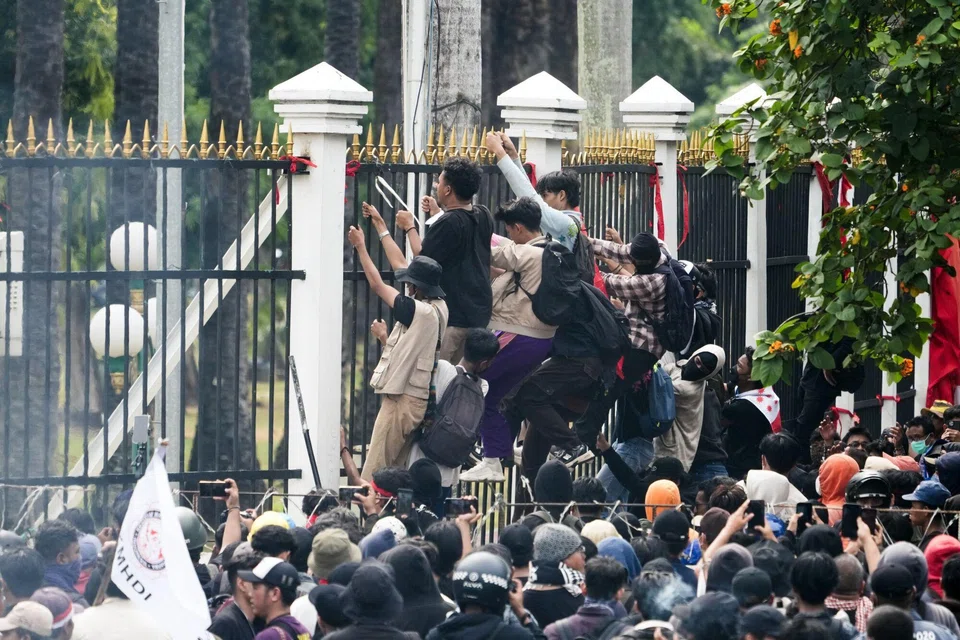
[JAKARTA] With less than two months before Indonesia’s leadership change at the federal level, the country’s stability is under scrutiny in light of the mass protests over a controversial election Bill.
The unrest, which has rattled capital markets and weakened the rupiah, throws the spotlight on potential risks ahead.
Yose Rizal Damuri, executive director of the Centre for Strategic and International Studies, pointed to Indonesia’s unusually-long transition from the February election results to the October presidential inauguration as a source of prolonged uncertainty, because it gives the outgoing president and Parliament room to implement policies that could trigger social unrest and instability.
“Laws passed during lame-duck periods often trigger political tension,” he said, noting that policies introduced during this window may not be upheld by the incoming government, which is a major concern for all parties affected by such changes.
The legislation which a group of Members of Parliament was trying to push through sought to lower the minimum age for governors and relax nomination requirements. Many read this as an attempt to enable Joko Widodo’s youngest son, Kaesang Pangarep, 29, to bypass age restrictions and be fielded as a candidate for governor in the regional election in Central Java in November.
The proposed change triggered widespread public outrage across cities on Thursday (Aug 22), and fuelled concerns about dynastic politics; critics argued that it could unfairly bolster the political influence of outgoing President Joko Widodo and his successor, Prabowo Subianto, fuelling unease among investors.
By late Thursday (Aug 22), Parliament – its hand forced – moved to withdraw the Bill and pledged to uphold the Constitutional Court’s decision on election eligibility criteria.
Up till the time of this U-turn, both the rupiah and equities had taken hits. The currency fell 0.72 per cent, breaching 15,613 to the US dollar, its steepest decline in two months, and becoming the worst-performing major Asian currency. The stock market’s key index fell nearly 1 per cent.
On Friday, the market responded positively, with stocks opening 0.74 per cent higher and the rupiah strengthening to 15,570 per US dollar.
Out on the streets, tensions simmered down among the protesters.
Lionel Priyadi, head of Fixed Income and Macro Strategy at Mega Capital, noted that, in addition to global factors, market sentiment in Indonesia is being influenced by concerns over political instability.
“The recent political turmoil has had a significant impact on investors. If the protests had continued, we could expect a market sell-off, with the rupiah potentially weakening to 15,600 to 15,800,” he told The Business Times.
The rupiah has traditionally been reactive to changes in global capital flows. Its higher yields, relative to that of developed markets, make it appealing to international traders, who often sell off their holdings swiftly when US dollar interest rates rise.
Before the protests erupted on Thursday, the rupiah had actually been enjoying a sustained period of appreciation. This month, it gained as much as 5 per cent, driven by expectations of potential US Federal Reserve interest rate cuts, which have bolstered emerging market currencies.
At its meeting on Wednesday, Bank Indonesia, the country’s central bank, decided to keep its key interest rate at 6.25 per cent, citing a cautious approach to managing external risks, despite the possibility of a cut due to the rupiah’s recent strength.
However, according to Fithra Faisal, senior economist at Samuel Sekuritas, the rupiah’s recent strength had not been supported by domestic fundamentals: The country is facing a twin deficit and an ongoing risk of declining exports, which is gradually shrinking the supply of dollars from trade.
That the country is going into a period of political uncertainty doesn’t help: There is the Oct 20 transfer of power from Joko Widodo to Prabowo, and then, the Nov 27 regional elections across the archipelago to fill posts for 37 provincial governors, 415 regents and 93 mayors.
Such political uncertainties can undermine investor confidence, leading to capital outflows and pressure on the rupiah.
“Given this fragile foundation, negative domestic sentiment, such as protests, has significantly prompted investors to take profits more quickly,” Faisal said.
The country’s current account deficit expanded to U$3.02 billion in the second quarter, up from U$2.41 billion in the previous quarter, marking the fifth consecutive quarter of deficit.
A widening deficit may indicate issues with Indonesia’s declining exports over the past few months, even as imports have surged.
“Going forward, the widening of this current account deficit presents challenges to Indonesia’s economic stability,” said Faisal.
Rising political fever
Despite the relatively smooth presidential election in February, market observers are keeping tabs on the two key political events in the fourth quarter.
They have warned that the ongoing political turbulence could threaten Indonesia’s economic stability. Phintraco Sekuritas, a Jakarta-based securities firm, wrote in its latest report: “While Indonesia’s latest economic data indicate that conditions remain relatively solid, the rising risk of domestic political instability could overshadow Indonesia’s economic growth outlook for the second half of 2024.”






